
A Chinese podcast · Same story, 4 levels
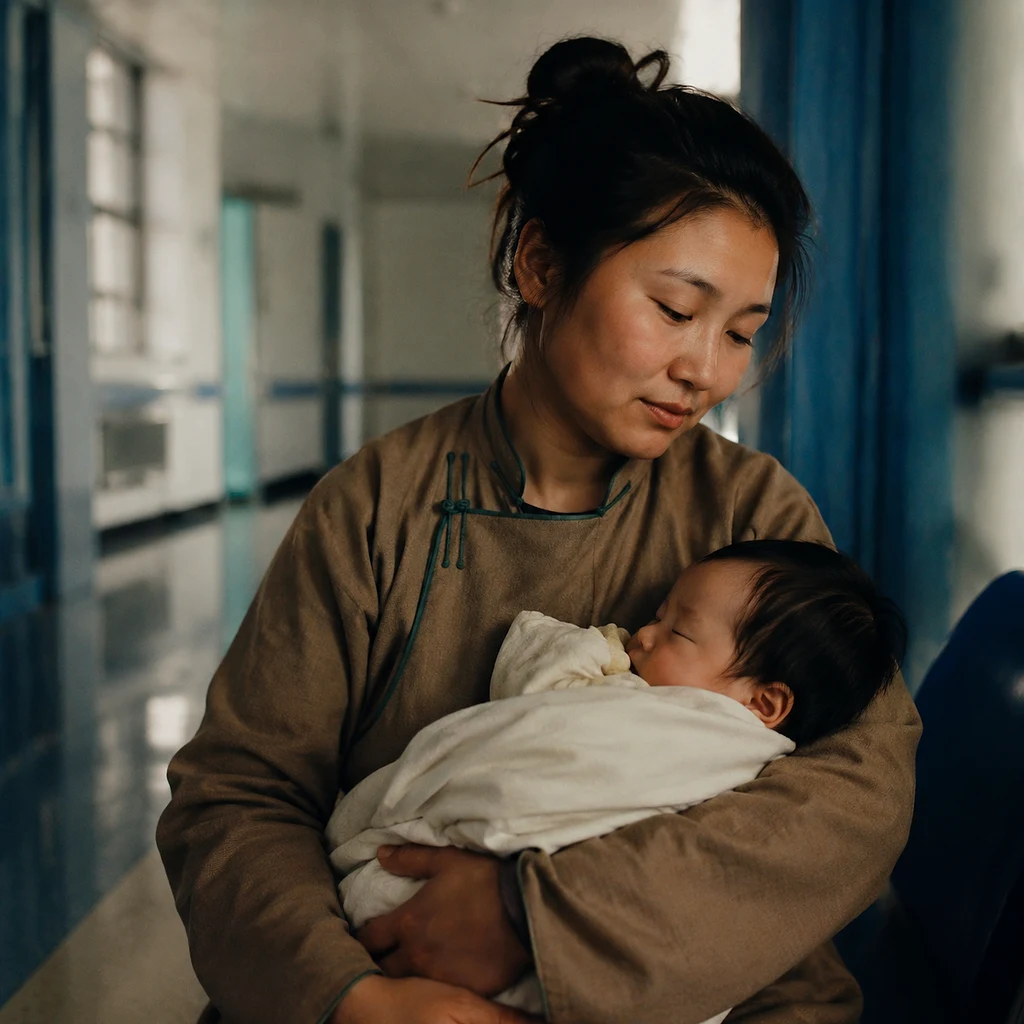
跨国看病:一个小宝宝的故事
Little S — A Mongolian Baby Treated at Shanghai's Renji Hospital
About this story
A Mongolian family brings baby Little S to Shanghai's Renji Hospital — affordable, kind, convenient care. HSK 2 Chinese listening practice.
This is an HSK 2 Chinese listening episode that runs about 5 minutes. The full Mandarin script is shown with tap-for-pinyin and a line-by-line English translation, so you can listen and read at once — comprehensible input in the sense of Stephen Krashen's i+1 theory. It teaches 17 key vocabulary words such as 医生、医院、身体 and walks through 6 grammar patterns, each explained in English with examples. The same news story is retold at 4 difficulty levels — use the level selector above to find the version that is challenging but still understandable for you.
Read at your level
原文Read the complete story in Chinese. Reveal pinyin and English only when you need them.
English transcript reference
Speaking of a story about a little baby, he was born in Mongolia but got sick.
This little baby's name is very long, let's call him Little S.
When Little S was only a few days old, he fell ill.
His father and mother were very happy because they had a son.
However, the doctor told them some bad news.
The doctor said there was a big problem inside Little S's body.
There was a kind of bad thing inside his body that couldn't come out.
This would turn his body yellow and also make him very uncomfortable.
The Mongolian doctor looked at Little S and felt it was very difficult to handle.
The doctor said to Little S's parents, "Our hospital here is too small."
"We cannot perform this surgery."
"Because Little S is too small; he is a newborn infant."
"In Mongolia, there are no hospitals that can help such a small child."
The doctor said that if the surgery wasn't done, Little S might die.
This was a very terrible thing.
Upon hearing this, the parents were very sad and also very anxious.
They asked the doctor, "What should we do?"
The doctor thought for a moment and said, "You can go to China."
"Shanghai, China has very big hospitals."
"The doctors there have many solutions."
So, Little S's family went to Shanghai, China very quickly.
They went to a large hospital in Shanghai called Renji Hospital.
In this hospital, the doctors gave Little S a check-up.
The doctor said Little S needed to replace something inside his body with a new one.
"This thing must be given to him by someone else."
Who could give this thing to Little S?
The doctor examined Little S's father.
The doctor found that the father's health was very good and he could help Little S.
The father loved his son very much.
Although this would be painful, the father was willing.
The father was going to give a part of his own body to his son.
This was a major surgery.
The surgery took six hours.
The doctors were very tired, but they were very serious.
The doctors put a small part of the father's body into Little S's body.
This surgery was performed very successfully.
After the surgery, Little S needed to stay in the hospital to rest.
Let's talk about the money issue.
Doing this surgery required a lot of money.
In total, it was about two hundred thousand yuan.
For Little S's family, this was a lot of money.
However, to save the child, they had to think of a way.
Their relatives and friends all gave them money.
There were also some strangers who helped them.
Everyone hoped that Little S could get better.
Before the surgery, Little S's body was yellow.
His belly was very big, and he looked very uncomfortable.
After the surgery, he was no longer yellow.
His face turned white and rosy.
His belly also became soft.
Little S's mother looked at her son and was very happy.
She said that the child looked completely healthy now.
This was a very good result.
Actually, there are many people like Little S.
Now, many foreigners come to China to see doctors.
Why do they want to come to China?
The first reason is that Chinese doctors are very experienced.
The second reason is that seeing a doctor in China is relatively cheap.
For example, there was a British woman.
Her stomach had been hurting for over a year.
Seeing a doctor in the UK required waiting a long time.
It might take several months to see a doctor.
She felt it was too slow because she was in a lot of pain.
Later, she decided to come to China.
In the Chinese hospital, she saw a doctor very quickly.
The doctor examined her and gave her medicine.
Moreover, she spent very little money.
It only cost a few thousand yuan, much cheaper than in the UK.
She talked about this matter online.
Many foreigners found it very interesting.
They said, "So seeing a doctor in China is this fast and this cheap."
This is why more and more people are coming to Chinese hospitals.
Besides patients coming to China, Chinese technology has also gone abroad.
Now, there are many computers in hospitals.
These computers are very smart.
We call them "Intelligent Doctors."
Computers can help doctors diagnose illnesses.
For example, in Saudi Arabia, there are Chinese computer doctors.
This computer can speak English and also Arabic.
The patient tells the computer where they feel uncomfortable.
The computer then tells the patient what medicine to take.
This is very convenient.
Shanghai's Renji Hospital also has a very powerful system.
This system can help nurses work.
Before, nurses were very busy and tired.
Now with smart computers, the nurses' workload has decreased a lot.
In this way, the hospital can take care of more patients.
This is not only good for China but also good for other countries.
Many countries, such as Indonesia, also want to use this Chinese system.
Because this allows people living in faraway places to see a doctor too.
These stories we just talked about are actually "cross-border medical care."
It means people from different countries going to other countries to see a doctor.
Or, the medical technology of one country going to help another country.
Little S's story is one of the best examples.
Because of cross-border medical care, this Mongolian baby could survive.
Because of cross-border medical care, that British woman could cure her illness quickly.
Now, the world has become smaller, and doctors and patients can help each other.
This is a very good thing.
Listen again
Try it without the transcript and notice what sounds clearer.
What vocabulary does this episode teach?
词汇A person qualified to treat people who are ill. Common phrase: 看医生 (to see a doctor).
A place where sick or injured people are given medical or surgical treatment.
Refers to the physical body or one's general health condition.
Often used in the negative (不舒服) to mean feeling unwell or sick.
Used to describe pain. E.g., 肚子疼 (stomach ache).
Substance for treatment. Verb used with it is 吃 (to eat/take).
Inexpensive; costing little money.
Suited to one's comfort, purpose, or needs.
To look after someone or something.
A very young child or baby.
Medical procedure. Common phrase: 做手术 (to perform/undergo surgery).
Family members related by blood or marriage.
Knowledge or skill acquired by a period of practical experience.
Often used for technology, e.g., 智能手机 (smartphone) or 智能医生 (AI doctor).
A set of connecting things or parts forming a complex whole.
Involving several countries or crossing boundaries.
Relating to the science of medicine or the treatment of illness.
* beyond level超纲词
What grammar patterns appear in this episode?
语法Used to express a condition ('If...'). Often paired with 就 (then), though not always explicitly required in colloquial speech.
医生说,如果不做手术,小S可能会死。
A conjunction pair meaning 'Although... but...'. It expresses a contrast or concession.
虽然这很疼,但是爸爸愿意。
医生非常累,但是他们很认真。
The 'Ba' construction is used to emphasize the manipulation of an object. The subject does something to the object to change its state or location.
爸爸要把自己身体里的一部分给儿子。
医生把爸爸的一小部分身体,放到了小S的身体里。
Indicates that a quality or situation is increasing over time ('more and more').
这就是为什么越来越多的人来中国医院。
Meaning 'Besides...' or 'Apart from...'. It introduces an additional item or situation.
除了病人来中国,中国的技术也去了国外。
Proper Nouns
专有名词Sources
来源Free account
Keep learning from this story
Create a free account to keep saved words and your preferred level together.
- Keep words with their story context
- Remember your preferred level
- Build your vocabulary over time