
A Chinese podcast · Same story, 4 levels
达拉斯垃圾车给房屋打“破旧分”
Dallas Trash Trucks Give Homes AI Blight Scores
About this story
A simple Dallas story about garbage trucks that photograph homes and give each house an AI blight score. HSK 1 Chinese listening practice.
This is an HSK 1 Chinese listening episode that runs about 4 minutes. The full Mandarin script is shown with tap-for-pinyin and a line-by-line English translation, so you can listen and read at once — comprehensible input in the sense of Stephen Krashen's i+1 theory. It teaches 14 key vocabulary words such as 今天、家、东西 and walks through 4 grammar patterns, each explained in English with examples. The same news story is retold at 4 difficulty levels — use the level selector above to find the version that is challenging but still understandable for you.
Read at your level
原文Read the complete story in Chinese. Reveal pinyin and English only when you need them.
English transcript reference
Today, you are at home.
Listen.
A big thing comes in front of your home.
This thing is big and slow.
It comes today, and it will come tomorrow too.
There are many things in your home.
Some things are things you do not want anymore.
Now, all the things you do not want are inside the big thing.
The big thing leaves.
Tomorrow, the big thing will come again.
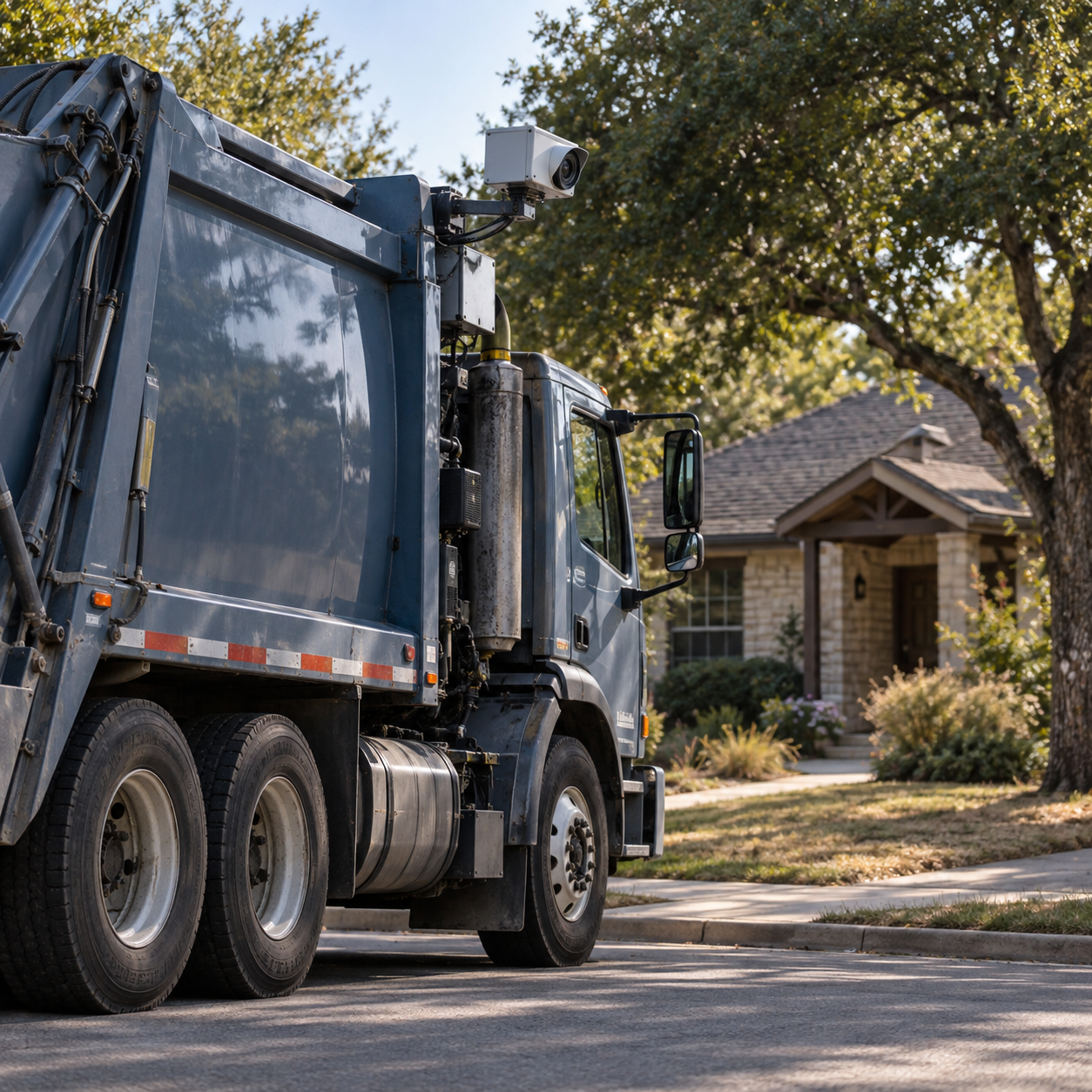
This big thing is called a garbage truck.
A garbage truck is big and slow.
The garbage truck comes to your home.
The things you do not want are now inside the garbage truck.
The garbage truck leaves.
Tomorrow, the garbage truck comes again.
Today, the garbage truck has something new.
This new thing can look at your home.
The new thing is called a camera.
The camera looks at your home.
After the camera looks, there is a photo in the computer.
Your home is in the photo.
The camera can see the house.
The house is in the photo.
Your home is also in the photo.
There is a camera on the garbage truck.
Let us talk about a place in the United States.
This place is called Dallas.
Dallas has many people and many houses.
Dallas wants to know whether the houses are good.
The camera looks at the houses.
The computer looks at the photos.
The computer gives each house a one, two, three, or four.
This is called a score.
A low score means a small problem with the house.
A high score means a big problem with the house.
The computer produces a score.
The computer cannot make people pay money.
People working for Dallas look at the photos first.
They look at the photos and the scores.
They decide whether the house really has a problem.
Then they write a letter.
One person received a letter.
The letter said: the color on top of your house does not look good.
Please take a look at your house.
The person looked at his house.
The person was unhappy.
He said: this is my home.
I do not like a garbage truck looking at my home.
Many other people said the same thing.
They said: my home belongs to me.
I am unhappy when a camera looks at my home.
Dallas says the camera can make the work faster.
Dallas has many houses.
It is slow for one person to look at many houses.
The garbage truck visits many homes today.
Tomorrow, the garbage truck visits many homes again.
The camera goes together with the garbage truck.
Today, the camera looks at one home.
Tomorrow, the camera looks at another home.
The camera can look at many houses.
Dallas workers can also look at many photos.
Some people like this method.
They want a beautiful place.
When all the houses look good, they are happy.
Some people do not like this method.
They want to feel happy in their own homes.
They do not want cameras looking at their homes.
Dallas is now listening to what these people say.
Will the cameras still be on garbage trucks tomorrow?
Dallas does not know yet.
The garbage truck will still come to your home.
The things you do not want will go into the garbage truck.
The camera on the garbage truck may also look at your house.
Think about it: would you be happy if a garbage truck looked at your home?
Listen again
Try it without the transcript and notice what sounds clearer.
What vocabulary does this episode teach?
词汇HSK 1. Used to place an event in the present day.
HSK 1. Used in 你的家, “your home.”
HSK 1. A general noun for objects or belongings.
HSK 1. Contrasts with 今天.
HSK 1. Here the computer examines photos.
HSK 1. A result complement meaning to successfully see.
HSK 1. Describes the kind of neighborhood some residents want.
HSK 1. Used to ask how residents feel.
The vehicle collecting trash and carrying the cameras.
The device photographing homes from the truck.
An image reviewed by the computer and city staff.
The building that receives a score.
A number from one to four assigned to a house.
封 is the measure word for letters.
* beyond level超纲词
What grammar patterns appear in this episode?
语法也 + Verb
也 adds “also” or “too.”
明天,垃圾车也来。
达拉斯的人也可以看很多照片。
有的……有的……
Use 有的人 to contrast different groups of people.
有的人喜欢这个办法。
有的人不喜欢这个办法。
Proper nouns
专有名词Sources
来源Free account
Keep learning from this story
Create a free account to keep saved words and your preferred level together.
- Keep words with their story context
- Remember your preferred level
- Build your vocabulary over time