
A Chinese podcast · Same story, 4 levels
达拉斯垃圾车给房屋打“破旧分”
Dallas Trash Trucks Give Homes AI Blight Scores
About this story
Dallas puts 100 AI cameras on trash trucks, flags 21,000 homes and raises privacy and fairness concerns. HSK 3 Chinese listening practice.
This is an HSK 3-4 Chinese listening episode that runs about 5 minutes. The full Mandarin script is shown with tap-for-pinyin and a line-by-line English translation, so you can listen and read at once — comprehensible input in the sense of Stephen Krashen's i+1 theory. It teaches 14 key vocabulary words such as 一样、但是、开始 and walks through 4 grammar patterns, each explained in English with examples. The same news story is retold at 4 difficulty levels — use the level selector above to find the version that is challenging but still understandable for you.
Read at your level
原文Read the complete story in Chinese. Reveal pinyin and English only when you need them.
English transcript reference
Every morning, an ordinary garbage truck drives past your home.
Like other garbage trucks, it collects the trash and drives away.
But in Dallas, this garbage truck is a little different.
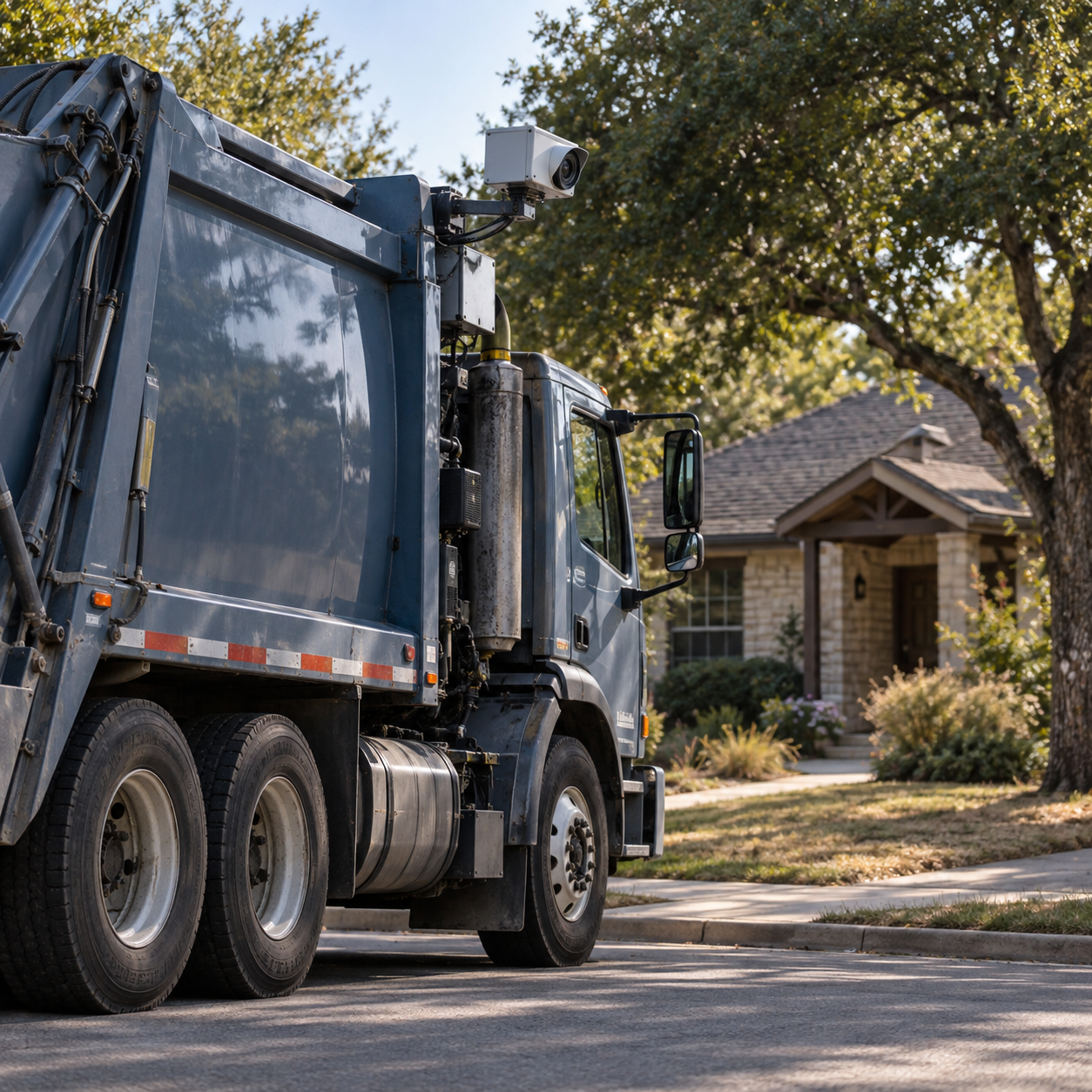
It collects trash while taking pictures.
It photographs your house, not the trash.
Dallas installed cameras on fifty garbage trucks.
Each truck has two cameras, one on the left and one on the right.
Fifty trucks means one hundred cameras in total.
The cameras face houses along the road and take pictures as the trucks move.
Afterward, computer software examines the photos.
The software looks for problems.
For example, the grass may be too tall, or trash may be lying by the road.
When it finds a problem, the software gives it a score.
The score runs from one to four, and a larger number means a more serious problem.
They call it a blight score.
This system has been in use since April.
By September, the computer had photographed more than twenty-one thousand houses.
Twenty-one thousand is a large number.
However, the city sent only eighteen hundred letters.
These are reminder letters, not fines.
The letter says: there may be a problem at your home, so please take a look.
If you ignore it, you may receive a fine later.
One Dallas resident received such a letter.
It said the chimney on his house needed repainting.
A chimney is the tall part on top of a house that lets smoke out.
He found it strange because his chimney did not appear to have a problem.
But the computer thought there was one.
It photographed the chimney color and judged that it looked old.
Besides chimneys, the computer photographed many other things.
For example, tall grass, long branches, damaged sidewalks, and peeling wall paint.
The computer records all these things.
However, the computer does not issue fines directly.
It only takes photos and alerts city employees.
The employees review the photos and decide whether to take action.
So a person, rather than a computer, decides on a fine.
The city says the system is meant to make Dallas cleaner and safer.
Officials say it is faster and more efficient.
Before, someone had to drive around inspecting; now garbage trucks pass every day and photograph houses along the way.
But many people disagree.
They worry about privacy.
The cameras photograph houses, and they also photograph people.
Although the company says it blurs faces and license plates, people are still worried.
They also worry that the system is unfair.
Many of the flagged houses are in southern Dallas.
The south is home to lower-income residents.
Some therefore feel the system is unfair to communities with less money.
One city council member is named Chad West.
He proposed taking funding away from the project.
But later he said they should wait.
The city manager said there would be a meeting in December devoted to this issue.
The project is a partnership with a company.
The company is called City Detect.
The city signed a three-year contract with the company for about 2.5 million dollars.
Two and a half million dollars is a lot of money.
So many people are asking: does this system really work?
Has it really made the city better?
Or has it only made some people more worried?
For now, garbage trucks are still driving and cameras are still taking pictures.
Every day, they pass different houses and capture different photos.
The computer keeps scoring, and employees keep reviewing.
Dallas residents are still waiting for the December meeting.
They want to know whether the system will continue.
They want to know whether their own houses will be photographed.
They want to know what will happen if that occurs.
These questions do not yet have answers.
But one thing is clear:
Your garbage truck may also be watching your house.
Think about it: how would you feel if your garbage truck photographed your home every day?
Listen again
Try it without the transcript and notice what sounds clearer.
What vocabulary does this episode teach?
词汇HSK 2. 和……一样 compares two things.
HSK 2. Introduces a contrast.
HSK 2. 从四月开始 means starting in April.
HSK 2. Marks a completed development.
HSK 2. Introduces a resident’s view.
HSK 2. Used for City Detect.
HSK 2. Used with privacy and fairness concerns.
HSK 3. Describes the truck’s outward appearance.
A mounted camera that photographs roadside homes.
The computer program that examines images.
A possible later penalty after a notice.
The right residents fear the cameras may affect.
To identify a property for human review.
Describes communities with less money for repairs.
* beyond level超纲词
What grammar patterns appear in this episode?
语法Proper Nouns
专有名词Sources
来源Free account
Keep learning from this story
Create a free account to keep saved words and your preferred level together.
- Keep words with their story context
- Remember your preferred level
- Build your vocabulary over time