
A Chinese podcast · Same story, 4 levels
达拉斯垃圾车给房屋打“破旧分”
Dallas Trash Trucks Give Homes AI Blight Scores
About this story
Dallas garbage trucks use 100 cameras to score homes, prompting fines, privacy fears and fairness questions. HSK 2 Chinese listening practice.
This is an HSK 2 Chinese listening episode that runs about 4 minutes. The full Mandarin script is shown with tap-for-pinyin and a line-by-line English translation, so you can listen and read at once — comprehensible input in the sense of Stephen Krashen's i+1 theory. It teaches 14 key vocabulary words such as 因为、所以、为什么 and walks through 4 grammar patterns, each explained in English with examples. The same news story is retold at 4 difficulty levels — use the level selector above to find the version that is challenging but still understandable for you.
Read at your level
原文Read the complete story in Chinese. Reveal pinyin and English only when you need them.
English transcript reference
Today, you are at home.
Listen.
A big vehicle comes in front of your home.
The big vehicle moves slowly.
It comes today, and it will come tomorrow too.
You have many things you do not want.
Now those things are all inside the big vehicle.
This big vehicle is called a garbage truck.
The garbage truck collects the things and drives away.
In Dallas, in the United States, garbage trucks also look at houses.
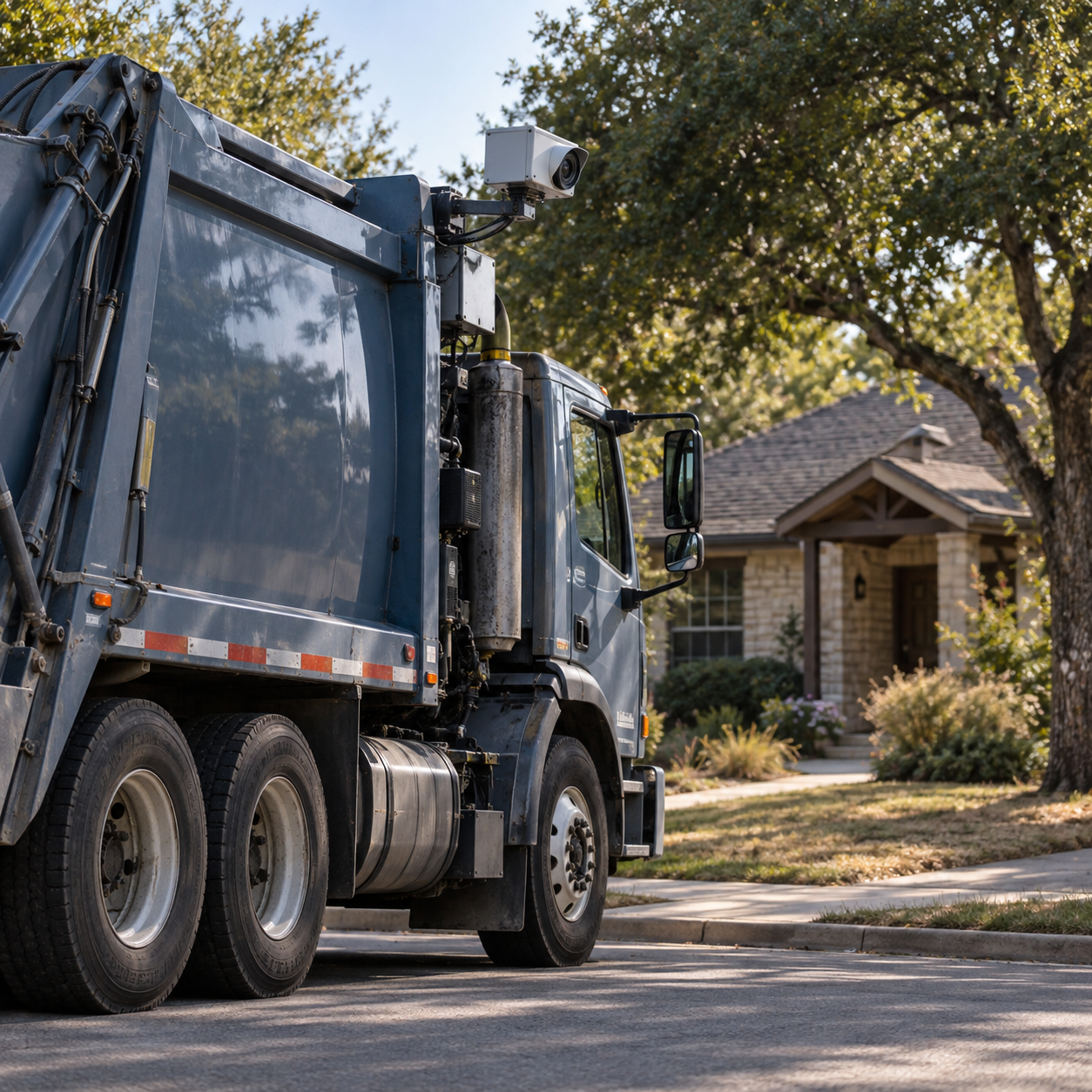
There are cameras on both sides of each garbage truck.
The cameras take pictures of houses.
After the cameras take pictures, the photos appear in a computer.
The photos show the grass, road, and walls in front of a house.
The cameras cannot see inside a house.
They can only see places beside the road.
Why did Dallas put cameras on garbage trucks?
Because the city wants to find problem houses more quickly.
The computer may record tall grass, broken pavement, or unwanted things by the door.
After looking at the photos, the computer gives each house a score.
The score runs from one to four.
A score of one means a smaller problem, and four means a bigger problem.
This score is called a blight score.
Since April, fifty garbage trucks with one hundred cameras have been working in Dallas.
The computer found more than twenty-one thousand houses that might have problems.
However, the computer cannot issue a fine directly.
City employees look at the photos first.
Only after looking do they decide whether there is a real problem.
If there is a real problem, the city first sends a reminder letter.
So far, the city has sent about eighteen hundred reminder letters.
People who receive a letter can fix the problem first.
Only if they keep doing nothing might they later have to pay a fine.
One person also received a reminder letter.
The letter said the chimney on his roof looked discolored and needed repainting.
He looked at his chimney and found it very strange.
He thought: the chimney is only a little old, so why should a garbage truck care?
He later learned that a camera photographed his house as the garbage truck passed.
Dallas says this method can make the work faster.
In the past, employees had to drive out and inspect houses themselves.
Now garbage trucks already travel to many places every day.
With cameras riding on the trucks, they can quickly take many photos.
The camera company also says faces and license plates in the photos are blurred.
The camera system is not connected to police computers.
However, many people are still worried.
They say the city should have told everyone first that garbage trucks were photographing houses.
They also worry that the method is unfair.
Many houses found by the computer are in southern Dallas.
The south has many lower-income families, and its houses are often older.
These people may not have much money to repair their homes.
They ask: why are we often the ones receiving reminder letters?
A city council member also wanted to stop funding the project.
Later, the city promised a December meeting where residents could share their views.
So the council member decided to wait until after the meeting.
The project has a three-year contract worth about 2.5 million dollars.
Some people think the money can make the city cleaner.
Others think the city should not look at everyone’s home this way.
Dallas has not made a final decision yet.
Garbage trucks are still collecting trash, and the cameras are still taking photos.
Think about it: how would you feel if a garbage truck photographed your home every day?
Listen again
Try it without the transcript and notice what sounds clearer.
What vocabulary does this episode teach?
词汇HSK 2. Introduces a reason, often paired with 所以.
HSK 2. Introduces a result.
HSK 2. Used to ask for a reason.
HSK 2. 房子的问题 means a problem with a house.
HSK 2. Marks an action completed by now.
HSK 2. Introduces a personal opinion.
HSK 2. Expresses uncertainty.
HSK 2. Refers to the maker of the camera system.
The city vehicle carrying side-facing cameras.
A device that takes photos of roadside properties.
A one-to-four score for possible property problems.
City staff review each image before action.
Money that may be charged if a problem is not fixed.
The roof structure cited in one resident’s notice.
* beyond level超纲词
What grammar patterns appear in this episode?
语法从……到……
Marks a range in time or number.
分数从一到四。
先……才……
Shows that one action must happen before another.
工作人员先看照片。
工作人员看了以后,才决定是不是真的有问题。
一边……一边……
Describes two actions happening at the same time.
垃圾车还在收垃圾,相机也还在拍照片。
Proper nouns
专有名词Sources
来源Free account
Keep learning from this story
Create a free account to keep saved words and your preferred level together.
- Keep words with their story context
- Remember your preferred level
- Build your vocabulary over time