
A Chinese podcast · Same story, 4 levels
我们为什么过端午?一个诗人、一条江,和两千年的纪念
Duanwu Festival Marks 2,000 Years of Tradition
About this story
The full story behind the Dragon Boat Festival: the patriotic poet Qu Yuan of Chu, his death in the Miluo River, how zongzi and dragon-boat racing grew from it, and the older 'poison month' health customs (mugwort, sachets, five-color threads). HSK 3 Chinese listening practice.
This is an HSK 3-4 Chinese listening episode that runs about 5 minutes. The full Mandarin script is shown with tap-for-pinyin and a line-by-line English translation, so you can listen and read at once — comprehensible input in the sense of Stephen Krashen's i+1 theory. It teaches 14 key vocabulary words such as 国家、健康、结果 and walks through 7 grammar patterns, each explained in English with examples. The same news story is retold at 4 difficulty levels — use the level selector above to find the version that is challenging but still understandable for you.
Read at your level
原文Read the complete story in Chinese. Reveal pinyin and English only when you need them.
English transcript reference
Today, we'll talk about a festival celebrated every year, yet whose origin many can't quite explain — the Dragon Boat Festival.
The Dragon Boat Festival
falls on the fifth day of the fifth lunar month,
so it's also called the 'Fifth-Month Festival'.
For many Chinese people,
Duanwu
means a three-day holiday,
a table full of zongzi,
and also
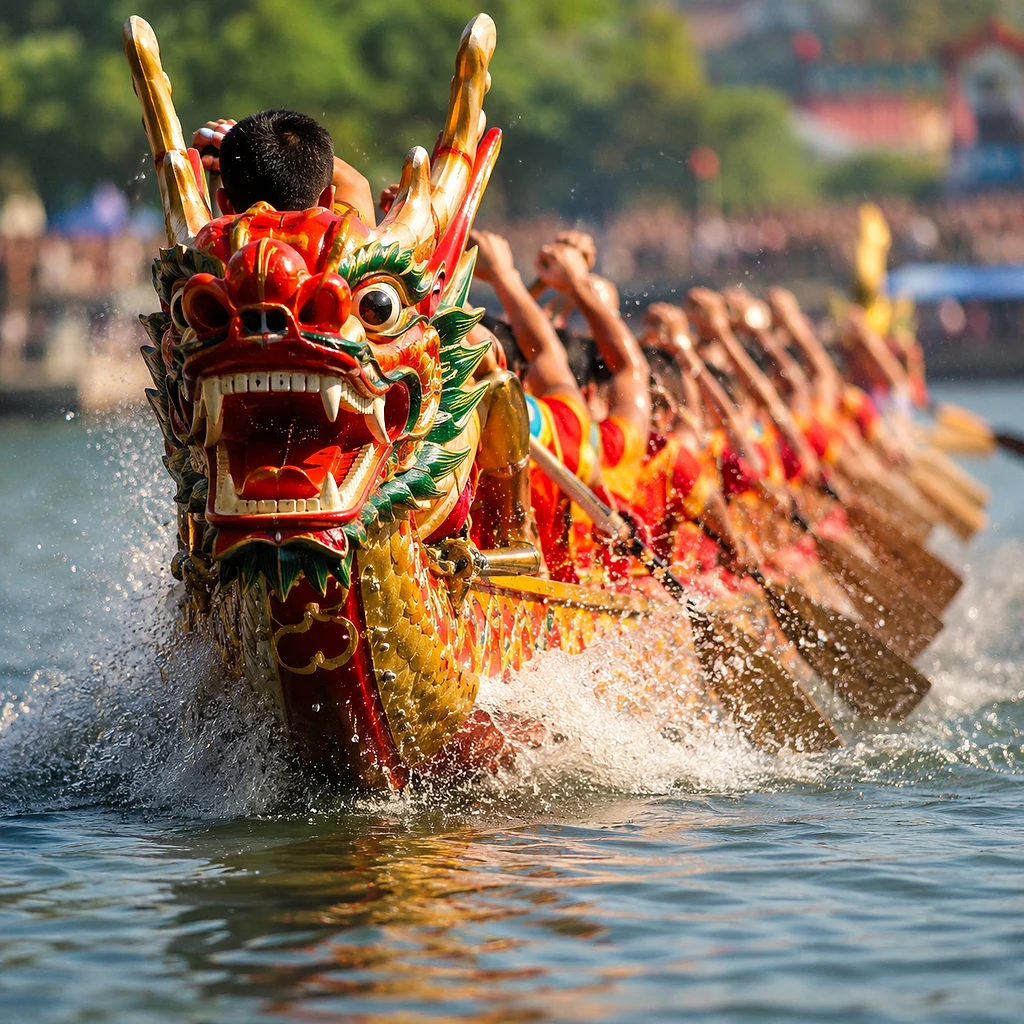
the lively dragon boats on the river.
But have you ever wondered:
the things we do today,
where do they actually come from?
Today,
we'll lay it all out,
one piece at a time,
and make it clear.
First,
the most important name of all — Qu Yuan.
Qu Yuan
lived over two thousand years ago.
At that time,
China was not yet unified,
split into several states.
Qu Yuan
was a minister of one of them, the state of Chu,
and at the same time,
a remarkable poet.
How patriotic was he?
He wished with all his heart to make Chu
stronger,
so it wouldn't be bullied by other states.
He gave the king
much good advice.
But
the wicked men around the king,
who disliked him,
were always speaking ill of him to the king.
As a result,
Qu Yuan was not only passed over,
but instead,
again and again,
was driven out of the capital.
He could only watch, helplessly,
as the Chu he loved so deeply
declined day by day.
In the end,
the worst news came after all:
Chu's capital
was, by the powerful state of Qin,
broken through.
For Qu Yuan,
it was as if the sky had fallen.
He simply could not bear
to watch his country perish.
And so,
in utter grief,
he picked up a stone,
and threw himself into the Miluo River.
That day
was exactly the fifth of the fifth month.
As the news spread,
the common folk on both banks
were stricken with grief.
They loved this poet so dearly.
People rowed their boats,
rushing out onto the river,
searching everywhere for his body,
yet could not find it.
So that the fish in the river
would not gnaw at Qu Yuan,
people, one after another,
took rice and food
and threw it into the river.
Some even
poured realgar wine into the river,
to drug the 'evil dragon' in the water, it was said.
You see,
many of today's customs,
their source is right here.
People rowing boats to find Qu Yuan
slowly evolved into
today's dragon-boat racing.
Throwing rice balls into the river
slowly evolved into
the zongzi we eat today.
Of course,
the story of Duanwu
has another side too.
In fact,
before Qu Yuan,
the ancients already felt
that the fifth lunar month
was a 'poison month'.
Because the weather turns hot,
snakes and insects multiply,
and people fall ill easily.
So,
many Duanwu customs
were, from the start, about 'health'.
For example,
hanging mugwort at the door,
wearing a scented sachet,
and on children's wrists,
tying five-color threads.
These
were all the ancients'
ways of praying for safety and driving off illness,
a kind of method.
And so,
the remembrance of Qu Yuan
and the ancient health customs
slowly,
merged together,
and became the Dragon Boat Festival we know today.
Speaking of this,
I want to say one more thing to you.
A man
has been gone for over two thousand years.
But because of him,
an entire people,
every year,
pause once for him,
eat a bite of zongzi,
watch a dragon-boat race.
This kind of memory
is truly remarkable.
Finally,
I want to leave you two questions.
First,
of the Dragon Boat Festival,
what do you like most —
which part?
The zongzi,
the dragon boats,
or that
story about Qu Yuan?
Second,
over two thousand years have passed.
Do you think
what people truly commemorate in Qu Yuan
is the man himself,
or
is it that quality in him —
that 'knowing it's hard, yet holding on',
that spirit?
These two questions
have no standard answer.
But they're worth our
thinking about slowly.
Listen again
Try it without the transcript and notice what sounds clearer.
What vocabulary does this episode teach?
词汇HSK 1-3. country.
HSK 1-3. healthy, health.
HSK 1-3. result; outcome.
HSK 1-3. news; message.
HSK 1-3. lively, bustling.
HSK 1-3. at the end; finally.
HSK 1-3. body.
很多人说不清来历的节日 = a festival whose origin many can't explain.
那时候,中国还没有统一 = at that time China was not yet unified.
是楚国的一位大臣 = a minister of the state of Chu.
他给国王,提了很多好的建议 = he gave the king much good advice.
屈原不但没被重用,反而被赶出了京城 = far from being promoted, he was driven from the capital.
他只能眼睁睁地,看着…楚国,一天天走向衰败 = he could only watch helplessly as Chu declined.
楚国的都城,被强大的秦国攻破了 = Chu's capital fell to powerful Qin.
* beyond level超纲词
What grammar patterns appear in this episode?
语法说不清 + Noun (can't quite explain)
Verb + 不清 = unable to make clear.
很多人说不清来历的节日。
不但 ... ,反而 ... (not only not..., but on the contrary...)
Marks an outcome opposite to expectation.
屈原不但没被重用,反而,一次又一次地,被赶出了京城。
只能 + Verb (can only)
Expresses being left with no other option.
他只能眼睁睁地,看着自己深爱的楚国,一天天走向衰败。
为了不让 ... (so as not to let...)
States a negative purpose.
为了不让江里的鱼,去啃食屈原,大家纷纷把米饭扔进江中。
X 慢慢演变成了 Y (X gradually evolved into Y)
Describes how a practice became a custom.
人们划船打捞屈原,慢慢演变成了,今天的赛龙舟。
本来就和 ... 有关 (was, from the start, related to...)
Notes an original connection.
端午的很多习俗,本来就和健康有关。
这两个问题,没有标准答案。但是值得 ... 慢慢去想
The channel's reflective close.
这两个问题,没有标准答案。但是值得我们,慢慢去想。
Proper nouns
专有名词Free account
Keep learning from this story
Create a free account to keep saved words and your preferred level together.
- Keep words with their story context
- Remember your preferred level
- Build your vocabulary over time