
A Chinese podcast · Same story, 4 levels
端午节:我们为什么吃粽子?
Duanwu Festival Marks 2,000 Years of Tradition
About this story
The Dragon Boat Festival explained slowly: zongzi and dragon boats, and the old story of Qu Yuan — a good man who loved his country, drowned in a river, and is still remembered 2,000 years later. HSK 1 Chinese listening practice.
This is an HSK 1 Chinese listening episode that runs about 4 minutes. The full Mandarin script is shown with tap-for-pinyin and a line-by-line English translation, so you can listen and read at once — comprehensible input in the sense of Stephen Krashen's i+1 theory. It teaches 12 key vocabulary words such as 老、岁、难过 and walks through 7 grammar patterns, each explained in English with examples. The same news story is retold at 4 difficulty levels — use the level selector above to find the version that is challenging but still understandable for you.
Read at your level
原文Read the complete story in Chinese. Reveal pinyin and English only when you need them.
English transcript reference
Today,
we'll talk about
a Chinese festival.
This festival
is very, very old.
How old?
It's old — very, very old.
It is
over two thousand years old.
Over two thousand years —
that is very, very old.
A festival this old —
why,
even today,
does everyone still celebrate it?
I think
it's because on this day,
there is good food.
Yes,
there is very tasty food.
Adults love it,
and children love it too.
So,
the thing everyone eats —
what is it?
And this festival —
what is it called?
Let's,
one by one,
take it slowly.
First,
which festival this is.
Its name
is the Dragon Boat Festival.
On the Dragon Boat Festival,
the thing everyone eats,
that food,
is called zongzi.
Zongzi
is made of rice.
On the outside,
it's wrapped in green leaves.
Inside,
some are sweet,
some are savory.
On the Dragon Boat Festival,
in some places,
many people
will, together,
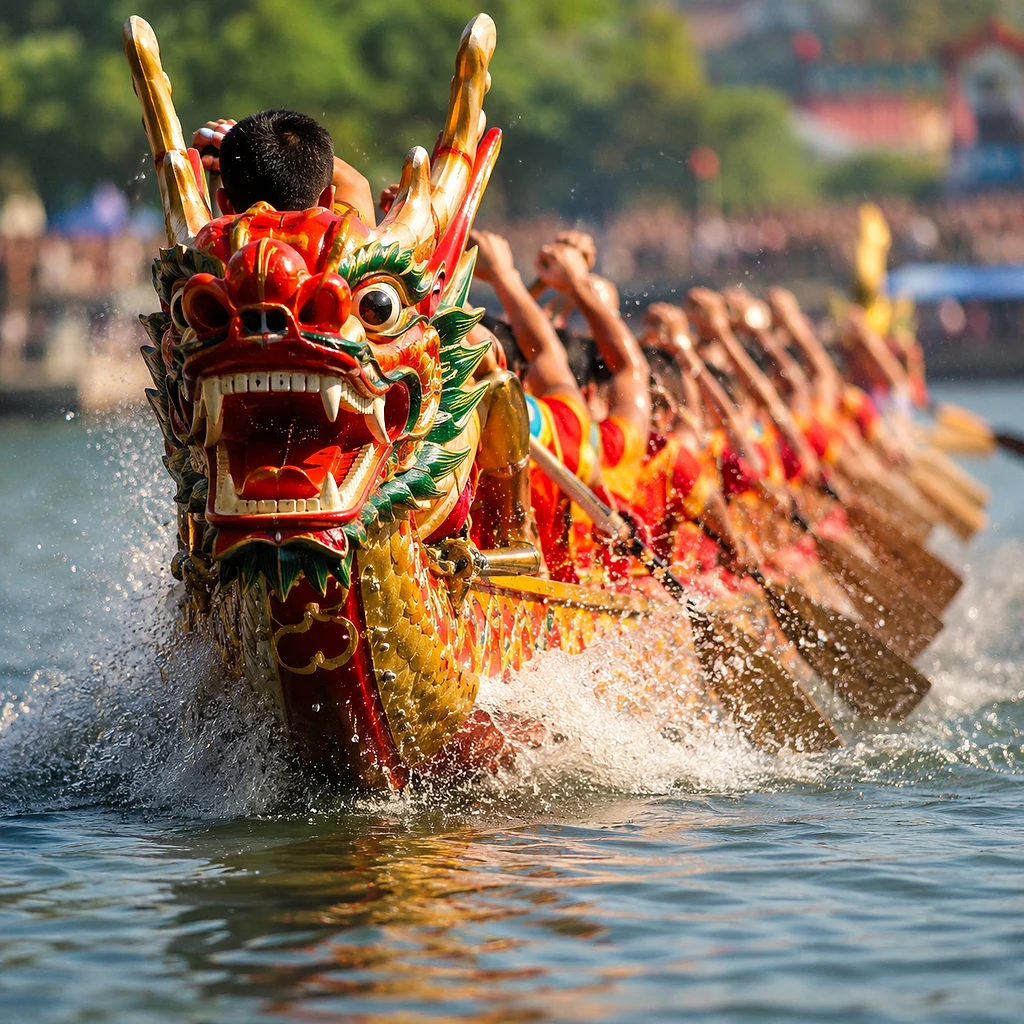
row a boat.
That kind of boat
is long and beautiful.
We call it
a dragon boat.
So,
why do people
eat zongzi
and race dragon boats?
Behind this
there is
a very old story.
Long ago,
there was a man,
his name was Qu Yuan.
Qu Yuan
was a good man.
He loved
his country very much.
He wanted, badly,
to make his country
better.
But
others wouldn't listen to him.
Later,
his country
met with disaster.
Qu Yuan
was terribly, terribly sad.
In the end,
he walked to
the bank of a great river,
and jumped in.
And just like that,
he was gone.
The people by the river
all loved Qu Yuan.
Hearing of this,
everyone was frantic.
They quickly
rowed their boats
out onto the river
to look for him.
They also thought:
there are fish in the river.
Would the fish
bite Qu Yuan?
So,
everyone took rice,
wrapped it up,
and threw it into the river.
They thought:
once the fish are full of rice,
they won't
bite Qu Yuan.
You see,
rowing boats to look for him,
slowly,
became
today's dragon-boat racing.
Throwing rice into the river,
slowly,
became
today's zongzi.
For over two thousand years,
Chinese people
still remember Qu Yuan,
this good man.
Finally,
I want to ask you:
in your country,
is there a festival
that exists to
remember one person?
That person —
who is it?
Listen again
Try it without the transcript and notice what sounds clearer.
What vocabulary does this episode teach?
词汇HSK 1 考纲词. 这个节日,很老很老 = this festival is very, very old.
HSK 1 考纲词. 两千多岁了 = over two thousand years old.
HSK 3 考纲词. 屈原非常非常难过 = Qu Yuan was terribly sad.
HSK 1. we; us.
HSK 1. they; them.
HSK 1. what.
HSK 3. 一个中国的节日 = a Chinese festival. The whole episode is about one.
大家都还在过 = everyone still celebrates it. 过节 = to celebrate a holiday.
它的名字,叫端午节 = its name is the Dragon Boat Festival.
Glossed inline: 用米做的,外面包着绿色的叶子 = made of rice, wrapped in green leaves.
Glossed inline: 又长又漂亮的船,我们叫它龙舟 = a long, beautiful boat — a dragon boat.
HSK 3. 有一个很老的故事 = there is a very old story.
* beyond level超纲词
What grammar patterns appear in this episode?
语法有多 + Adj + 呢?(how Adj is it?)
A rhetorical question to set up an answer.
有多老呢?
它有,两千多岁了。
是用 + Material + 做的 (made of...)
States what something is made from.
粽子,是用米做的。
又 A 又 B (both A and B)
Stacks two qualities.
那种船,又长,又漂亮。
为什么 + 要 ... ?(why does one...?)
Asks the reason for an action.
人们为什么,要吃粽子,要划龙舟呢?
把 + Object + Verb (disposal)
Foregrounds what is done to the object.
大家把米,包起来,扔到河里。
X 慢慢地,就变成了 Y (X slowly became Y)
Describes a gradual transformation — how customs began.
划着船去找他,慢慢地,就变成了,今天的龙舟。
有没有 ...?(is there...?)
A yes-no question for the reflective close.
在你的国家,有没有一个节日,是为了,记住一个人?
Proper Nouns
专有名词Free account
Keep learning from this story
Create a free account to keep saved words and your preferred level together.
- Keep words with their story context
- Remember your preferred level
- Build your vocabulary over time