
A Chinese podcast · Same story, 4 levels
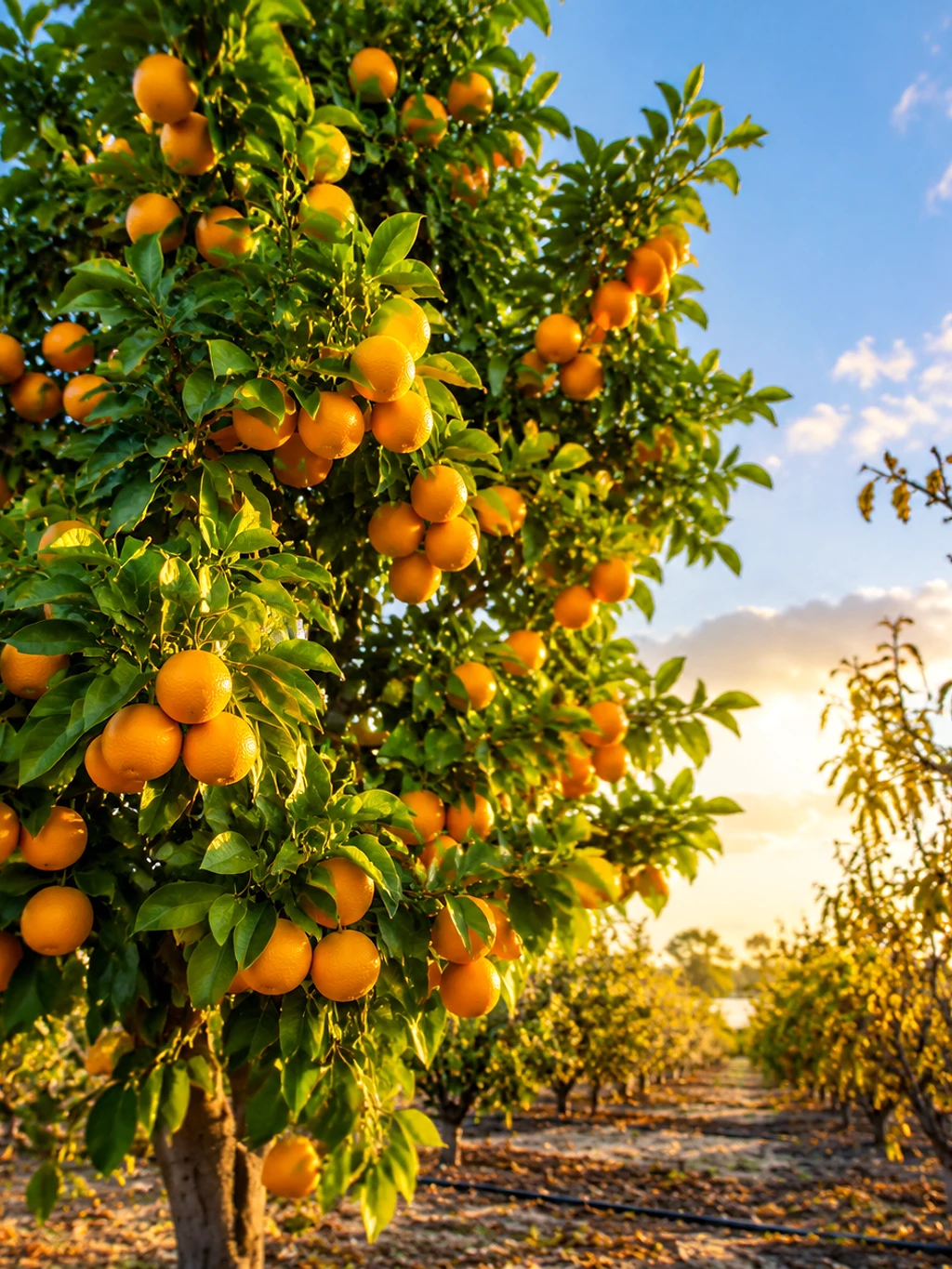
黄龙病毁掉了佛罗里达九成五的橙子,基因编辑能救回来吗?
Citrus Greening Wiped Out 95% of Florida's Oranges. Can Gene Editing Bring Them Back?
About this story
For 20 years citrus greening — huanglongbing, spread by an insect the size of a pollen grain — has gutted Florida's orange groves: production down 95%, four juice plants left out of 54. This year the EPA approved a Crispr-edited rootstock and a harmless virus that helps trees fight back, and growers have ordered hundreds of thousands of trees. The first juice oranges are two years away. Chinese listening practice at four levels. HSK 5-6 Chinese listening practice.
This is an HSK 5-6 Chinese listening episode that runs about 4 minutes. The full Mandarin script is shown with tap-for-pinyin and a line-by-line English translation, so you can listen and read at once — comprehensible input in the sense of Stephen Krashen's i+1 theory. It teaches 12 key vocabulary words such as 恢复、价格、经历 and walks through 3 grammar patterns, each explained in English with examples. The same news story is retold at 4 difficulty levels — use the level selector above to find the version that is challenging but still understandable for you.
Read at your level
原文Read the complete story in Chinese. Reveal pinyin and English only when you need them.
English transcript reference
Florida's orange industry may finally have found a savior.
For twenty years, its orange groves have been tormented by an incurable disease.
The disease makes oranges drop before they're ripe, and the ones left are bitter and unpleasant to eat.
In English it's called "citrus greening"; in Chinese it has a better-known name: huanglongbing, "yellow dragon disease."
More than ninety percent of Florida's oranges are squeezed for juice, and since the disease appeared, production has fallen by ninety-five percent.
Last year alone, about 24,000 hectares of groves went out of production, roughly a quarter of what was left.
Now about 200,000 hectares of land sit idle, and some abandoned groves have become cattle pasture or new housing developments.
The disease clogs a tree's "blood vessels," so water and nutrients can't get through.
It's spread by the Asian citrus psyllid, a non-native insect so small it looks like pollen, which passes the bacterium to orange trees as it sucks their sap.
A light breeze can carry it from one grove to the next, and pesticides struggle to control it.
Florida's orange growers had survived many disasters before this.
In the 1980s, severe freezes damaged the oranges; in the early 2000s, to fight another disease, the government sent crews with woodchippers to destroy large numbers of trees; and three hurricanes tore whole groves out by the roots.
But none of those disasters was as deadly as citrus greening.
According to University of Florida research, the orange industry lost more than half its workers between 2003 and 2021.
In the 1980s, Florida had fifty-four orange-juice processing plants; now only four are left.
Becker, a senior vice president at one of them, said: what we really need is people to come back into the business; if they don't, I'm scared of where we might end up.
In the small town of Frostproof, Rucks, who has grown oranges all his life, pointed to the railway tracks and said they used to be lined with citrus packing houses.
Now there's a huge junkyard there, selling equipment from dismantled juice plants.
About ten years ago, citrus greening nearly bankrupted him, so he had to start growing blueberries, bamboo and ornamental plants.
He said: we're just desperately trying to find alternatives.
This year, the US Environmental Protection Agency approved two new technologies, giving the industry a chance at rebirth.
The first uses gene editing to breed orange trees that can resist citrus greening.
An orange tree is really two plants grafted together: the rootstock below grows the roots and decides whether the tree can resist disease, and the scion above decides what fruit it bears.
The company that made these trees sells only the rootstock, and its data show the new rootstock is thousands of times more resistant to the greening bacterium than existing trees.
The University of Florida scientist who found the relevant genes says it's the first crop edited specifically to fight disease that has come to market.
One nursery is growing more than a million of these new trees; its head grafter says he's seen millions of trees go out from there and almost every one eventually died, and this is the first real hope he's seen in twenty years.
The second technology is to give trees already in the ground a harmless virus that makes them continuously produce a small antibacterial molecule.
The company's founder used a comparison: the old approach was like taking just one pill of a course of antibiotics.
Farmers have already ordered hundreds of thousands of disease-resistant trees to plant next spring, and the state will spend 330 million dollars over two years to help the industry recover.
But it will still be two years before the new trees bear oranges for juice, and the question is whether the industry can hold on until then.
Even if the oranges come back, the customers will have to be won back too.
Since citrus greening appeared, juice prices have soared and breakfast tables have filled with other drinks, and Americans now drink less than half as much orange juice.
Still, scientists say these technologies might one day also protect grapes and corn; one plant-disease scientist said: with these technologies, the sky is the limit.
If one day the orange juice you drink comes from gene-edited orange trees, would you mind?
Listen again
Try it without the transcript and notice what sounds clearer.
What vocabulary does this episode teach?
词汇HSK 4. 帮助这个行业恢复.
HSK 4. 橙汁价格大涨.
HSK 3. 已经经历过很多次灾难.
HSK 3. 根据佛罗里达大学的研究.
HSK 3. 我很害怕最后会变成什么样子.
HSK 4. 政府派人用粉碎机把大片的树毁掉.
产 (produce) + 量 (amount).
把细菌传给了橙子树.
没有一次灾难像黄龙病这么致命.
美国环境保护局批准了两项新技术.
抵抗黄龙病.
你会介意吗?
* beyond level超纲词
What grammar patterns appear in this episode?
语法自从……以后
Ever since…
佛罗里达的橙子,九成以上都用来榨果汁,而自从黄龙病出现以后,产量已经下降了百分之九十五。
光是……,就……
In … alone, …
光是去年,就有大约两万四千公顷橙子园停产,占剩下面积的四分之一左右。
就算……,还得……
Even if…, you would still have to…
就算橙子回来了,还得把顾客找回来。
Proper nouns
专有名词Free account
Keep learning from this story
Create a free account to keep saved words and your preferred level together.
- Keep words with their story context
- Remember your preferred level
- Build your vocabulary over time