
A Chinese podcast · Same story, 4 levels
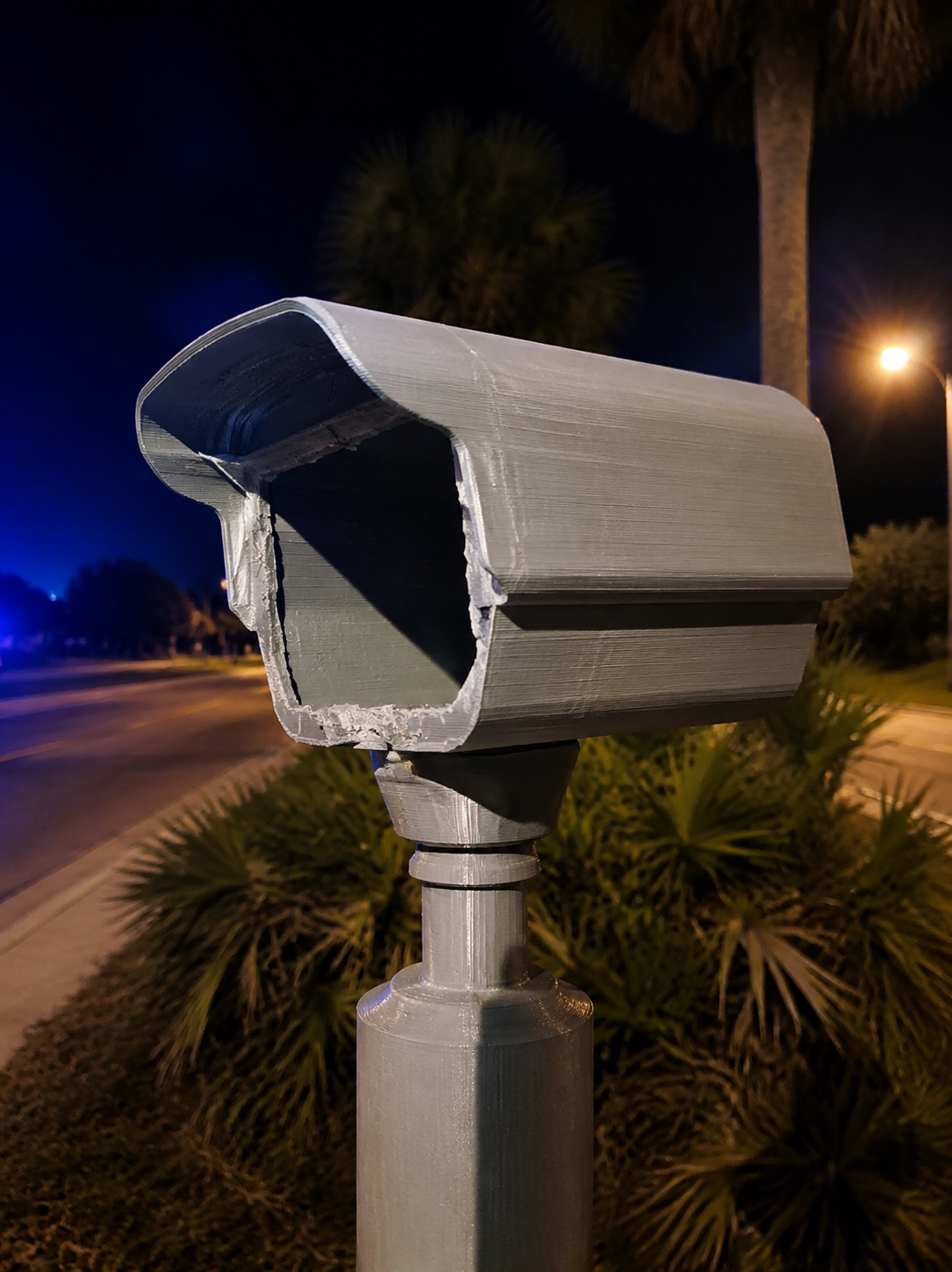
警察用3D打印机做了个假摄像头当诱饵。砸了它的年轻人,被控三条重罪。
Florida Vandal Charged Over $5 Fake Camera
About this story
Florida Vandal Charged Over $5 Fake Camera. HSK 5-6 Chinese listening practice.
This is an HSK 5-6 Chinese listening episode that runs about 4 minutes. The full Mandarin script is shown with tap-for-pinyin and a line-by-line English translation, so you can listen and read at once — comprehensible input in the sense of Stephen Krashen's i+1 theory. It teaches 6 key vocabulary words such as 设备、清楚、于是 and walks through 3 grammar patterns, each explained in English with examples. The same news story is retold at 4 difficulty levels — use the level selector above to find the version that is challenging but still understandable for you.
Read at your level
原文Read the complete story in Chinese. Reveal pinyin and English only when you need them.
English transcript reference
First, be clear about what this kind of camera does — the rest of the story rests on it.
It is mounted by the road. It does not photograph faces, only license plates.
Every car that drives past has its plate number, the time and the place recorded, and entered into a searchable database.
Police can use it to find a fleeing vehicle, and they can also use it to join every place a person has been over the past six months into one complete trail.
That is exactly why it has always been controversial in America: it records everyone alike, including people who have never done anything wrong.
This summer, in a small Florida city called Oviedo, trouble started along one boulevard.
Between late July and early August, several plate cameras on that road were stolen or smashed, one after another.
The police could not find out who was doing it.
So they came up with a plan — and that plan is the real heart of this story.
They made a fake camera.
Not bought from the manufacturer: an officer at the department printed it at home on a 3D printer.
A plastic shell, almost identical to the real thing on the outside, and inside, nothing at all.
When it was finished they mounted it by the road, and then waited.
About two hours after it went up, just past midnight, a twenty-four-year-old man appeared.
He cut the fake camera down with a pair of garden shears, and then smashed it.
The police arrested him on the spot.
What comes next is the part of this most worth stopping on: he was charged with three felonies.
One: criminal mischief, with damage over one thousand dollars.
Two: grand theft, property valued between seven hundred fifty and five thousand dollars.
Three: damaging or stealing computers, electronic devices and related equipment.
Line the three of them up and one thing is common to all: every one is built on the same foundation — what that object was worth.
Over a thousand dollars, or the first charge does not stand.
Over seven hundred fifty dollars, or the second one does not stand.
Which makes the question very sharp: what exactly was the thing he smashed worth?
As far as he knew, it was a real plate camera, and replacing one might cost thousands of dollars.
In fact, what he smashed was a plastic model an officer had printed at home on a 3D printer.
The material cost was a few dollars of plastic, plus a few hours of printing time.
In his head, he destroyed thousands of dollars.
In reality, he destroyed five dollars.
Which of the two should the law accept?
This is not word play. It is precisely the line on which three felonies stand or fall.
Counted by what he believed, it is a felony.
Counted by objective value, perhaps not a single charge holds.
And there is an uglier layer to this.
The mayor of Oviedo said publicly that she had no idea the police were doing this.
In other words, a city mayor did not know her own police department had put a fake camera by the road to bait someone.
She also said publicly that the case is legally very much worth thinking about.
Pull the whole thing together and the shape of it is clear.
To catch a man destroying surveillance equipment, the police built a piece of fake surveillance equipment themselves.
And then, with a device that did not exist, they bought three felonies that very much do.
The thing that was destroyed was fake. The prison time might be real.
Think about it:
If a man believes he smashed thousands of dollars but actually smashed five, which one should he answer for?
Listen again
Try it without the transcript and notice what sounds clearer.
What vocabulary does this episode teach?
词汇监控设备 — surveillance equipment, the word the whole ending pivots on.
先说清楚 — first, be clear about it.
Links a situation to the action it caused: 于是他们想了一个办法.
他被起诉了,三条重罪 — he was charged with three felonies.
故意毁坏财物 — intentional destruction of property.
一直有争议 — it has always been controversial.
* beyond level超纲词
What grammar patterns appear in this episode?
语法……才构成……
才 marks a threshold: only when the condition is met does the thing come into being.
一千美元以上,才构成第一条。 — Only over one thousand dollars does the first charge come into being.
把 A 连成 B
"Join A into B" — the 把 construction with a resultative, used for assembling scattered data into a whole.
把某个人过去半年去过哪些地方,连成一条完整的轨迹。 — Join everywhere a person has been over six months into one complete trail.
按……算
"Calculated according to ..." — sets which standard is being applied.
按他的主观认知算,是重罪。 — By his own understanding, it is a felony.
按客观价值算,可能一条都够不上。 — By objective value, perhaps not one charge holds.
Proper nouns
专有名词Sources
来源Free account
Keep learning from this story
Create a free account to keep saved words and your preferred level together.
- Keep words with their story context
- Remember your preferred level
- Build your vocabulary over time