
A Chinese podcast · Same story, 4 levels
迪拜航空副驾驶用驾驶舱里的斧子砍伤机长,乘客冲进去救下了整架飞机
A FlyDubai Co-Pilot Attacked His Captain With the Cockpit's Own Axe. Passengers Broke In and Saved the Plane.
About this story
The FlyDubai FZ1073 axe attack, why the post-9/11 cockpit door mattered, and the background-check gap behind it. HSK 3 Chinese listening practice.
This is an HSK 3-4 Chinese listening episode that runs about 5 minutes. The full Mandarin script is shown with tap-for-pinyin and a line-by-line English translation, so you can listen and read at once — comprehensible input in the sense of Stephen Krashen's i+1 theory. It teaches 18 key vocabulary words such as 情况、普通、害怕 and walks through 7 grammar patterns, each explained in English with examples. The same news story is retold at 4 difficulty levels — use the level selector above to find the version that is challenging but still understandable for you.
Read at your level
原文Read the complete story in Chinese. Reveal pinyin and English only when you need them.
English transcript reference
When you board a plane, security checks your bag to see whether you're carrying a knife.
But on September 30th, one man didn't need to bring a knife at all.
What he wanted was already on the plane, hanging right in the cockpit.
It was an axe.
Every large plane has an axe like this in its cockpit.
It's for saving lives: when something goes wrong, a door won't open, or there's a fire behind a panel, you smash through with it.
That day, this life-saving axe was used to hack at a person.
The one who picked up the axe was the plane's co-pilot.
The one who was attacked was the captain sitting next to him.
Let's start from the beginning.
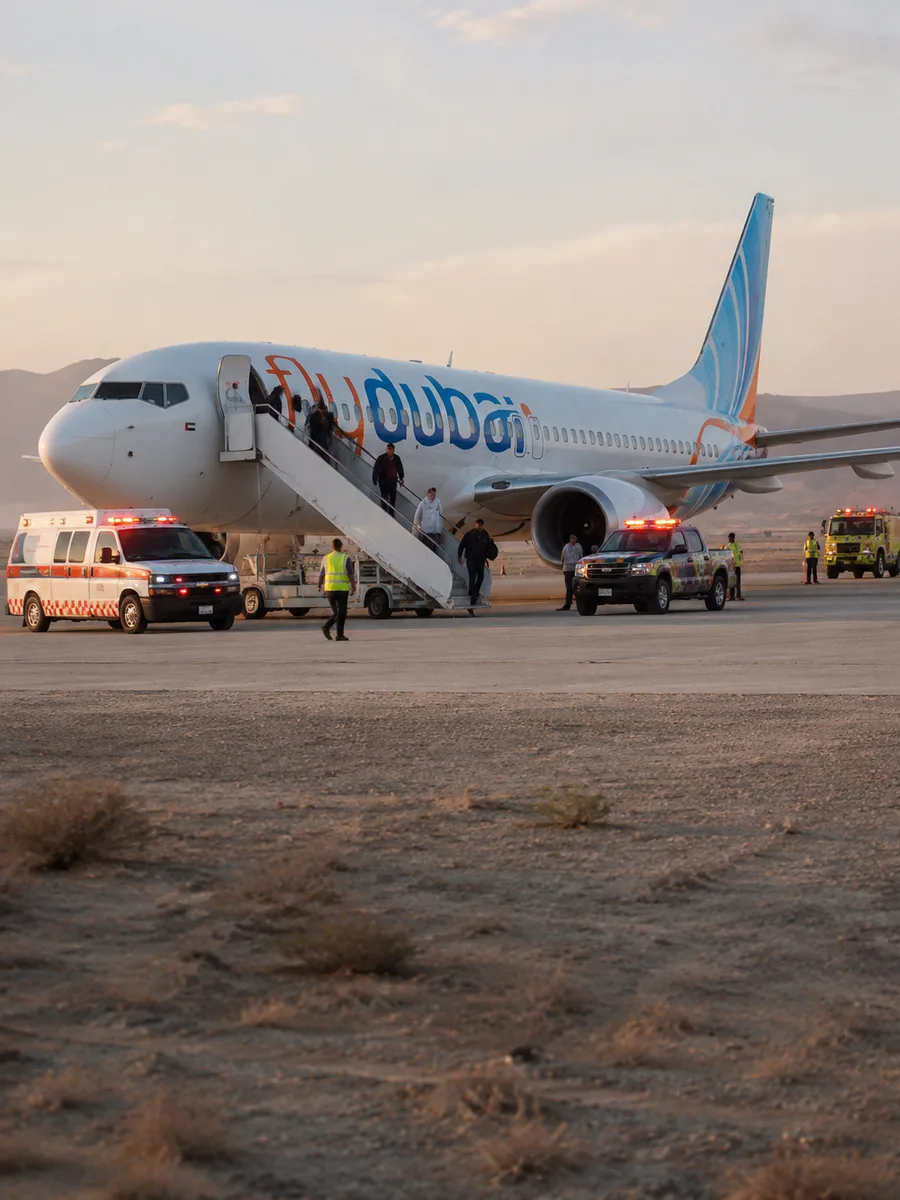
A little after seven that morning, FlyDubai flight FZ1073 took off from Dubai, bound for Tel Aviv in Israel.
There were 174 people on board, most of them Israeli passengers.
There were two people in the cockpit: the captain and the co-pilot.
The captain, Smit, is Indian and had been flying for seventeen years.
The co-pilot was fairly young.
For just over two hours, everything was normal.
Then the co-pilot suddenly picked up the axe and swung it at the captain.
The captain was badly wounded and collapsed on the cockpit floor.
Next, the plane started to dive.
In under two minutes, it fell more than five thousand meters from around ten thousand meters.
It dropped so fast that part of the tail — the fin — was torn off.
The passengers in the back didn't know at first what was happening.
One passenger said later: the feeling of falling was completely not normal.
Everyone was very scared, but they couldn't get into the cockpit.
Here's a very important detail: the cockpit door.
After 9/11 in America in 2001, cockpit doors all over the world changed.
They became very strong — impossible to open from outside, only from inside.
The design is meant to stop bad people from rushing from the cabin into the cockpit.
But this time, the bad guy was already inside the cockpit.
The door that protects the pilots locked out everyone who could help.
This has happened before: in 2015, on a German plane, the co-pilot locked the captain out and deliberately flew into a mountain; all 150 people died.
That time, the captain outside the door simply couldn't get in.
This time was different: the captain was also inside the door.
So everything came down to the captain.
The captain lay on the floor, bleeding heavily.
He later told Indian Prime Minister Modi: I told myself to use the last of my strength to open the door.
He did it.
The moment the door opened, several passengers rushed in.
First in was an Israeli plumber.
He said: I grabbed the man, held him from behind, and first pulled him out of the cockpit.
Other passengers came to help, and together they pinned the co-pilot down.
But a new problem came up: who would fly the plane?
The captain was badly hurt, and the co-pilot was already pinned to the floor.
Luckily, there were two off-duty pilots on board that day, traveling as ordinary passengers.
The two of them walked into the cockpit and took over the plane.
About twelve minutes later, at around 4,500 meters, the plane steadied again.
Meanwhile, a dentist on his way back from China knelt beside the captain and kept stopping his bleeding.
The plane didn't continue to Israel; it diverted to Tabuk in Saudi Arabia.
Tabuk is a city in northwest Saudi Arabia.
After flying another eighty-five minutes, the plane landed safely in Tabuk.
Of the 174 people, no passengers were seriously hurt; the captain was badly injured but stable.
So who is this co-pilot?
His name is Hamam al-Hammami, and he is Omani.
阿曼 is Oman, right next to Dubai.
He used to work at Oman Air.
Oman Air found that he had very extreme ideas.
Extreme means ideas that have gone all the way to the edge, like believing it's right to hurt other people.
So Oman Air stopped letting him fly and only let him work in an office.
Around 2024, he left Oman Air and later joined FlyDubai.
FlyDubai did a background check on him.
A background check is when a company, before hiring someone, looks into what they've done in the past.
But this check mainly looked at whether he had committed any crimes.
He hadn't, so the check found no problems.
No one found out about his extreme ideas.
The UAE's prosecutor said this was a terrorist attack.
A terrorist attack means deliberately hurting lots of ordinary people to make everyone afraid.
Now, four countries are investigating: did he act alone, or was someone else behind him?
This has made many people start thinking about a question.
We keep checking passengers' bags — but who checks the people flying the plane?
What do you think: how should airlines check a pilot?
Listen again
Try it without the transcript and notice what sounds clearer.
What vocabulary does this episode teach?
词汇HSK 3. 机长伤得很重,但是情况稳定 = badly hurt but stable.
HSK 3. 他们只是普通乘客 = they were just ordinary passengers.
HSK 3. 大家都很害怕.
HSK 3/4. 那扇保护飞行员的门.
HSK 3. 阿曼航空发现,他有很极端的想法.
HSK 3. 谁来检查?
HSK 2. 已经开了十七年飞机 = had already been flying for 17 years.
HSK 3/4. 飞机在塔布克安全降落 = landed safely in Tabuk.
HSK 3. 只让他在办公室工作.
一把斧子. The cockpit crash axe.
Contrast 客舱, the passenger cabin.
副 = deputy/second.
The pilot in command.
HSK 4. 以色列乘客.
很极端的想法 = very extreme ideas.
背景 = background, 调查 = investigation.
故意伤害很多普通人,让大家害怕.
止 = stop, 血 = blood. 帮他止血.
* beyond level超纲词
What grammar patterns appear in this episode?
语法被 + verb (passive)
Marks that the subject receives the action.
那天,这把救命的斧子,被拿来砍人。
被砍的,是坐在他旁边的机长。
……的,是 X
Puts the focus on who did something: 'the one who… was X'.
拿起斧子的,是飞机的副驾驶。
冲在最前面的,是一个以色列的水管工。
Verb + 不了 / 不 + 进去
Cannot do the action.
可是他们进不了驾驶舱。
门外的机长怎么也进不去。
怎么也 + 不/没 + verb
No matter how hard — still can't.
那一次,门外的机长怎么也进不去。
把 + object + verb + 在 + place
Do something to an object so it ends up somewhere.
副驾驶把机长关在门外。
那扇保护飞行员的门,把能帮忙的人,都关在了外面。
是为了 + purpose
States the reason or goal behind something.
这样设计,是为了不让坏人从客舱冲进驾驶舱。
X,就是 Y
Defines a new term in simpler words.
背景调查,就是公司在用一个人以前,查一查他过去做过什么。
恐怖袭击,就是故意伤害很多普通人,让大家害怕。
Proper nouns
专有名词Free account
Keep learning from this story
Create a free account to keep saved words and your preferred level together.
- Keep words with their story context
- Remember your preferred level
- Build your vocabulary over time