
A Chinese podcast · Same story, 4 levels
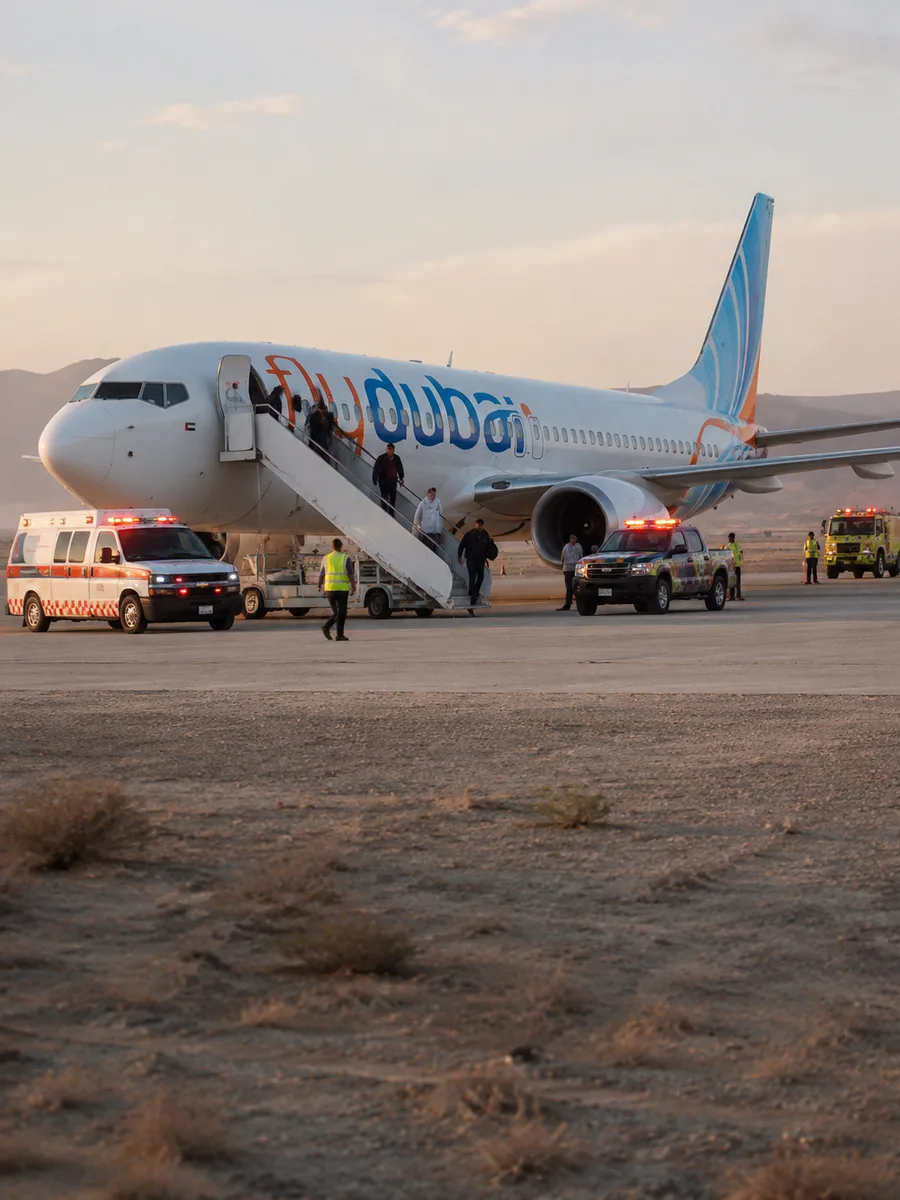
迪拜航空副驾驶用驾驶舱里的斧子砍伤机长,乘客冲进去救下了整架飞机
A FlyDubai Co-Pilot Attacked His Captain With the Cockpit's Own Axe. Passengers Broke In and Saved the Plane.
About this story
A FlyDubai co-pilot attacks the captain with the cockpit axe mid-flight, and passengers break in to save 174 people. HSK 1 Chinese listening practice.
This is an HSK 1 Chinese listening episode that runs about 4 minutes. The full Mandarin script is shown with tap-for-pinyin and a line-by-line English translation, so you can listen and read at once — comprehensible input in the sense of Stephen Krashen's i+1 theory. It teaches 17 key vocabulary words such as 飞机、开、坐 and walks through 6 grammar patterns, each explained in English with examples. The same news story is retold at 4 difficulty levels — use the level selector above to find the version that is challenging but still understandable for you.
Read at your level
原文Read the complete story in Chinese. Reveal pinyin and English only when you need them.
English transcript reference
On a plane, there's something most people don't know about.
It's kept behind the pilots.
This thing is called an axe.
An axe is for opening doors.
You know what a door is.
Your home has doors, schools have doors, and planes have doors too.
When a door on a plane won't open, the pilots can use the axe to open it.
An axe is a good thing to have.
But on September 30th, someone used this axe to attack a person.
The person he attacked was a pilot.
Let's look at what it was like on the plane that day.
That morning, a plane was in Dubai.
迪拜 is Dubai.
This plane was going to Israel.
以色列 is Israel.
There were 174 people on the plane.
At the front of the plane were two pilots.
One pilot was named Smit.
Smit had been flying planes for seventeen years.
The other pilot was young.
The plane flew for a little over two hours and climbed to ten thousand meters.
Then the young man picked up the axe.
He attacked Smit with the axe.
Smit was badly hurt; he was on the floor and couldn't get up.
What was the young man trying to do?
He wanted the plane to go down, all the way to the ground.
He wanted none of the 174 people on board to make it home.
The plane went down, fast, very fast.
In two minutes, the plane dropped five thousand meters.
The passengers were all terrified.
Think about it: if you were on a plane and it was dropping fast, wouldn't you be scared?
But Smit thought: I have to open the door.
Behind the pilots there is a door.
People outside can't open this door.
Smit was on the floor, badly hurt, but he still opened the door.
The door opened.
The passengers could see inside.
A few passengers ran in.
They grabbed the man with the axe.
They dragged him out.
Now, who would fly the plane?
Smit couldn't fly anymore.
But on the plane, there were two other people who could fly.
They weren't working that day; they were passengers too.
These two pilots sat down and started flying the plane.
The plane stopped going down.
Twelve minutes later, the plane was flying normally again.
In the end, the plane didn't go to Israel.
It went to Saudi Arabia.
沙特 is Saudi Arabia.
The plane landed in Saudi Arabia.
All 174 people got off the plane.
Smit was badly hurt, but he didn't die.
A doctor who was a passenger on the plane stayed with him the whole time.
Now, Smit is in the hospital.
An axe is for opening doors.
That day, a man used an axe to attack someone.
But Smit opened the door, the passengers ran in, and the pilots flew the plane.
Everyone on this plane made it home.
Think about it: if you were on this plane, would you run in?
Listen again
Try it without the transcript and notice what sounds clearer.
What vocabulary does this episode teach?
词汇HSK 1. 开飞机 = to fly a plane; 坐飞机 = to take a plane. 一架飞机 uses the measure word 架.
HSK 1. Two uses in this story: 开门 (open the door) and 开飞机 (fly a plane).
HSK 1. 坐飞机的人 = the people taking the plane, i.e. passengers.
HSK 1. 很多人不知道 = many people don't know.
HSK 1. 一个东西 = a thing. 斧子,是开门的东西。
HSK 1. 飞机前面 = at the front of the plane.
HSK 1. 开飞机的人后面,有一个门。
HSK 1. 他想要… = he wanted…; 你想一想 = think about it.
HSK 1. 一个坐飞机的医生 = a doctor who was a passenger.
HSK 1. 在医院里 = in the hospital.
Every airliner cockpit carries a crash axe for emergencies. Measure word 把: 一把斧子.
HSK 2. 开门 = open the door. The cockpit door can only be opened from inside.
HSK 2 as a standalone verb. 用斧子打人 = to attack someone with an axe. You already know it from 打电话.
HSK 3. 你怕不怕? = are you scared?
HSK 3. 用斧子开门 = use an axe to open a door.
他在地上,起不来了 = he was on the floor and couldn't get up.
一架飞机 = one plane; 这架飞机 = this plane.
* beyond level超纲词
What grammar patterns appear in this episode?
语法用 + tool + verb
Use something to do something. The tool comes right after 用, then the action.
开飞机的人可以用斧子开门。
有一个人,用这个斧子打人。
Verb + 了 + duration + 了
Something has been going on for this long and is still true now.
Smit 开飞机,开了十七年了。
Verb + 不了
Cannot do it — the action is impossible, not just unwanted.
飞机上的门开不了的时候……
这个门,外面的人开不了。
都回不了家。
Adj + 不 + Adj?
A yes/no question formed by repeating the adjective or verb with 不.
你怕不怕?
把 + object + verb + 出来
Do something to an object so that it comes out. Here: drag him out.
他们把他拉了出来。
X,是 Y
The simplest way to define or explain a word: X is Y.
斧子,是开门的东西。
迪拜,是 Dubai。
Proper nouns
专有名词Free account
Keep learning from this story
Create a free account to keep saved words and your preferred level together.
- Keep words with their story context
- Remember your preferred level
- Build your vocabulary over time