
A Chinese podcast · Same story, 4 levels
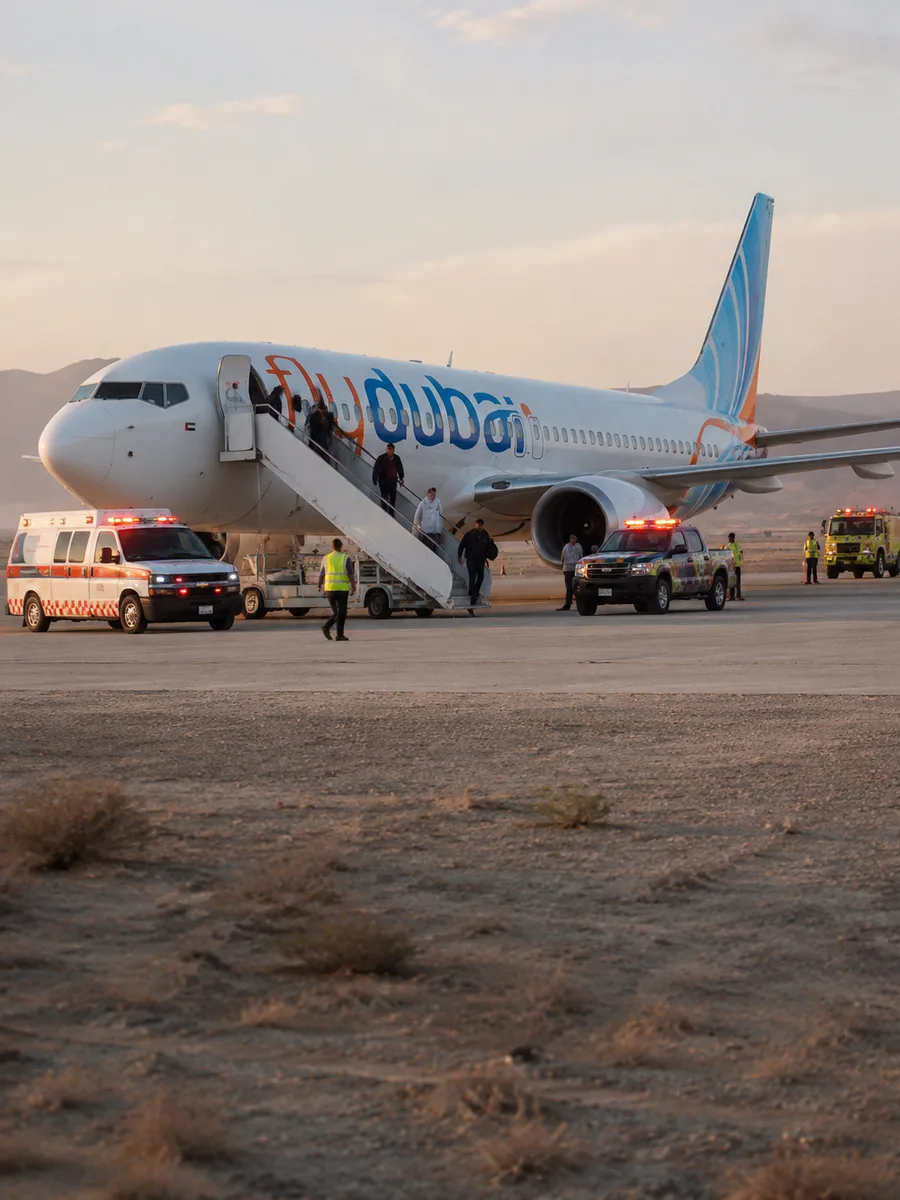
迪拜航空副驾驶用驾驶舱里的斧子砍伤机长,乘客冲进去救下了整架飞机
A FlyDubai Co-Pilot Attacked His Captain With the Cockpit's Own Axe. Passengers Broke In and Saved the Plane.
About this story
The FlyDubai FZ1073 axe attack: how a locked post-9/11 cockpit door nearly doomed 174 people, and the pilot-vetting gap it exposed. HSK 5-6 Chinese listening practice.
This is an HSK 5-6 Chinese listening episode that runs about 5 minutes. The full Mandarin script is shown with tap-for-pinyin and a line-by-line English translation, so you can listen and read at once — comprehensible input in the sense of Stephen Krashen's i+1 theory. It teaches 18 key vocabulary words such as 乘客、保护、危险 and walks through 7 grammar patterns, each explained in English with examples. The same news story is retold at 4 difficulty levels — use the level selector above to find the version that is challenging but still understandable for you.
Read at your level
原文Read the complete story in Chinese. Reveal pinyin and English only when you need them.
English transcript reference
This time, the weapon didn't need to be smuggled on board at all.
Security checked every passenger's bag, but it was already on the plane — hanging in the cockpit.
It was an emergency crash axe.
Every airliner cockpit carries one, for chopping through panels and smashing open exits in a fire or when a door jams.
Put simply, it's a tool for saving lives.
On September 30th, on FlyDubai flight FZ1073, someone used it to try to kill.
The man holding the axe was the plane's co-pilot; the man he hacked at was the captain sitting next to him.
Let's rewind to that morning.
At 7:05 a.m. local time, the plane took off from Dubai for Tel Aviv, Israel.
There were 174 people on board, most of them Israeli passengers.
The captain, Smit, is Indian, with seventeen years of flying.
Just over two hours after takeoff, everything was normal, cruising above ten thousand meters.
Then the co-pilot suddenly grabbed the crash axe and swung at the captain.
The captain, wounded in several places, collapsed onto the cockpit floor.
Almost at the same moment, the plane began a rapid plunge.
Within two minutes, it fell more than five thousand meters.
The dive was so violent that part of the tail fin was torn away.
Passengers in the cabin later recalled that the feeling of falling, faster and faster, told them instantly something was wrong.
But they couldn't help, because the cockpit door was locked.
That door is a story in itself.
After 9/11 in 2001, airlines worldwide installed reinforced cockpit doors: bulletproof, impossible to open from outside, unlocked only from within.
The design assumes the danger comes from the cabin, and the pilots are safe behind the door.
But what if the danger is already sitting in the cockpit?
Then the door ends up protecting the attacker.
It has happened before.
In 2015, a Germanwings co-pilot waited until the captain went to the toilet, locked him out, and deliberately flew the plane into a mountain, killing all 150 people.
The same kind of door — that time, the captain outside simply couldn't get in.
This time the ending was different, and the key was that on the other side of the door lay a man who hadn't given up.
The captain later told Indian Prime Minister Modi: I told myself, one last push, go open that door.
Badly hurt as he was, he still got the door open.
The moment it opened, passengers rushed in.
First in was an Israeli plumber, who said: I grabbed the terrorist, locked him from behind, and first dragged him out of the cockpit.
Several other passengers followed and pinned the co-pilot hard to the floor.
Next came the most critical problem: nobody was flying the plane.
As luck would have it, two off-duty pilots were on board, sitting in the back as passengers.
They went into the cockpit and took over.
From the start of the plunge to stabilizing took about twelve minutes; the plane finally leveled off at around 4,500 meters.
Meanwhile, a dentist on his way back from China knelt by the captain, pressing on the wounds to stop the bleeding.
The plane gave up on Tel Aviv and diverted to Tabuk in northwest Saudi Arabia, landing safely eighty-five minutes later.
No passengers were seriously hurt; the captain's injuries are serious but he is stable.
Twelve minutes of chaos, 174 lives, saved by a wounded captain, a group of ordinary passengers, two pilots who happened to be there, and a dentist.
So where did things go wrong?
The co-pilot is Hamam al-Hammami, an Omani national.
He used to work at Oman Air; the airline found he had extremist leanings — reportedly he had visited radical websites — so it suspended his flying and moved him to a desk job.
Around 2024, he quit and moved to FlyDubai.
FlyDubai did run a background check, of course, but it mainly looked at criminal records.
He had none, so he passed.
Whether he was becoming radicalized, the screening never looked at — and Oman was never asked.
To put it bluntly: his old employer no longer dared let him fly, and his new one put him back in the cockpit.
That's the loophole.
The UAE attorney general has classified it as a terrorist attack, and Israeli Prime Minister Netanyahu said the man boarded intending to crash the whole plane.
Now security agencies from four countries, including the UAE, Israel and Saudi Arabia, are jointly investigating: did he act alone, or was there a group behind him?
The most unsettling part is this: twenty-five years after 9/11, aviation security has been built around guarding against passengers.
Screening has grown stricter, doors stronger, but all of it assumes the bad guy is outside the door.
Once the bad guy is the pilot himself, the whole system nearly stops working.
So the industry will likely face an awkward question: how deep should pilot background checks go?
Only criminal records, or also what they say online, what they think?
Too shallow and there are loopholes; too deep and you run into privacy.
What do you think — should an airline have the right to check what a pilot looks at online?
Listen again
Try it without the transcript and notice what sounds clearer.
What vocabulary does this episode teach?
词汇HSK 4. 大多数是以色列乘客.
HSK 4. 这扇门保护的,就成了凶手.
HSK 4. 危险来自客舱 = danger comes from the cabin.
HSK 4. 故意让飞机撞山.
HSK 4. 背景调查 = background check; 联合调查 = joint investigation.
HSK 4. 一个还没放弃的人; 飞机放弃了特拉维夫.
HSK 4. 安全落地 = land safely; 航空安全 = aviation safety.
HSK 5. 这一整套系统几乎是失效的.
HSK 5. 犯罪记录 = criminal record.
凶 = violent/murderous, 器 = implement. The opening word of the episode.
驾驶 (to pilot) + 舱 (cabin). Contrast 客舱, the passenger cabin.
副 = deputy. The second pilot beside the 机长.
急速下坠 = a rapid plunge.
备降塔布克 = diverted to Tabuk.
极端倾向 = extremist leanings.
激进 = radical, -化 = -ization.
Literally a leaking hole. 这就是漏洞.
恐怖 = terror, 袭击 = attack. 定性为恐怖袭击 = classified as a terrorist attack.
* beyond level超纲词
What grammar patterns appear in this episode?
语法之所以 A,关键在于 B / 是因为 B
Explains the reason behind an outcome: the reason A happened lies in B.
这一次,结局之所以不一样,关键在于门的另一边,躺着一个还没放弃的人。
连 X 都 …
Even X — stresses an extreme case.
下坠得太猛,连尾翼都被扯掉了一部分。
至于 X,…
As for X — shifts to a related point.
至于他是不是正在激进化,这套审查根本没有去看。
一旦 A,B
Once A happens, B follows.
一旦坏人就是飞行员本人,这一整套系统几乎是失效的。
把 X 定性为 Y
Formally classify X as Y.
阿联酋检察官已经把这件事定性为恐怖袭击。
A 太 X,会…;A 太 Y,又会…
Weighs two opposite risks.
查得太浅,会有漏洞;查得太深,又会碰到隐私的问题。
说白了 / 说得直白一点
Conversational markers meaning 'put simply' / 'to put it bluntly'.
说白了,这是一件救命的工具。
说得直白一点:前东家已经不敢让他开飞机,新东家却让他坐回了驾驶舱。
Proper nouns
专有名词Free account
Keep learning from this story
Create a free account to keep saved words and your preferred level together.
- Keep words with their story context
- Remember your preferred level
- Build your vocabulary over time