
A Chinese podcast · Same story, 4 levels
法国高中生因缺老师罢课抗议:二十五万人上街,五百多所学校停课
French High-School Students Walk Out Over Missing Teachers: 250,000 March, Thousands Arrested and 500 Schools Shut
About this story
France's high-school protests: teacher shortages, 5,000 arrests, a teen who lost a hand, and the budget behind it. HSK 3 Chinese listening practice.
This is an HSK 3-4 Chinese listening episode that runs about 3 minutes. The full Mandarin script is shown with tap-for-pinyin and a line-by-line English translation, so you can listen and read at once — comprehensible input in the sense of Stephen Krashen's i+1 theory. It teaches 16 key vocabulary words such as 钱、简单、办法 and walks through 6 grammar patterns, each explained in English with examples. The same news story is retold at 4 difficulty levels — use the level selector above to find the version that is challenging but still understandable for you.
Read at your level
原文Read the complete story in Chinese. Reveal pinyin and English only when you need them.
English transcript reference
A fifteen-year-old student lost a hand during a protest.
It happened in Lens, northern France: during a clash between students and riot police, a grenade exploded next to him.
This is already the third week of French high-school protests.
The protests began in late September at a high school in Créteil, a Paris suburb.
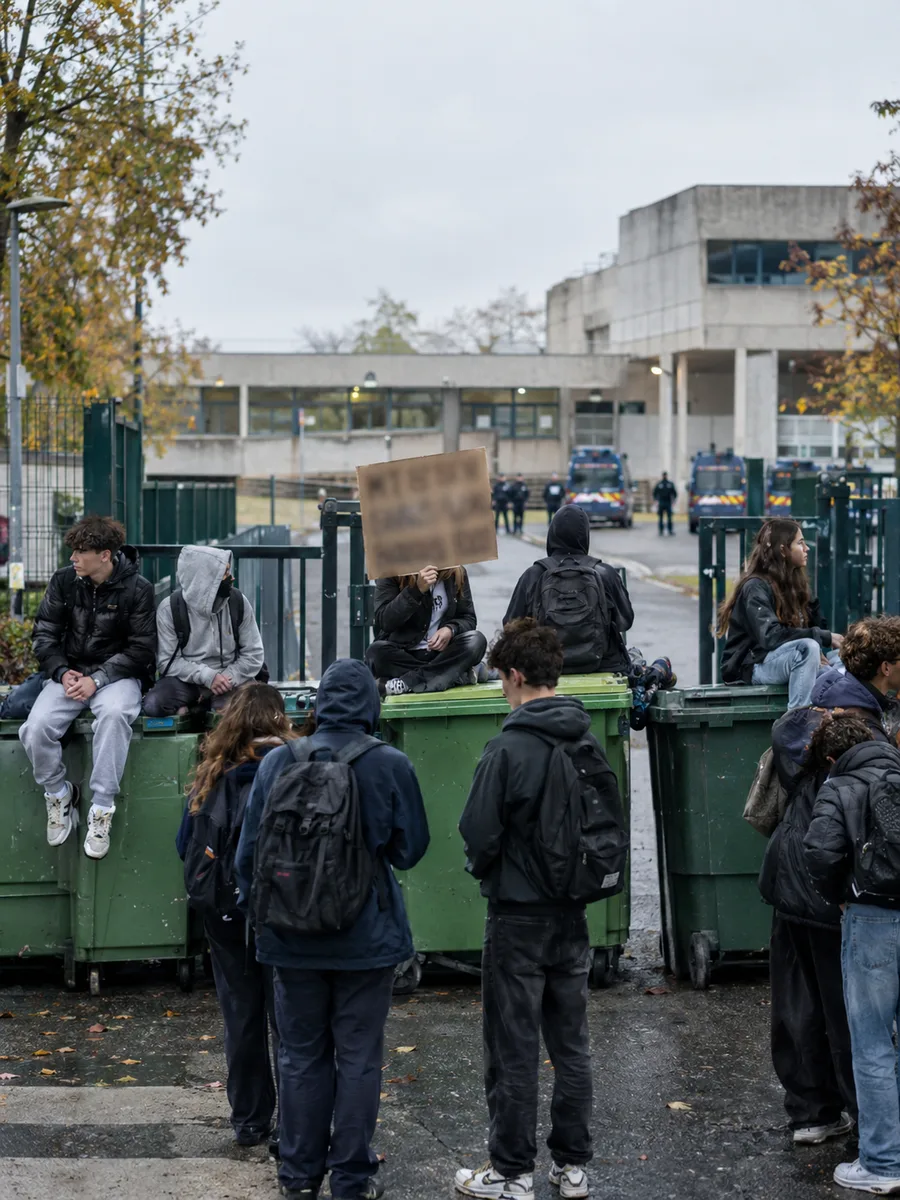
At first, students simply stopped going to class, stood at the school gate, and voiced their complaints.
Their complaints are actually very specific.
The biggest problem is a lack of teachers.
According to statistics, last school year nearly 10 percent of classes in France's public secondary schools didn't happen because there was no teacher.
One student said: there are thirty-five of us in a class, and not even enough chairs.
Others said: the building is about to collapse, the cafeteria is too small, and the school has no money at all.
On top of that, classrooms can reach thirty-five degrees in summer, and there's the university application system that makes every final-year student anxious.
As frustration built up, the class boycott spread from one school to hundreds.
September 30th was the biggest day: more than 250,000 people marched nationwide, 56,000 in Paris alone.
But the protests quickly turned violent.
Schools were set on fire, teachers were beaten, and in Marseille students burned a fire truck.
The police response was tough too: more than 5,000 people arrested, most of them minors, with nearly 2,000 in a single day.
More than 1,800 people have already been prosecuted.
Many were injured: students, school staff, and more than 600 police officers.
By October 5th, more than 500 high schools nationwide were fully or partly closed, out of only 3,700 in all of France.
How has the government responded?
Education Minister Geffray announced that schools would resume classes 'part by part, slowly.'
He also set out five directions: a teacher for every class, better school conditions, adjusted school hours, a more transparent university application system, and listening more to students.
The government also promised to put concrete money on the table before the end of the month.
But that's exactly the problem: where does the money come from?
France is under heavy budget pressure, with high deficits and debt, and has spent the past few years trying to spend less.
The students' message is simple: save money, fine, but not from the classroom.
In half a year France elects a president, so these protests are also making the whole political mood more tense.
Do you think boycotting classes is a good way for students to protest?
Listen again
Try it without the transcript and notice what sounds clearer.
What vocabulary does this episode teach?
词汇HSK 1. 学校根本没有钱; 钱从哪里来?
HSK 3. 学生们的意思很简单.
HSK 3. 一直在想办法少花钱.
HSK 3/4. 大学申请系统.
HSK 1. 一个十五岁的学生.
HSK 1. 最大的问题是老师不够.
HSK 1. 还有那个让每个高三学生都很焦虑的大学申请系统.
HSK 1. 学校根本没有钱.
罢课就从一所学校变成了几百所学校.
学生和防暴警察发生冲突.
一颗手榴弹在他身边爆炸.
其中大部分是未成年人.
一千八百多人被起诉.
预算压力很大.
政府赤字和债务都很高.
赤字和债务.
* beyond level超纲词
What grammar patterns appear in this episode?
语法越 + verb + 越 + Adj
The more…, the more….
不满越积越多,罢课就从一所学校变成了几百所学校。
从 A 变成了 B
Changed from A into B.
罢课就从一所学校变成了几百所学校。
光……就……
… alone….
光巴黎就有五万六千人。
而……
Whereas; while (contrast).
而法国一共只有三千七百所高中。
A,可以,但……
A is fine, but….
要省钱,可以,但不能从教室里省。
再过 + time,就要……了
In … time, … will happen.
再过半年,法国就要选总统了。
Proper nouns
专有名词Free account
Keep learning from this story
Create a free account to keep saved words and your preferred level together.
- Keep words with their story context
- Remember your preferred level
- Build your vocabulary over time