
A Chinese podcast · Same story, 4 levels
法国高中生因缺老师罢课抗议:二十五万人上街,五百多所学校停课
French High-School Students Walk Out Over Missing Teachers: 250,000 March, Thousands Arrested and 500 Schools Shut
About this story
France's lycée revolt: how a Créteil blockade became a national movement, and the debt crisis behind missing teachers. HSK 5-6 Chinese listening practice.
This is an HSK 5-6 Chinese listening episode that runs about 4 minutes. The full Mandarin script is shown with tap-for-pinyin and a line-by-line English translation, so you can listen and read at once — comprehensible input in the sense of Stephen Krashen's i+1 theory. It teaches 16 key vocabulary words such as 控制、估计、学生 and walks through 6 grammar patterns, each explained in English with examples. The same news story is retold at 4 difficulty levels — use the level selector above to find the version that is challenging but still understandable for you.
Read at your level
原文Read the complete story in Chinese. Reveal pinyin and English only when you need them.
English transcript reference
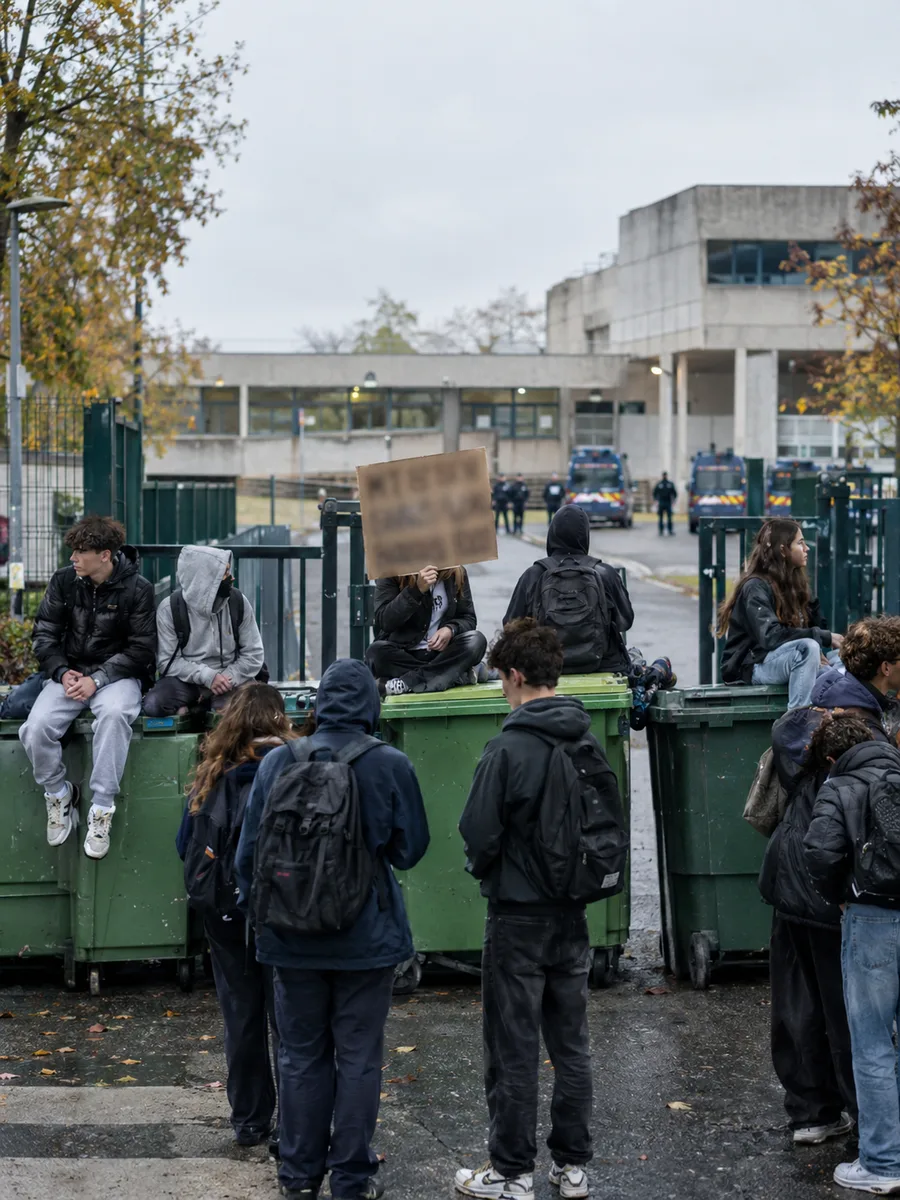
In late September, at the Saint-Exupéry high school in Créteil, a south-eastern suburb of Paris, a group of students blocked the entrance at the school gate.
In less than three weeks, it became a high-school movement sweeping the whole country.
On September 30th, more than 250,000 people marched nationwide, 56,000 in Paris; on October 1st alone, the Interior Ministry said nearly 2,000 were arrested; by October 5th, more than 500 of the country's 3,700 high schools were fully or partly shut.
The most shocking image came from the northern city of Lens: a fifteen-year-old student, in a clash with riot police, had a hand blown off by a grenade.
So what exactly are these teenagers protesting about?
The answer is surprisingly plain: no teachers, no chairs, no money.
Official data show that last school year about 10 percent of teaching hours in France's public secondary schools went untaught for lack of teachers, worst in maths and English.
One student told the media: there are thirty-five of us in a class, and not enough chairs in the classroom.
Another said: the building is about to collapse, the cafeteria is too small, and the school's budget is zero.
Add classrooms at 35 degrees in summer and a university application platform that puts final-year students under huge pressure, and the discontent built up bit by bit, finally igniting at one school and spreading rapidly nationwide.
The protests soon spiraled out of control.
Schools were set on fire and looted, staff were beaten, students in Marseille burned a fire truck, and property damage is estimated at tens of millions of euros.
The police response was just as tough: more than 5,000 arrested, the vast majority minors, more than 1,800 prosecuted, and besides students and school staff, more than 600 police officers injured.
The government's stance has moved from hardline to concessions.
Prime Minister Lecornu released casualty figures while condemning the violence; Education Minister Geffray announced a 'partial, progressive' return to class and five measures: guaranteeing lessons, improving facilities, adjusting class hours,
making university applications more transparent, and giving students more say, plus a promise of a funding plan by month's end.
But the real difficulty is precisely that last item: money.
France's finances are already tight; its deficit has long exceeded the EU limit, and its debt-to-GDP ratio is among the highest in Europe.
For years the government has pushed austerity, and public services like education are among the first to be squeezed.
So on the surface this movement is students demanding teachers, but underneath it's an old question: how does a heavily indebted country keep the public services it has promised?
The French are no strangers to this kind of conflict.
From the yellow-vest movement of 2018 to the 2023 general strikes against Macron raising the retirement age, the street has always been the main way French society expresses discontent.
What's different this time is that the people on the streets are teenagers who can't yet vote.
And with a presidential election in half a year, no side wants to look weak right now.
Some worry that long school closures will make students pay the highest price, especially in suburban schools already short of teachers.
Others argue that without protests like these, nobody would have noticed that 10 percent of untaught lessons.
What do you think: when a country is short of money, should education be protected first?
Listen again
Try it without the transcript and notice what sounds clearer.
What vocabulary does this episode teach?
词汇HSK 4/5. 抗议很快失去控制.
HSK 4. 财产损失估计高达几千万欧元.
HSK 1. 一群学生在校门口堵住了入口.
HSK 4. 让高三学生压力巨大.
HSK 4. 数学和英语最严重.
HSK 4. 不满一点点积累.
HSK 4. 教育部长.
HSK 5. 公布伤亡数字.
一场席卷全国的高中生运动.
和防暴警察的冲突中.
有学校被纵火、被洗劫.
一千八百多人被起诉.
赤字长期超过欧盟规定的上限.
政府一直在推紧缩.
一个负债累累的国家.
一边谴责暴力.
* beyond level超纲词
What grammar patterns appear in this episode?
语法一边……,一边……
Doing two things at once.
总理勒科尔尼一边公布伤亡数字,一边谴责暴力
表面上……,深层次上……
On the surface…, underneath….
所以,这场运动表面上是学生要老师,深层次上是一个老问题
从 A,到 B
From A to B (range of examples).
从二零一八年的黄背心运动,到二零二三年反对马克龙提高退休年龄的大罢工
对……并不陌生
Is no stranger to….
法国人对这种冲突并不陌生。
恰恰是……
Precisely….
但是,真正的难题恰恰是最后这一条:钱。
如果不是……,……
If it weren't for….
如果不是这样的抗议,没人会注意到那百分之十没上成的课。
Proper nouns
专有名词Free account
Keep learning from this story
Create a free account to keep saved words and your preferred level together.
- Keep words with their story context
- Remember your preferred level
- Build your vocabulary over time