
A Chinese podcast · Same story, 4 levels
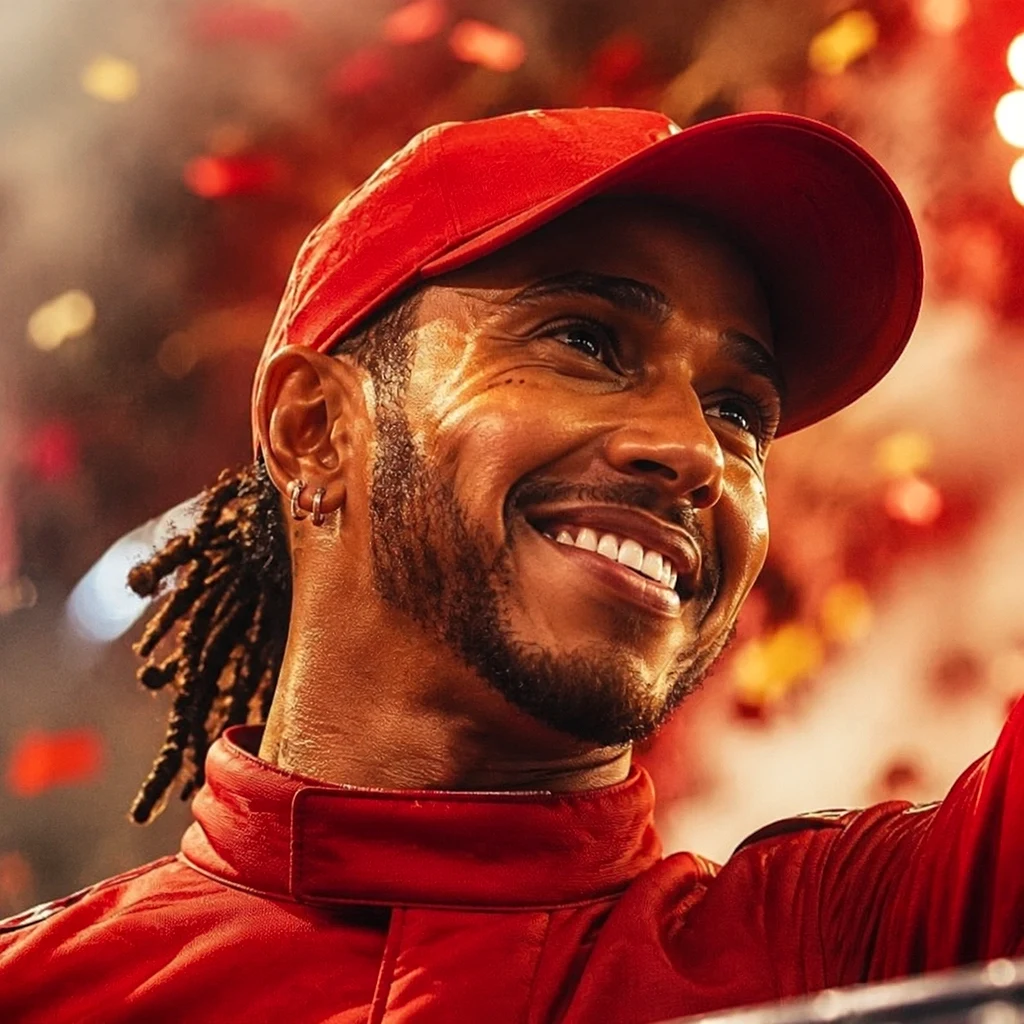
红色终于点燃:四十一岁的汉密尔顿,与一场迟到了一年半的胜利
Hamilton Wins His First Ferrari Race at 41
About this story
Advanced Chinese listening practice. The full story of Lewis Hamilton's first Ferrari win at the 2026 Spanish GP: the seismic decision to leave Mercedes at his career's twilight, the romance and weight of Ferrari red, a brutal winless year-plus and overwhelming doubt, the perfect three-stop strategy and Alonso-triggered VSC, Antonelli's streak-ending failure, and a meditation on betting your legacy on a dream — because the real failure is never trying. HSK 5-6 Chinese listening practice.
This is an HSK 5-6 Chinese listening episode that runs about 5 minutes. The full Mandarin script is shown with tap-for-pinyin and a line-by-line English translation, so you can listen and read at once — comprehensible input in the sense of Stephen Krashen's i+1 theory. It teaches 14 key vocabulary words such as 理论、证明、关键 and walks through 7 grammar patterns, each explained in English with examples. The same news story is retold at 4 difficulty levels — use the level selector above to find the version that is challenging but still understandable for you.
Read at your level
原文Read the complete story in Chinese. Reveal pinyin and English only when you need them.
English transcript reference
Today we'll talk about something that broke the hearts of racing fans worldwide.
Yesterday, June 14, on the track in Barcelona, Spain,
forty-one-year-old Hamilton
finally won his first race victory for Ferrari.
For friends who don't follow F1 much,
let me first give a bit of background.
F1 is the world's highest-level,
most expensive, most cutting-edge motorsport.
And Hamilton is the legend of this sport himself.
He's won seven world championships,
tying the all-time record.
His number of race wins is the most in history.
For a long stretch,
he was practically synonymous with F1.
And all this glory
was forged within the Mercedes team.
So the real starting point of the story
is a decision that shook the entire sports world.
Hamilton could easily have, at Mercedes,
retired in glory, ending his career in comfort.
But he didn't.
He chose, at the twilight of his career,
to leave the team that made him a god,
and move to Ferrari.
To understand how heavy this decision was,
you first have to understand what Ferrari means to a driver.
In the world of F1,
Ferrari is the oldest,
and most romantic, team.
That iconic shade of red
is the ultimate dream of countless drivers from childhood.
To win a race for Ferrari
is a glory close to a religious faith.
What Hamilton wanted was exactly this.
He wanted, before retiring,
to drive that red car with his own hands,
and stand on the top of the podium.
So, even at forty-one,
even having to adapt to a new team from scratch,
he went without hesitation.
However, the start of the dream was cruel.
In the year-plus after moving to Ferrari,
Hamilton didn't win a single race.
The team's chemistry was off, and the car wasn't fast enough.
The doubts from outside were overwhelming.
Some said his best days were behind him,
some said his form would never return,
and others declared
that moving to Ferrari was the biggest blunder of his career.
Those days, for someone used to winning,
were an enormous torment.
But Hamilton
neither complained nor lay down and quit.
He treated every race as a chance,
grinding it out race after race.
He was waiting.
Waiting for a moment that could set the red alight again.
Yesterday, in Barcelona,
that moment finally arrived.
This victory was won with real intelligence.
When every other team chose to pit twice,
Ferrari, for Hamilton,
boldly set up a three-stop strategy.
One extra pit stop, in theory, costs time.
But their grasp of the rhythm was nearly perfect.
More crucially, midway through the race,
Alonso's car had a failure,
triggering a 'virtual safety car',
and the whole field was forced to slow down.
This timing
happened to push the value of Hamilton's three-stop strategy
to its maximum.
And so, step by step, he overtook,
and in the end firmly held onto first place,
first across the finish line.
Behind him,
was Mercedes' Russell,
almost twenty seconds back in second.
McLaren's Norris was third.
And this race had one more dramatic twist.
The one originally leading the points standings
was Mercedes' nineteen-year-old star, Antonelli.
He had already racked up five straight wins, unstoppable.
But just yesterday, his car too had a failure,
and he retired from the race.
His five-win streak ended right there.
This back-and-forth
made the weight of Hamilton's victory even heavier.
The moment Hamilton crossed the line,
the team radio erupted in cheers.
And he himself, in the car,
was so moved he could barely form words.
Because everyone understood,
his last race victory
went all the way back to nearly two years ago.
The wait in between was far too long.
At the end of the show,
I want to talk with you about what's truly moving here.
What moves us isn't that a veteran won another race.
It's that:
a person who already had everything,
at an age when he could have basked in his honors,
chose instead to tear it all down and start over,
to bet on a dream that might not come true.
What he bet was his lifelong reputation.
He could easily have just kept failing,
and ended up remembered as someone who 'tarnished his legacy'.
But he won the bet.
Even if it was only one race,
he proved:
that forty-one-year-old self, written off by countless people,
could still stand at the top of the world.
So finally, I want to leave the question with you.
In your heart,
is there also a dream
you fear is 'too late',
fear 'will fail',
and so keep not daring to touch?
Look at Hamilton.
Maybe the real failure
was never not winning,
but not daring even to try.
Listen again
Try it without the transcript and notice what sounds clearer.
What vocabulary does this episode teach?
词汇HSK 1-4. theory.
HSK 1-4. to prove.
HSK 1-4. crucial, key.
HSK 1-4. value.
HSK 1-4. world.
HSK 1-4. chance.
HSK 1-4. purpose / aim.
让全球车迷集体破防 = had racing fans worldwide collectively moved to tears. Popular online term.
为法拉利,赢下了他的第一个分站冠军 = won his first Grand Prix for Ferrari.
最烧钱、最尖端的赛车运动 = the most expensive, most cutting-edge motorsport.
他几乎就是 F1 的代名词 = he was practically synonymous with F1.
他大可以功成身退 = he could easily have retired in glory.
让他封神的车队 = the team that made him a god (a legend).
最具浪漫色彩的一支车队 = the most romantic team.
* beyond level超纲词
What grammar patterns appear in this episode?
语法大可以 + Verb (could perfectly well...)
Marks an easy alternative path that was not taken.
汉密尔顿大可以在梅赛德斯,功成身退。
要理解 ... 你得先理解 ...
Sets up necessary background before a key point.
要理解这个决定有多重,你得先理解,法拉利对车手意味着什么。
哪怕 ... 哪怕 ... 还是 ... (even... even... still...)
Stacked concessives building to a resolve.
于是,哪怕已经四十一岁,哪怕要从零开始适应一支新车队,他还是义无反顾地去了。
既没有 ... 也没有 ... (neither... nor...)
Double negation for emphasis.
但是汉密尔顿,既没有抱怨,也没有躺平。
更关键的是 + Clause (more crucially...)
Foregrounds the decisive factor.
更关键的是,比赛中途,阿隆索的赛车出现故障。
它动人,不在于 X,而在于 Y
'What's moving isn't X, but Y' — a refined not-X-but-Y for argument.
它动人,不在于一个老将又赢了一场。而在于:一个已经拥有了一切的人,偏偏选择推倒重来。
真正的 X,从来不是 A,而是 B
Defines the true essence by contrast — a strong closing device.
真正的失败,从来不是没赢,而是,连试都不敢试。
Proper nouns
专有名词Free account
Keep learning from this story
Create a free account to keep saved words and your preferred level together.
- Keep words with their story context
- Remember your preferred level
- Build your vocabulary over time