
A Chinese podcast · Same story, 4 levels
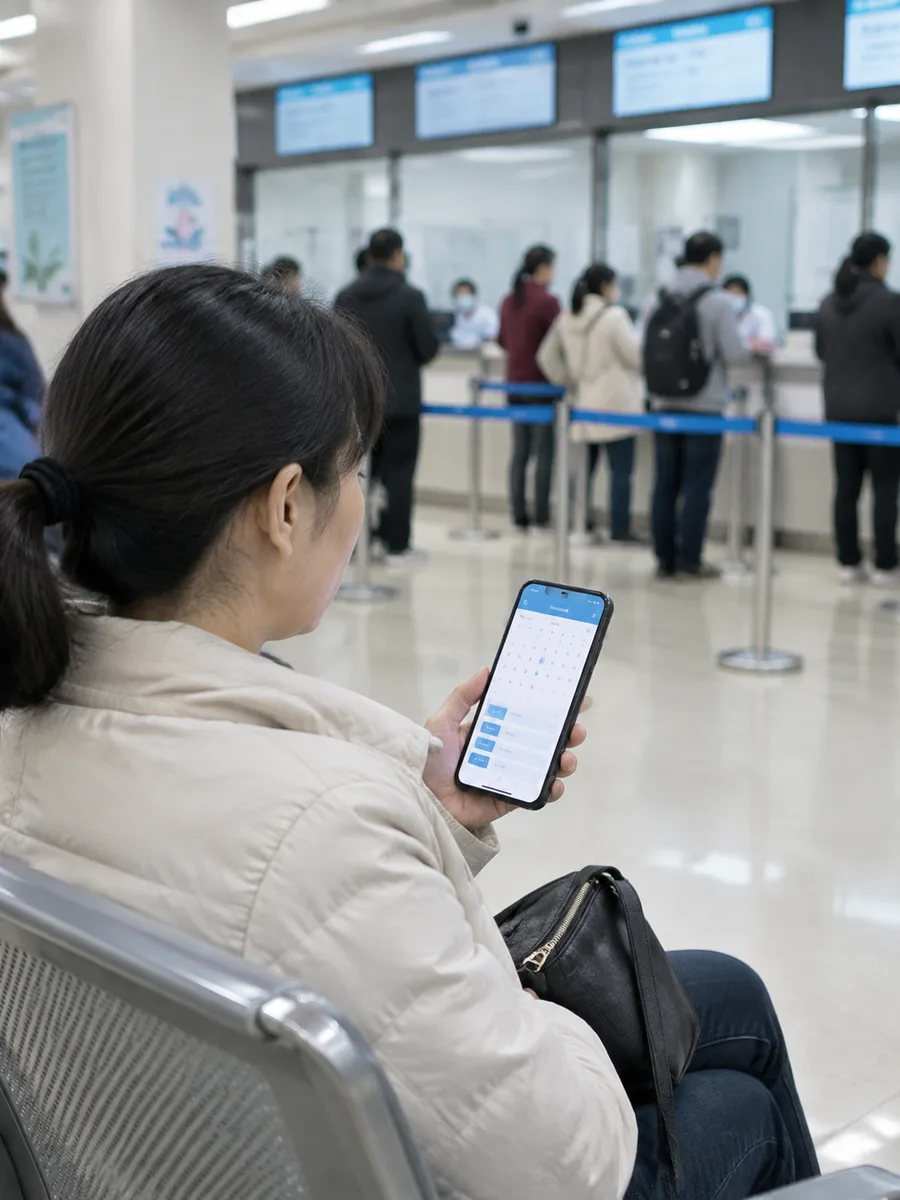
帮女友挂号,怎么最后被判刑?
Hospital Booking Bots Lead to Convictions
About this story
HSK 5 Chinese listening. Booking software helped a girlfriend see a doctor, then paid bookings and an overloaded hospital system led to convictions.
This is an HSK 5-6 Chinese listening episode that runs about 3 minutes. The full Mandarin script is shown with tap-for-pinyin and a line-by-line English translation, so you can listen and read at once — comprehensible input in the sense of Stephen Krashen's i+1 theory. It teaches 12 key vocabulary words such as 程序、软件、系统 and walks through 4 grammar patterns, each explained in English with examples. The same news story is retold at 4 difficulty levels — use the level selector above to find the version that is challenging but still understandable for you.
Read at your level
原文Read the complete story in Chinese. Reveal pinyin and English only when you need them.
English transcript reference
A programmer wrote a small appointment-snatching program for his girlfriend, and in the end both of them were sentenced.
In the report, the pseudonyms Zhou Ming and Wang Lin are used to refer to them.
Wang Lin was in poor health and often had to go to the hospital to see a doctor.
But expert appointments at big hospitals are very hard to get; as soon as a popular slot is released, it is gone.
Zhou Ming wrote programs, so he thought, could he write a small program to help his girlfriend grab an appointment?
What this small program does is very simple: it imitates a person using a hand to click a mouse, clicking that registration button.
A person's hand can click at most six or seven times per second, but this small program can click more than a thousand times per second.
Zhou Ming himself felt that this program was too simple and had no technical content.
Relying on this program, Wang Lin no longer had to worry about her own expert appointments.
Because she was always going to see a doctor, acquaintances asked her, how did you manage to get your appointment?
At first, Wang Lin meant well; after discussing it with Zhou Ming, she helped a few acquaintances grab appointments for free.
Later, more and more people came looking for her, and the two of them could not handle it.
So they began charging fees to help people grab appointments.
Wang Lin posted ads on a social media app, found clients, and talked with clients.
Zhou Ming operated the software in front of the computer, grabbed appointments, and then resold them at a higher price.
One thing needs to be made clear here.
The people using this kind of appointment-grabbing software were not only them.
There were also three other people who used similar software to grab appointments; these three were handled separately.
These people each used appointment-grabbing software, and a hospital registration system in Wuhan was paralyzed as a result.
What does paralyzed mean?
It means the system could not move; not a single person making a normal appointment could get one.
The hospital noticed something was wrong and called the police.
The police found Zhou Ming and Wang Lin, and seized six mobile phones, two computers, and an account book from them.
In the final calculation, Zhou Ming actually earned 12,900 yuan from grabbing appointments.
The profit was 12,900 yuan, yet the registration system could not be used normally because of it.
After trial, the court held that Zhou Ming and Wang Lin's actions constituted the crime of destroying a computer information system.
This is the court's determination in this case.
In the end, Zhou Ming was sentenced to twelve months in prison.
Wang Lin was an accomplice and was sentenced to ten months in prison, with a one-year suspended sentence.
Accomplice means that in this matter, she was not the main person.
Wang Lin received a suspended sentence and temporarily did not have to go to prison.
One had to go to prison, and one had to follow the rules outside; this is the result of this matter.
At first, this program helped the girlfriend solve the problem of difficulty getting an appointment.
Later, helping acquaintances for free turned into paid proxy grabbing, and other similar software also kept accessing the hospital's system.
When the system could not work normally, ordinary patients also could not book appointments.
From a personal request for help to paid proxy grabbing, and then to system paralysis, the matter step by step reached the court.
The report said that hospital appointments were already in short supply, and software constantly clicking to grab appointments would occupy system resources and affect other patients' normal booking.
This was not an appointment difficulty that two people working together could solve; the impact of the software had already reached other people seeing doctors.
What the court needed to judge was whether their actions damaged the system, and also to consider how much role each person played in this matter.
Think about it: if someone takes money and guarantees to get you an expert appointment, what would you ask him first?
Listen again
Try it without the transcript and notice what sounds clearer.
What vocabulary does this episode teach?
词汇HSK 5. A computer program or an official procedure. In the script: 写程序 (write programs), 小程序 (small program/app).
HSK 5. Computer software. In the script: 抢号软件 (appointment-grabbing software), 操作软件 (operate software).
HSK 5. A system, often computer or organizational. In the script: 挂号系统 (registration system), 计算机信息系统 (computer information system).
HSK 3. Hospital. In the script: 大医院 (big hospital), 去医院看病 (go to the hospital to see a doctor).
HSK 4. Normal, regular, or functioning properly. In the script: 正常预约 (normal booking), 不能正常使用 (cannot be used normally).
HSK 4. To affect or influence; also a noun. In the script: 影响其他患者正常预约 (affect other patients' normal booking).
Story word. 抢 (grab) + 号 (appointment number). Refers to quickly securing a hospital appointment slot, often using software.
Story word. To register for a hospital appointment. In the script: 挂号系统 (registration system), 挂号按钮 (registration button).
Story word. 专家 (expert) + 号 (appointment number). A hospital appointment with a specialist doctor, often hard to get.
Story word. Literally paralysis; used for a system being down or unable to function. In the script: 系统陷入瘫痪 (the system was paralyzed).
Story word. Legal term for a person who is not the principal offender. In the script: 王琳是从犯 (Wang Lin was an accomplice).
Story word. A sentence that is suspended, so the person does not serve prison time if they follow rules. In the script: 缓刑一年 (one-year suspended sentence).
* beyond level超纲词
What grammar patterns appear in this episode?
语法被 + Verb + 了
Passive construction indicating that the subject receives the action. Often used in legal or news contexts to state consequences.
一个程序员给女朋友写了一个抢号的小程序,最后两个人都被判了刑。
最后,周铭被判了有期徒刑十二个月。
王琳是从犯,被判了有期徒刑十个月,缓刑一年。
Emphasizes a fact or explanation, often focusing on the reason, manner, or identity. Here it highlights the nature of the program or the person's role.
周铭是写程序的,他就想,能不能写个小程序,帮女朋友抢号。
从犯的意思就是,这件事里,她不是主要的那个人。
Expresses a gradual increase: 'more and more'. Used to show a growing trend over time.
后来找她的人越来越多,两个人忙不过来了。
从……到……,再到……
Describes a progression or range from one stage to another, and then to a further stage. Useful for narrating a sequence of developments.
从个人求助到收费代抢,再到系统瘫痪,事情一步步走到了法院。
Proper nouns
专有名词Sources
来源Free account
Keep learning from this story
Create a free account to keep saved words and your preferred level together.
- Keep words with their story context
- Remember your preferred level
- Build your vocabulary over time