
A Chinese podcast · Same story, 4 levels
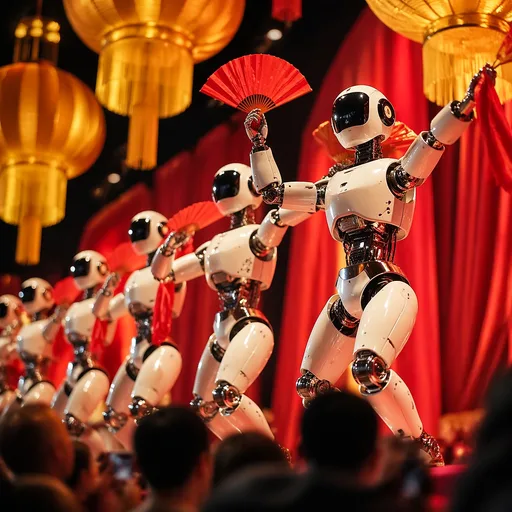
春晚:会跳舞的机器人
Unitree Robots Star in CCTV Spring Festival Gala
About this story
A simple story about watching humanoid robots dance and sing on China's 2026 Spring Festival Gala TV show at home. HSK 1 Chinese listening practice.
This is an HSK 1 Chinese listening episode that runs about 7 minutes. The full Mandarin script is shown with tap-for-pinyin and a line-by-line English translation, so you can listen and read at once — comprehensible input in the sense of Stephen Krashen's i+1 theory. It teaches 15 key vocabulary words such as 电视、休息、跳舞 and walks through 5 grammar patterns, each explained in English with examples. The same news story is retold at 4 difficulty levels — use the level selector above to find the version that is challenging but still understandable for you.
Read at your level
原文Read the complete story in Chinese. Reveal pinyin and English only when you need them.
English transcript reference
Speaking of watching TV, it's everyone's favorite thing to do.
Today is a special day.
Today is Chinese New Year.
Everyone is at home.
Nobody is outside working.
Nobody is outside studying.
Everyone is resting at home.
My dad is at home.
My mom is at home.
I'm also at home.
We're all in the living room.
What's in the living room?
There's a table in the living room.
There are chairs in the living room.
There's fruit on the table.
There are red apples.
There are yellow bananas.
There's also delicious tea.
We're sitting in the chairs.
What are we doing?
We're watching TV.
Today's TV programs are great.
There are many people on TV.
They're singing.
They're dancing.
They're all very happy.
We're all very happy too.
At this moment, something new appeared on TV.
Everyone, take a look.
What is this?
Is this a person?
Look at its head.
It has a head.
Look at its hands.
It has hands.
Look at its feet.
It also has feet.
It looks very much like a person.
But it's not a person.
It's a machine.
It's a robot.
This robot is new.
This robot is very good-looking.
It's white.
It's black.
Its body is very hard.
It's standing there.
It's not moving.
Everyone is watching it.
Dad asked: "What is this?"
Mom said: "This is a robot."
What can robots do?
Let's take a look.
The robot moved.
Its hands moved.
Its feet moved.
It started walking.
It walks very well.
It walks very fast.
It won't fall down.
It can also run.
Look at it.
It runs very fast.
It runs just like a person.
No, it runs faster than a person.
That's amazing.
What else can robots do?
It can do kung fu.
Do you know kung fu?
This is Chinese kung fu.
The robot can do it too.
Look at its hands.
Its hands are very fast.
There's something in its hands.
That's a stick.
It's holding a stick.
It performs beautifully.
Whoosh!
Whoosh!
Its movements are very fast.
It didn't hit anyone.
It performs extremely well.
There's another robot.
It's also very interesting.
It looks like it drank alcohol.
Do you know what it means to have drunk alcohol?
A person who has drunk alcohol doesn't walk straight.
This robot is the same.
It walks this way.
It walks that way.
Its body is moving.
Its head is also moving.
It looks like it's about to fall.
But it didn't fall.
It stands very steadily.
This is very difficult.
It's hard for people to do.
It's also hard for robots to do.
But it did it.
Is there only one robot here?
No.
There are many robots here.
There's one.
There are two.
There are three.
There are over a dozen.
They're all together.
They're all on the stage.
They move together.
This one moved.
That one also moved.
They're all the same.
They do the same movements.
This is very beautiful.
This is very hard to do.
Who made them move?
It's the computer.
The computer controls them.
The computer tells them how to move.
They listen to the computer.
Do robots have brains?
Their brain is the computer.
It's very smart.
It knows many things.
There's a person on TV.
He's talking to the robot.
The person asked: "How are you?"
The robot said: "I'm fine."
The person asked: "What can you do?"
The robot said: "I can dance."
Is this real?
Yes, this is real.
This is new technology.
This is the computer speaking.
The computer is very smart.
It learned many characters.
It learned many words.
It can talk to people.
Dad is watching TV.
Dad is very happy.
Dad said: "Great!"
Dad said: "Really great!"
Mom is watching TV.
Mom is also very happy.
Mom said with a smile: "So beautiful!"
I'm also very happy.
I said: "I want to buy one."
I want to buy a robot.
Can it help me?
Can it help me cook?
Can it help me do laundry?
Today's robots can't do that yet.
But in the future they can.
Future robots will be even better.
They will do many things.
They will go to the store.
They will buy apples.
They will buy water.
We watched for a long time.
The TV is still playing.
We're still watching.
This New Year is wonderful.
Because we have family.
And because we have robots.
Robots make us happy.
Technology makes us happy.
We all love watching TV.
We all love watching robots.
What is this story about?
It's about this year's "Spring Festival Gala."
This is China's biggest TV show.
It happens every New Year.
This year there were many robots.
They performed on TV.
Some robots did kung fu.
Some robots danced.
Some robots acted like they were drunk.
These are all new technologies.
They were made by Chinese companies.
These robots are amazing.
They made everyone very happy.
Listen again
Try it without the transcript and notice what sounds clearer.
What vocabulary does this episode teach?
词汇A common HSK 1 noun. Used in the phrase 看电视 (to watch TV).
HSK 2 verb meaning to take a break or rest.
HSK 2 verb-object compound. 跳 (to jump) + 舞 (dance).
HSK 2 verb-object compound. 唱 (to sing) + 歌 (song).
HSK 1 noun. Literally 'electric brain'.
HSK 1 adjective describing an emotional state.
HSK 1. we; us.
HSK 1. they; them.
Literally 'machine (jīqì) person (rén)'. Key topic word.
Common household word, usually HSK 4, but essential for daily life stories.
Traditional Chinese martial arts. Often used with the verb 打 (dǎ - to hit/practice).
HSK 3 adjective. Used here to praise the robots' abilities.
Verb describing losing balance and falling.
HSK 5 verb. Used here to explain how computers operate the robots.
HSK 4 noun. Refers to the new tech behind the robots.
* beyond level超纲词
What grammar patterns appear in this episode?
语法Expresses existence (there is/there are) in a specific location.
客厅里有桌子。
桌子上面有水果。
电视里有很多人。
Describes the degree or manner of an action. Used to assess how well an action is done.
它走得很好。
它跑得很快。
它打得非常好。
Proper nouns
专有名词Sources
来源Free account
Keep learning from this story
Create a free account to keep saved words and your preferred level together.
- Keep words with their story context
- Remember your preferred level
- Build your vocabulary over time