
A Chinese podcast · Same story, 4 levels
春晚舞台上的科技跃迁:从醉拳机器人到生成式AI的全面渗透
Unitree Robots Star in CCTV Spring Festival Gala
About this story
Unitree, MagicLab, and UBTECH humanoids dance drunken boxing as generative AI floods CCTV's 2026 Spring Gala. HSK 5-6 Chinese listening practice.
This is an HSK 5-6 Chinese listening episode that runs about 10 minutes. The full Mandarin script is shown with tap-for-pinyin and a line-by-line English translation, so you can listen and read at once — comprehensible input in the sense of Stephen Krashen's i+1 theory. It teaches 14 key vocabulary words such as 拥抱、门槛、瑕疵 and walks through 4 grammar patterns, each explained in English with examples. The same news story is retold at 4 difficulty levels — use the level selector above to find the version that is challenging but still understandable for you.
Read at your level
原文Read the complete story in Chinese. Reveal pinyin and English only when you need them.
English transcript reference
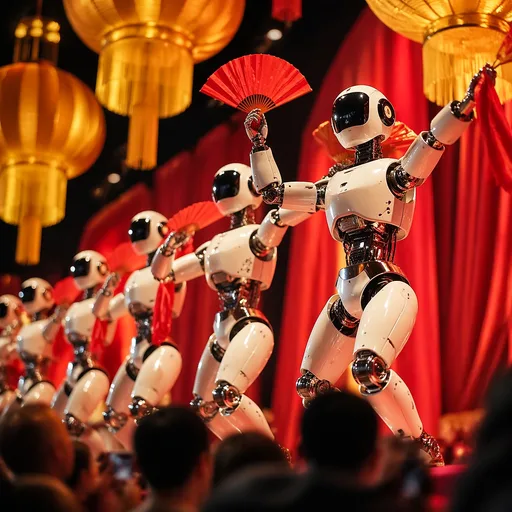
Speaking of this year's Spring Festival Gala's most eye-catching and even somewhat cyberpunk moment, it has to be those humanoid robots performing nunchaku moves and drunken fist kung fu on stage.
This scene was not merely a technology showcase, but rather a symbolic footnote of our era, signaling that China's robotics industry is entering public consciousness in a tremendously impactful way.
Looking back at Monday night's audiovisual feast, products from four Chinese robotics companies practically became the stars of the stage — no longer the peripheral mascots of the past that could only wave and perform simple gestures,
but genuinely participating in the core performances, sharing the stage with human performers,
and even stealing the spotlight in certain segments.
Throughout the entire gala, over a dozen humanoid robots took turns appearing on stage, demonstrating jaw-dropping motion control capabilities — from cartwheels and backflips to changing formations while running,
the precision of every movement revealing the astonishing iteration of the algorithms behind them.
Particularly noteworthy was the performance by Unitree Technology — this wasn't their first Spring Festival Gala appearance; last year they merely made a cameo in a folk dance, but this year they delivered a hardcore martial arts demonstration.
Imagine a group of steel bodies not only skillfully wielding nunchucks but also engaging in simulated combat with human performers, and completing complex formation changes while running at full speed — this kind of highly dynamic,
highly coordinated humanoid robot swarm control technology was reportedly demonstrated publicly for the first time in the world.
The visual impact was tremendous, shattering people's stereotypical impression of robots as stiff and sluggish, and revealing an almost biological fluidity.
Besides Unitree, MagicLab's robots were equally impressive — they completed a move called a "Thomas Flair 360" during the opening performance, a first among humanoid robots of comparable size,
then they joined a song-and-dance number themed around smart manufacturing, as if announcing the aesthetic sensibility of the Industry 4.0 era to the world.
Of course, this phenomenon of "robots fully invading the Spring Festival Gala" was no accident — behind it lies fierce competition among major tech companies vying for this top-tier exposure platform.
Reportedly, to secure a spot on this stage watched by hundreds of millions, several robotics companies invested millions of yuan, and this massive investment was directly reflected in social media buzz,
with the Weibo topic about "robots fully invading the Spring Festival Gala" quickly surging to the number two trending spot.
In another sketch themed around elderly care, Noetix Robotics (formerly Ubtech) brought four different humanoid robots playing the role of emotional support home assistants — they could not only do backflips but also engage in emotional interaction with human actors,
and there was even a bionic robot modeled directly after the famous comedian Cai Ming, its lifelikeness prompting both awe at technological progress and a slight chill of the "uncanny valley" effect.
Beyond the on-stage spectacle, Galbot robots showcased the practical potential of dual-arm wheeled robots in household settings through a pre-recorded short film — from folding clothes and sorting items to frying sausages, these seemingly trivial chores
represent precisely the final hurdle for robots to enter ordinary households.
If humanoid robots were the "muscle and bone" of this gala, then artificial intelligence technology was undoubtedly the "soul" running through it all.
This year's Spring Festival Gala saw its tech quotient rise not just in hardware, but in the deep integration of software and algorithms — especially the application of generative AI, which elevated the entire production to a new level.
According to CCTV's data, mentions of "new quality productive forces" in this year's gala were more than eight times that of last year — this wasn't just a political slogan, but the core logic behind the entire gala's planning.
ByteDance's "Doubao" large language model played a significant role, not only appearing as a virtual character frequently interacting with the hosts, but also voicing a robot character in a sketch and even providing real-time text translation services.
Even more visually striking was ByteDance's video generation model Seedance 2.0, which created dynamic backgrounds for multiple performances — for instance, in a traditional Chinese-style segment, ink-wash horses in the background seemed to leap off the page and gallop around the singer,
and this blending of virtual and real elements greatly expanded the visual boundaries of the stage.
Of course, this large-scale AI application also sparked considerable controversy and discussion — sharp-eyed viewers pointed out visual flaws in the AI-generated backgrounds, such as mismatched flower petals and leaves,
and some netizens even quipped on Weibo that "this year's Spring Festival Gala has a higher AI content than my graduation thesis,"
and behind such humorous complaints lies a complex public attitude toward the use of generative content in formal settings: both marveling at its efficiency and creativity while remaining vigilant about its authenticity and potential deepfake risks.
Nevertheless, CCTV proudly announced that its internally developed large language model was used for the first time to generate visual content and digital avatars — a strong signal that mainstream media is fully embracing AI technology.
From an audience analysis perspective, this "tech show" was clearly a success, especially for younger viewers.
Data shows that young viewership of this year's Spring Festival Gala increased by 10% year-over-year, accounting for over 40% of total viewers — for a program with over forty years of history that was once thought to be losing its youth audience,
this was undoubtedly a successful comeback.
To cater to the tastes of "digital natives," the gala even incorporated the wildly popular micro-drama trope of "domineering CEO falls for the cleaning lady" into its sketches — this keen capture of pop culture,
combined with hardcore technology showcases, successfully shifted the gala's audience demographic toward a younger direction.
Of course, as a globally watched cultural extravaganza, international elements remain an indispensable piece of the puzzle.
While maximizing the tech factor, the gala didn't forget its cultural exchange mission — international superstars like Westlife from Ireland and John Legend from the United States
added touches of nostalgia and international fusion to the show.
Especially when Westlife sang their classic "My Love" or John Legend performed "All of Me," the cross-border power of music created a fascinating tension with the Chinese cutting-edge technology sharing the same stage,
combining both a tribute to past classics and a vision of future technology.
At the Yiwu sub-venue, Lionel Richie and Jackie Chan jointly performed "We Are the World" via pre-recorded video — this timeless charity anthem carried especially profound meaning amid today's complex international landscape.
Additionally, Spanish flamenco, Hungarian traditional dance, and performances by China's Hani and Lisu ethnic groups shared the stage, while Chinese and Austrian acrobats collaborated on a high-tech diabolo performance enhanced by motion-tracking technology,
all showcasing a cultural confidence of "appreciating beauty together."
This attempt to fuse the most traditional folk arts with the most cutting-edge robotics and AI technology is this year's Spring Festival Gala's greatest highlight, and also a reflection of a certain state of mind in contemporary Chinese society:
on one hand, deeply rooted in the soil of traditional culture,
and on the other, eagerly wanting to embrace the infinite possibilities brought by technological transformation.
When we see those robots performing drunken fist on stage with fluid movements, even more precise than some human beginners, we can't help but wonder: is this a triumph of technology, or the beginning of some cultural evolution?
These robots are no longer cold industrial products — they've been given character personalities and even carry cultural symbolism; for example, the robot modeled after Cai Ming isn't just an impersonation act, but a rehearsal for a future society of human-machine coexistence.
Although these robots currently exist more as spectacles on stage, Galbot's housework video hints that the distance from stage to living room, from performance to service, may be much shorter than we imagine.
As large language model technology continues to mature, robots' "brains" are becoming smarter, while advances in motors and control algorithms are making their "cerebellums" more developed — the speed of this mind-body coordinated evolution is astonishing.
Perhaps in the near future, what we see on the Spring Festival Gala won't be robots performing acts, but robots as family members watching the gala with us, even helping us make dumplings and serve tea.
And those controversies about AI-generated content and jokes about "AI content levels" will eventually subside as the technology matures, or transform into new ethical discussions.
After all, when technology becomes sufficiently advanced, it tends to become as transparent as air, integrating into every aspect of our lives — and this year's Spring Festival Gala may well be a high-profile preview of that future.
Listen again
Try it without the transcript and notice what sounds clearer.
What vocabulary does this episode teach?
词汇Literally to hug, but frequently used metaphorically to mean accepting or welcoming a new technology, idea, or change.
Can refer to a physical door sill or a figurative barrier/requirement to enter a field or market.
Refers to a small defect or fault in something that is otherwise good.
To make fun of someone or something in a good-natured or slightly mocking way.
To do or say something specifically to please someone else's tastes or expectations.
Often used in the phrase 万众瞩目 (focus of millions of people).
Used for intense competition, often in sports, politics, or business.
Transliteration of the English term; refers to a sci-fi subgenre featuring advanced tech and dystopian society.
Technical term for AI that can create content (like ChatGPT or Midjourney).
The phenomenon where a robot looking nearly human, but not quite, causes a feeling of revulsion or eeriness.
A specific political/economic term recently popularized in China referring to advanced, innovation-led productivity.
Originally a gaming term, now popular slang for an underdog achieving sudden success against the odds.
Internet slang referring to a recurring joke, cultural reference, or cliché.
A stock character in Chinese romance novels and dramas; a wealthy, powerful, and controlling male lead.
* beyond level超纲词
What grammar patterns appear in this episode?
语法非...莫属 (fēi... mòshǔ)
A double negative pattern meaning 'it must be...' or 'it belongs to none other than...'. It emphasizes that a certain role or description fits only one specific subject.
说到今年春晚最让人眼前一亮...的瞬间,恐怕非那群在舞台上耍着双截棍、打着醉拳的人形机器人莫属了。
不仅仅是...更/而是... (bùjǐnjǐn shì... gèng/érshì...)
Used to express 'not only... but also/rather...'. It negates that something is limited to the first aspect and emphasizes the second, often more important, aspect.
这一幕不仅仅是单纯的科技展示,更像是一个充满象征意味的时代注脚。
它们不再是过去那种只能在边缘挥挥手...的吉祥物,而是真正参与到了核心表演中。
既...又... (jì... yòu...)
Used to list two simultaneous qualities or actions, meaning 'both... and...'.
这种跨越国界的音乐力量...既有对过往经典的致敬,又有对未来科技的展望。
既惊叹于它的效率和创意,又对它的真实性和潜在的深伪风险保持警惕。
随着... (suízhe...)
Meaning 'along with' or 'as'. It introduces a condition or situation that is changing, followed by the result of that change.
随着大模型技术的不断成熟,机器人的“大脑”正在变得越来越聪明。
终将随着技术的完善而逐渐平息。
Proper nouns
专有名词Sources
来源Free account
Keep learning from this story
Create a free account to keep saved words and your preferred level together.
- Keep words with their story context
- Remember your preferred level
- Build your vocabulary over time