
A Chinese podcast · Same story, 4 levels
匈牙利大选:欧尔班的十六年会结束吗?
Orbán Faces Magyar in Hungarian Election
About this story
After 16 years, Viktor Orbán's Fidesz faces Péter Magyar and the Tisza party in a Hungary vote that could end his rule. HSK 3 Chinese listening practice.
This is an HSK 3-4 Chinese listening episode that runs about 8 minutes. The full Mandarin script is shown with tap-for-pinyin and a line-by-line English translation, so you can listen and read at once — comprehensible input in the sense of Stephen Krashen's i+1 theory. It teaches 16 key vocabulary words such as 城市、国家、情况 and walks through 5 grammar patterns, each explained in English with examples. The same news story is retold at 4 difficulty levels — use the level selector above to find the version that is challenging but still understandable for you.
Read at your level
原文Read the complete story in Chinese. Reveal pinyin and English only when you need them.
English transcript reference
Speaking of what all of Europe is watching this weekend, it's Hungary's general election.
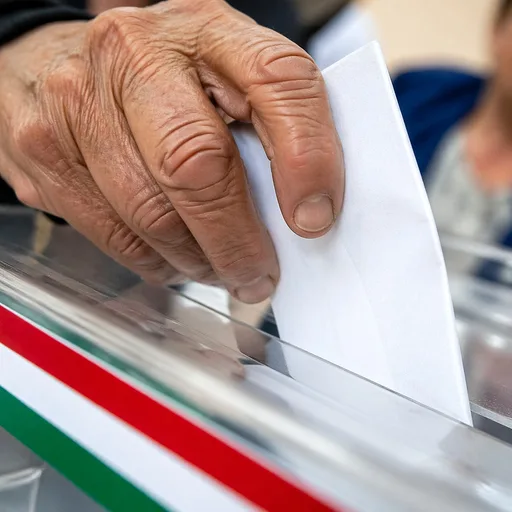
Tomorrow, April 12, Sunday, Hungary will elect a new parliament.
There are 199 seats in parliament.
Whichever party wins the most seats, that party's leader becomes the new prime minister.
This election has one central question.
Can Orbán still win?
To understand how important this question is.
We have to first talk about who Orbán is.
Viktor Orbán is 62 years old this year.
He is Hungary's current prime minister.
He has been prime minister for 16 years.
Uninterrupted from 2010 to now.
Before that he was also prime minister once, from 1998 to 2002.
So counting those four years, he has been prime minister for a total of 20 years.
Currently 30% of Hungary's population was born during Orbán's rule.
They have only known one prime minister since childhood.
When Orbán was young he was actually an anti-communist liberal.
The party he founded is called Fidesz.
At first this party was a center-right, pro-European party.
But starting in 2010.
Orbán's line went through a fundamental change.
He rewrote the national constitution.
He reshaped the judicial system.
He controlled most of the media.
He distributed state resources to his friends.
With these methods, he built a new political model.
He calls this model "illiberal democracy."
What does it mean?
It means there are still elections in name.
But the rules have been changed to the point where the opposition basically can't win.
Foreign observer organizations give this model different names.
Freedom House rates Hungary as "partly free."
The V-Dem Institute directly calls it "electoral autocracy."
This is Hungary's political background today.
So why is there suddenly hope in this election?
The answer is related to one person.
His name is Péter Magyar.
Magyar is 44 years old this year.
His background is interesting.
He used to be an insider in Fidesz.
His ex-wife Varga Judit was once the Minister of Justice.
So he isn't an outside critic.
He grew up watching this system from the inside.
He knows how this system operates.
He knows where all the loopholes are.
In early 2024, Magyar suddenly turned.
Why?
Because of a child protection case scandal.
At that time Hungary's president Novák Katalin pardoned a convicted accomplice.
This accomplice was related to a child sexual abuse case.
This incident caused enormous public outrage in Hungary.
The entire country was shocked.
Novák Katalin was forced to resign.
And Magyar stood up to publicly criticize the government.
He said this wasn't an accident.
It was a systemic corruption problem.
This instantly made him the national focus.
He left Fidesz.
Then joined a new party called Tisza.
Tisza is the name of a river in Hungary.
It's also the abbreviation of the English "Respect and Freedom."
Magyar became the leader of this party.
Over the next two years he did one thing.
Which was to travel the whole country.
Holding rallies city by city.
This direct face-to-face political approach with voters.
Hasn't been seen in Hungary for many years.
Because Orbán's politics has never relied on street rallies.
He relies on media and administrative machinery.
When Magyar went to the streets.
He discovered an overlooked reality.
Many Hungarians are tired of Orbán's rule.
They're unhappy with high prices.
They're unhappy with corruption.
They're unhappy with the government misusing EU funds.
They're unhappy with Orbán getting too close to Putin.
These discontents were suppressed by the media in the past.
But now they erupted at rallies.
Magyar's rallies kept getting bigger.
Sometimes twenty to thirty thousand people come in a single city.
This is an astonishing scale in Hungary.
What are Magyar's core promises?
First is anti-corruption.
He promises to cooperate fully with the EU's anti-corruption agency.
To investigate how the Fidesz government used EU funds.
Second is restoring rule of law.
Making Hungary meet EU standards again.
So the frozen EU funds can be unfrozen.
Hungary currently has over 20 billion euros in EU funds frozen over rule of law issues.
That's a huge amount of money.
Third is reducing dependence on Russian energy.
Orbán has always been close to Putin.
Even after Russia invaded Ukraine.
Hungary is the least active country in the EU regarding aid to Ukraine.
Magyar promises to change this stance.
Fourth is promising to repair relations with the EU.
Making Hungary a normal EU member again.
Not always the problem student.
Magyar's slogan is simple.
He says: "We don't want to live in fear anymore."
"This country belongs to everyone."
"Not just those in power."
What do the polls look like now?
The latest PolitPro aggregate poll shows.
The Tisza party is leading Fidesz by about 9%.
Tisza at 49%, Fidesz at 40%.
But different polls have very different results.
Some pro-government polling agencies give results showing Fidesz still leading.
The real situation is probably somewhere in between.
But there's one thing they agree on.
This is the most serious challenge Orbán has faced in 16 years.
None of the previous opposition ever really threatened him.
Magyar is the first.
Even if Magyar wins on the ballot.
Things won't simply end.
Orbán controls most of the state machinery.
The election commission was appointed by him.
Most of the media are his people.
The courts have been remade by him too.
So even if the voting results are unfavorable.
He has many ways to influence the final outcome.
Some analysts are worried.
If the gap isn't big enough.
Orbán may find excuses to overturn the results.
Or declare the results invalid.
This has happened in some other countries.
So all of Europe is watching nervously.
U.S. Vice President Vance went to Budapest to visit Orbán last month.
This is seen as Trump administration support for Orbán.
EU leaders have publicly expressed concerns about democracy.
Regardless of the outcome.
This election is the most important political event in Hungary in nearly twenty years.
It will decide the country's future direction.
It will also affect the direction of right-wing politics in all of Europe.
Orbán is not just Hungary's prime minister.
He is a symbolic figure for the entire European right wing.
If he falls.
Politicians of similar style in other countries will also be shaken.
If he wins again.
They will gain greater confidence.
So the result of this election.
Is much more important than you think.
Tomorrow is the day the answer is revealed.
All of Europe is waiting.
Listen again
Try it without the transcript and notice what sounds clearer.
What vocabulary does this episode teach?
词汇HSK 1-3. city.
HSK 1-3. country.
HSK 1-3. situation / circumstances.
HSK 1-3. result; outcome.
HSK 1-3. relationship; connection.
HSK 1-3. to express.
HSK 1-3. to research; research.
HSK 1-3. to investigate; investigation.
The legislative body of a country.
A position in parliament.
Opposed to communism.
Politically liberal faction.
Moderate conservative.
The court system.
Orbán's term for his political model.
A system with elections but no real competition.
* beyond level超纲词
What grammar patterns appear in this episode?
语法Proper nouns
专有名词Sources
来源Free account
Keep learning from this story
Create a free account to keep saved words and your preferred level together.
- Keep words with their story context
- Remember your preferred level
- Build your vocabulary over time