
A Chinese podcast · Same story, 4 levels
他们把几千条内裤埋进二十五个国家的土里:这项研究拿了今年的搞笑诺贝尔奖
Buried Underpants Reveal Soil Health in 25 Countries
About this story
A team buried thousands of pairs of cotton underpants across 25 countries for two months, then dug them up to measure soil health — and won a 2026 Ig Nobel Prize, awarded in Zurich for the first time in 35 years. Chinese listening practice at four levels. HSK 5-6 Chinese listening practice.
This is an HSK 5-6 Chinese listening episode that runs about 5 minutes. The full Mandarin script is shown with tap-for-pinyin and a line-by-line English translation, so you can listen and read at once — comprehensible input in the sense of Stephen Krashen's i+1 theory. It teaches 12 key vocabulary words such as 研究、成本、普通 and walks through 3 grammar patterns, each explained in English with examples. The same news story is retold at 4 difficulty levels — use the level selector above to find the version that is challenging but still understandable for you.
Read at your level
原文Read the complete story in Chinese. Reveal pinyin and English only when you need them.
English transcript reference
Let me give you the picture first.
On the evening of September the third, fifteen hundred people sat in a hall in Zurich, each of them holding a paper aeroplane.
Every time a name was read out on stage, the aeroplanes flew across in waves.
The people putting the trophies into the winners' hands were several genuine Nobel laureates.
The prize money is ten trillion — banknotes a certain country voided long ago, which today would not buy a bottle of water.
This is the thirty-sixth Ig Nobel Prize ceremony.
The prize has a single criterion: make people laugh, then make them think.
It awards ten prizes a year; every one sounds absurd, and behind every one is genuine published research.
The one that travelled furthest this year stars a pair of underpants.
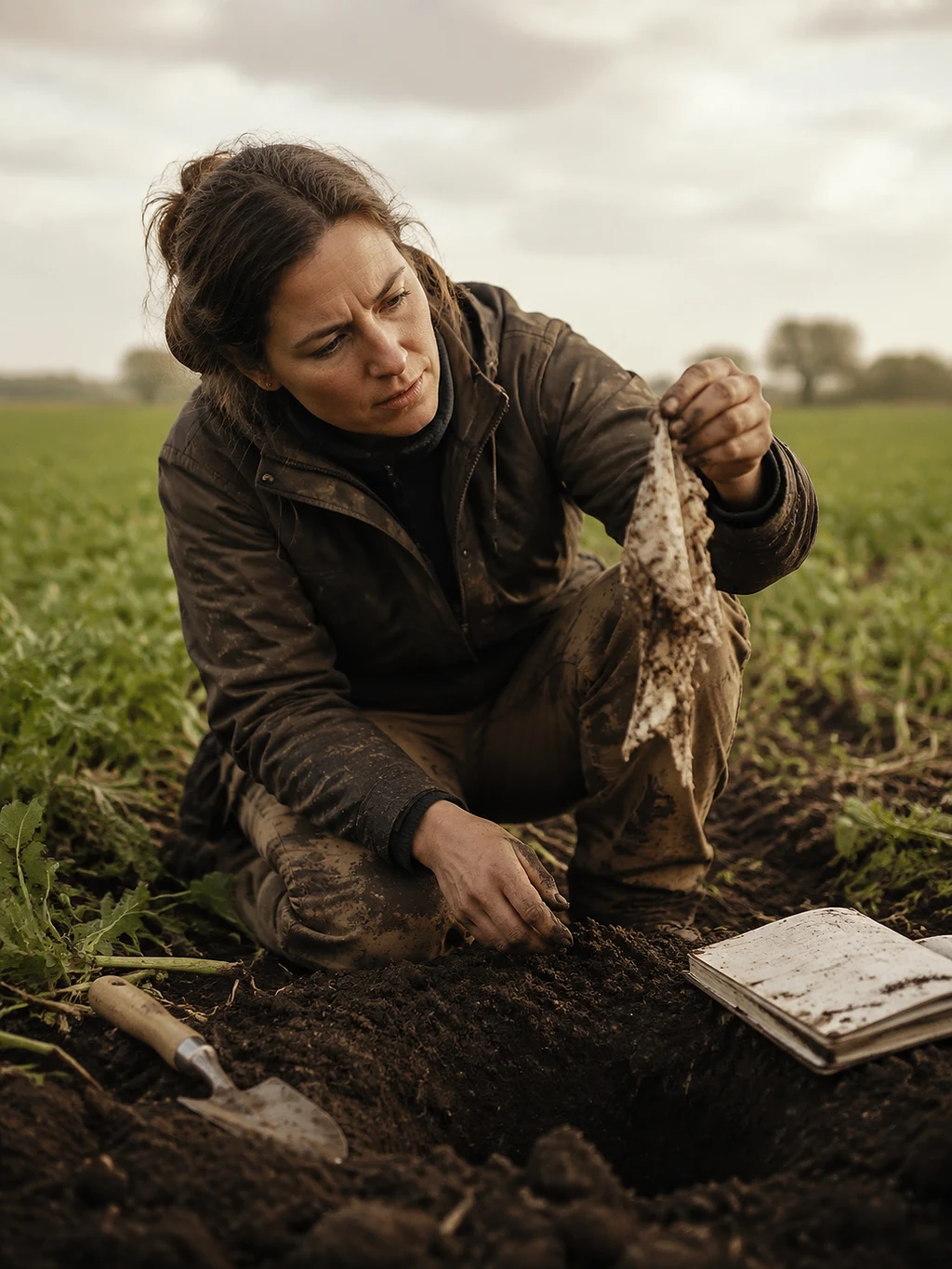
A team from Switzerland, the Netherlands and Germany bought several thousand pairs of pure cotton white underpants and buried them in the ground.
Across twenty-five countries and more than a thousand sampling points, they buried them by a single standardised method.
Two months later they dug them up one by one, washed them and weighed them.
Read that description alone and it really does sound like a prank.
It is in fact a rather beautifully designed measurement.
The principle is direct.
Soil is home to a staggering number of microbes that continuously break down organic matter, and cotton is pure organic matter.
The higher the biological activity of the soil, the faster the cellulose is degraded.
Two months on, if all that comes up is a few threads and an elastic waistband, this soil is thriving.
If the underpants are essentially intact, biological activity in this ground has almost stopped.
The crucial part is cost.
The conventional approach means sampling, sending it to a lab and running a microbial biomass assay — hundreds or thousands per test, far beyond an ordinary smallholder.
A pair of underpants costs a few coins; bury it, dig it up, take a look, and an ordinary person has done it themselves.
It converts a metric that belonged to the laboratory into an operation anyone can carry out.
The least serious-looking design in the room is answering a very serious question: is the ground under my feet still alive?
The rest of this year's prizes run exactly the same way.
One team systematically compared the body odour of infants and adolescents, and the conclusion was almost cruelly plain: parents generally find the smell of babies pleasant, and that of teenagers not.
Another analysed the "milk" secreted by viviparous cockroaches and found its protein carries roughly three times the energy density of cow's milk.
Physicists derived, from fluid dynamics, a urinal curve that almost eliminates splashback.
And one more repeatedly tested whether tapping or stepping is more likely to provoke a snake into striking — the cost of that research can be imagined.
Every one of them makes you laugh out loud first.
And every one of them makes you add a second sentence: this does seem genuinely useful.
It is worth pausing here to answer a common objection.
Does making jokes of science weaken public trust in it?
For more than thirty years the organisers' answer has been consistent: what gets laughed at is our prejudice about what deserves to be studied.
A cotton pair of underpants in the soil and an instrument costing hundreds of thousands are measuring the same variable.
That saying the first out loud makes people laugh is precisely the evidence that we assume serious questions may only arrive in serious shapes.
The actual daily reality of research has always been full of operations that look entirely undignified.
One more change this year deserves recording.
For thirty-five years the prize was held in the United States, inseparable from its association with Harvard.
This year it moved to Europe for the first time, landing in Zurich, co-hosted by the local university system.
A prize known for a distinctly American strain of mischief has moved into a country known for precision and rigour.
That combination is itself rather in the spirit of the thing.
The ceremony also kept one of its traditions: leading scholars are asked to explain their field first in twenty-four seconds, and then clearly, in seven words.
Seven words cannot explain a discipline, and that is exactly the point — it forces you to admit you do not understand it as well as you thought.
Two questions to leave you with.
The first is concrete: when did you last hear something, laugh out loud, and a moment later find yourself thinking it actually made sense?
The second is bigger: if a question can only be asked in a form that looks ridiculous, should we laugh first, or listen first?
There is no standard answer to these two questions, but they are worth thinking through slowly.
Listen again
Try it without the transcript and notice what sounds clearer.
What vocabulary does this episode teach?
词汇HSK 3. 每一项背后都是真实发表过的研究 — the load-bearing claim.
HSK 4. 关键在于成本 — the hinge of the argument for the method.
HSK 3. 普通农户根本用不起 — who the expensive method excludes.
HSK 3. 按统一方法埋了下去 — what makes it science rather than a stunt.
HSK 3. The property being measured, and the reason any of it matters.
HSK 3. 结论朴素得近乎残忍 — the smell study's finding.
The technical register: 土壤生物活性越高,纤维素被降解得越快。
What cotton actually is, and therefore what the microbes are eating.
The precise verb for what happens to the underpants underground.
The essay's central point: 把一项原本属于实验室的指标,变成了任何人都能执行的操作。
The organisers' answer to the criticism: what gets laughed at is our 成见 about what deserves study.
The joke in the venue change: an American-humour prize moving to a country famous for 严谨.
* beyond level超纲词
What grammar patterns appear in this episode?
语法恰恰说明……
Says a fact proves the opposite of what you assumed — "that is precisely the evidence that…". A sharp move in argument.
把前者讲出来会引人发笑,恰恰说明我们默认了严肃的问题只能用严肃的形状出现。
把 A 变成 B
Converts one thing into another. Here it states the achievement in a single sentence.
它把一项原本属于实验室的指标,变成了任何人都能执行的操作。
……,这正是重点
Flags that what looks like a flaw is in fact the purpose. Used for the seven-word lecture: failing to explain is the lesson.
七个词说不清一门学问,这正是重点——它逼着你承认,你其实并不像自己以为的那样理解它。
Proper nouns
专有名词Sources
来源Free account
Keep learning from this story
Create a free account to keep saved words and your preferred level together.
- Keep words with their story context
- Remember your preferred level
- Build your vocabulary over time