
A Chinese podcast · Same story, 4 levels
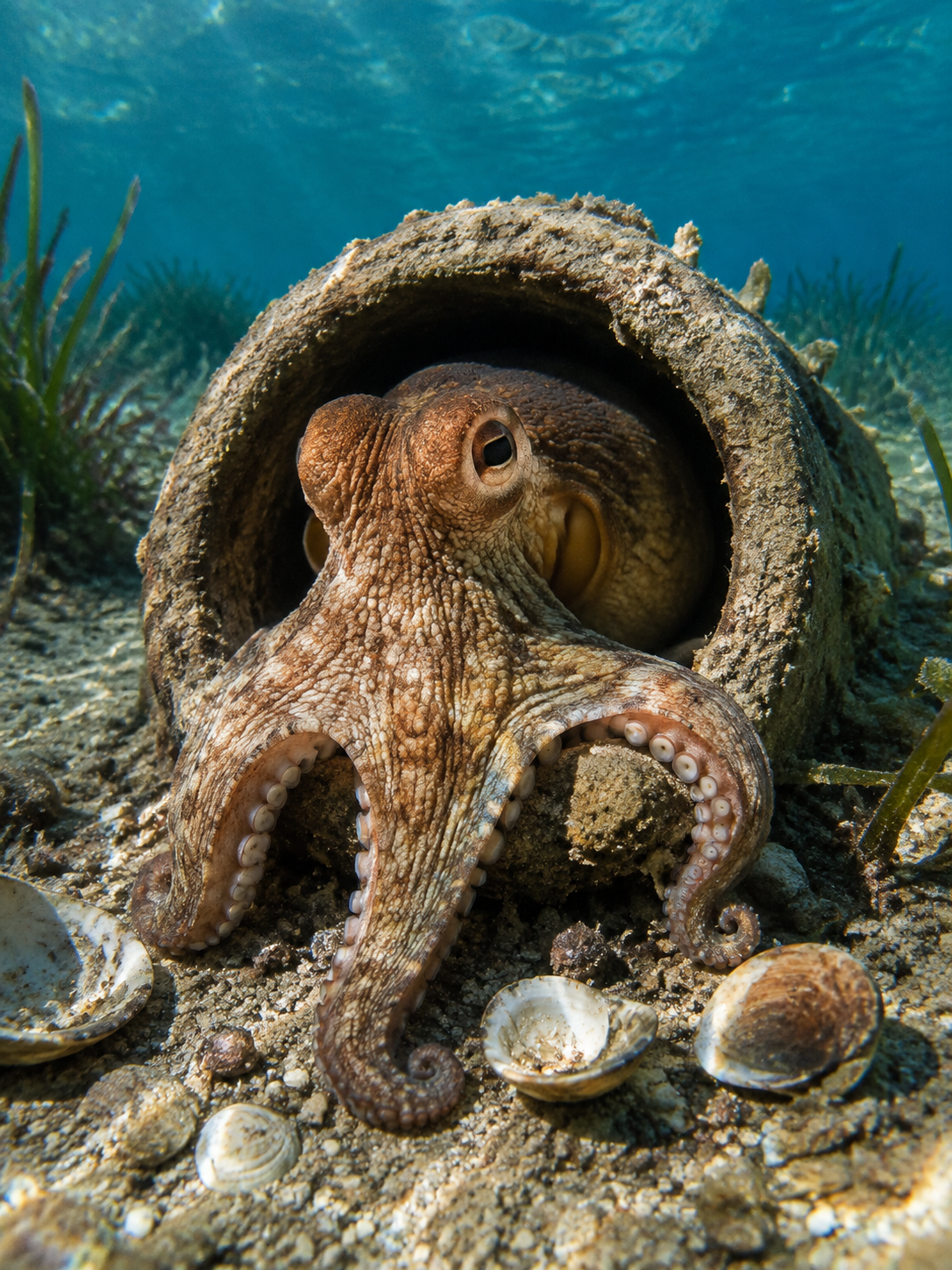
蓝蟹搭压舱水来到意大利,吃光了蛤蜊。他们放了八万只小章鱼下去——但章鱼可能不肯去。
Italy Releases 80,000 Octopuses to Fight Blue Crabs
About this story
Italy Releases 80,000 Octopuses to Fight Blue Crabs. HSK 5-6 Chinese listening practice.
This is an HSK 5-6 Chinese listening episode that runs about 4 minutes. The full Mandarin script is shown with tap-for-pinyin and a line-by-line English translation, so you can listen and read at once — comprehensible input in the sense of Stephen Krashen's i+1 theory. It teaches 9 key vocabulary words such as 海、船、种 and walks through 3 grammar patterns, each explained in English with examples. The same news story is retold at 4 difficulty levels — use the level selector above to find the version that is challenging but still understandable for you.
Read at your level
原文Read the complete story in Chinese. Reveal pinyin and English only when you need them.
English transcript reference
Remember a number first: seventeen million euros.
That is the loss calculated by a region in north-eastern Italy, accumulated from 2022 until now.
That region is one of the most important clam-producing areas in Europe.
This money was not taken by a person. It was eaten by a crab.
It is called the blue crab.
The blue crab does not belong to the Mediterranean; its home is on the Atlantic coast of North America.
So how did it get across?
By ship.
When an ocean-going cargo ship sails empty, its centre of gravity is too high and it becomes unstable, so a great deal of seawater is pumped into the hull to hold it down. That is called ballast water.
At the destination, when cargo is loaded, that water is pumped back out.
Blue crab larvae are extremely small; they were mixed into that seawater, crossed the entire Atlantic with the ship, and were then discharged into an unfamiliar sea.
So this needs saying clearly from the start: it did not swim here. We carried it here.
Once in the Mediterranean, it found the place almost purpose-built for it.
The key is that pair of blue claws.
They are hard and sharp, and naturally suited to prying open shells.
And a clam’s entire defence is that single layer of shell.
A species specialised in opening shells arrives, and nothing local can hold it in check — that is the whole meaning of the word "invasive".
It is not fiercer. It simply has no opponent here.
Now the response, which is the genuinely interesting part of this news.
Last year, that region funded a project called Octo-Blu.
The idea takes one sentence: raise octopuses, then put them in the sea.
In a laboratory in a small seaside town, they hatch octopus larvae in white tanks.
Once the young reach a certain size, they are released near the reefs.
So far, eighty thousand have gone in.
They also did something I find rather moving: they laid a great many artificial dens of cement mixed with clay across the seabed.
Because the octopus is a den-dwelling animal; without a den it will not settle, and will not do well.
If you want to invite an animal to help you, you have to build it a house first.
Why the octopus in particular?
The researchers on the project say it plainly: in the wild, the octopus is among the most fearsome predators of crustaceans.
A crab’s weapons are its shell and claws, and the octopus happens to be exactly the hunter that specialises in shells.
It sounds like a beautiful plan: no chemicals, no nets, letting the ecosystem handle the ecosystem’s own problem.
But the part of this most worth remembering is the flaw the researchers volunteered themselves.
The highest density of blue crabs is in warm, sandy, shallow lagoons.
And the octopus does not tolerate that kind of water well.
Put those two sentences together and the conclusion is a little awkward:
Octopuses really are very good at eating blue crabs, but octopuses may not be willing to go where the blue crabs are.
Which is to say, this plan may fail outright.
And the people saying so are not sceptics. They are the ones paying for it.
I think that is worth writing down more than the plan itself.
A project that states its largest uncertainty before it has any results is not a common thing today.
Finally, take this back to the beginning.
The blue crab has done nothing wrong; at home it is a normal part of a complete ecosystem.
It was our ships that delivered it to a place with no predators, and only then did it become a disaster.
And now we are using ships, tanks and artificial dens again, sending a second animal to patch the first mistake.
This time it may work. It may not.
Think about it:
Something that should not be here has already arrived. Is sending something else to eat it a good idea, or not?
Listen again
Try it without the transcript and notice what sounds clearer.
What vocabulary does this episode teach?
词汇It was discharged into 一片陌生的海 — an unfamiliar sea.
Twice over: the ships that brought the problem, and the ships bringing the answer.
第二种动物 — a second species.
让生态自己去处理生态的问题 — letting the ecosystem handle its own problem.
A place with no predator is the whole definition of the disaster.
The episode defines it: not fiercer, simply without an opponent here.
Pumped in to steady an empty hull, pumped out at the destination — with passengers.
What the blue crab lacks here, and what they are trying to supply.
The flaw in the whole plan lives in this word.
* beyond level超纲词
What grammar patterns appear in this episode?
语法而……没有任何东西能……
And nothing at all can — states an absence that defines a situation.
本地没有任何东西能压制它——这就是"入侵"两个字的全部含义。
未必
Not necessarily — weaker and more precise than 不会.
但章鱼未必肯去蓝蟹最多的地方。
把 A 送到 B
To deliver A to B. The 把 construction foregrounds what was done to A.
是我们的船把它送到了一个没有天敌的地方。
Proper nouns
专有名词Sources
来源Free account
Keep learning from this story
Create a free account to keep saved words and your preferred level together.
- Keep words with their story context
- Remember your preferred level
- Build your vocabulary over time