
A Chinese podcast · Same story, 4 levels
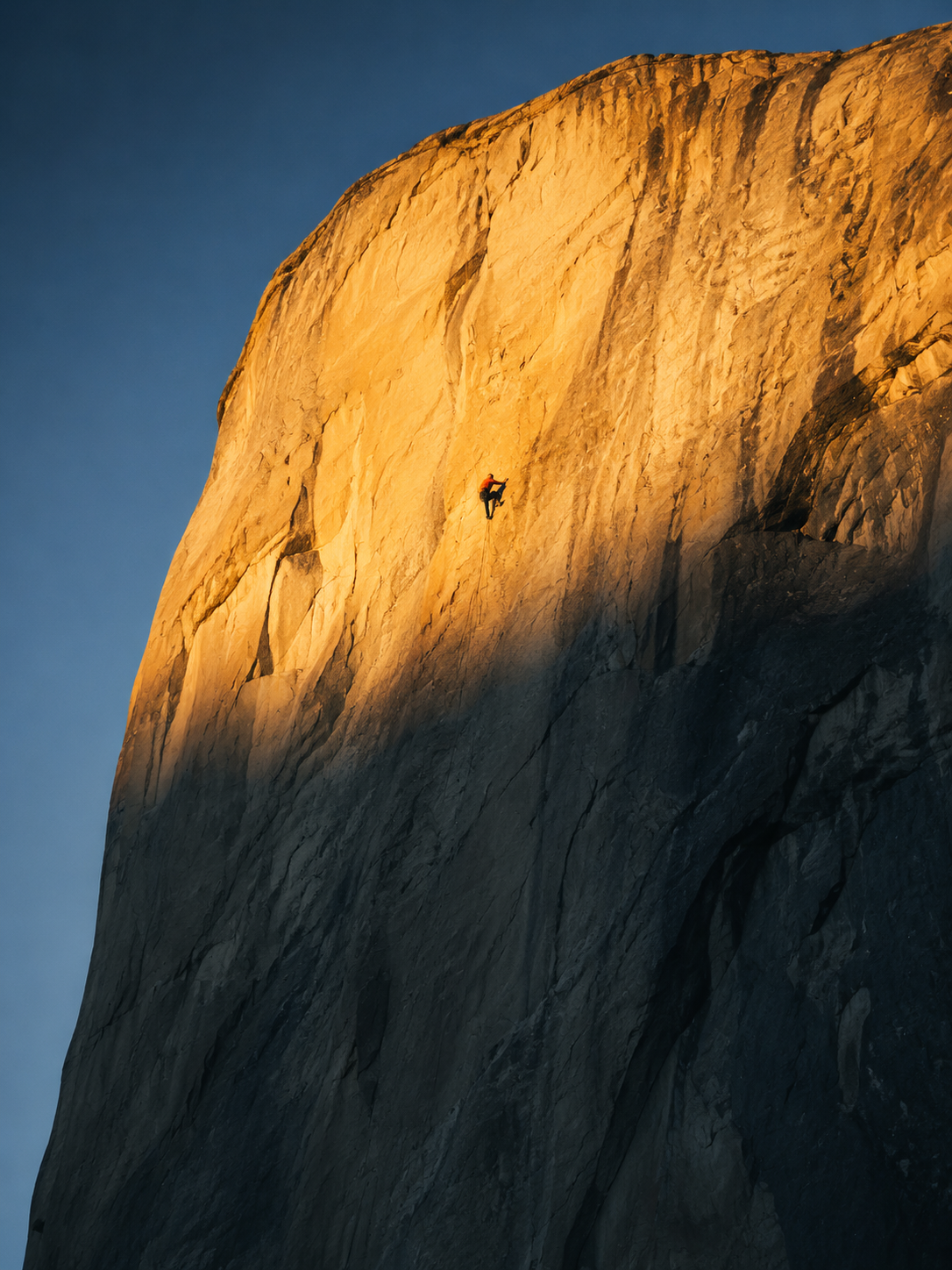
九百米 El Capitan 两小时五十五分速攀纪录保持者坠亡,年仅三十岁
El Capitan Climber Jake Whisenant Dies at 30
About this story
El Capitan Climber Jake Whisenant Dies at 30. HSK 5-6 Chinese listening practice.
This is an HSK 5-6 Chinese listening episode that runs about 2 minutes. The full Mandarin script is shown with tap-for-pinyin and a line-by-line English translation, so you can listen and read at once — comprehensible input in the sense of Stephen Krashen's i+1 theory. It teaches 11 key vocabulary words such as 纪录、断层、悼念 and walks through 3 grammar patterns, each explained in English with examples. The same news story is retold at 4 difficulty levels — use the level selector above to find the version that is challenging but still understandable for you.
Read at your level
原文Read the complete story in Chinese. Reveal pinyin and English only when you need them.
English transcript reference
Two hours, fifty-five minutes, thirty-two seconds.
That is the time taken to climb nine hundred metres of vertical granite.
That wall is El Capitan, in Yosemite, and the man who climbed it was Jake Whisenant, thirty.
On August 3rd he fell to his death while climbing in the Sierra Nevada.
El Capitan stands about nine hundred metres, a single mass of granite, close to vertical.
The overwhelming majority of climbers need two to three days to finish it, sleeping at night hanging off the wall.
But there is a very small circle that competes on speed. That is speed climbing.
In October two years ago, Whisenant and his partner Brant Hysell climbed one of its routes in two hours fifty-five.
The fastest record before that stood at three hours and five minutes.
They took nearly ten minutes off it in one attempt.
In this discipline, records usually advance by tens of seconds.
Ten minutes faster in one go is not progress. It is a break in the line.
This May, he climbed the wall's most famous route twice within a single day.
So in American climbing, his is the kind of name that gets remembered.
Then came August 3rd.
To be clear: it did not happen on El Capitan.
Police record the cause as accidental. The circumstances remain under investigation, and no further detail has been released.
At a moment like this, the easiest thing in the world is for outsiders to fill in a story on the person's behalf.
There is no need to do that.
After the news spread, the climbing community produced a great many tributes.
What came up again and again was how steady he was when he was leading other people.
That is worth pausing on.
Speed climbing, seen from outside, looks like risk-taking.
Inside the circle it is understood as something else: breaking a route into thousands of movements, then repeating each one until it needs no thought.
What the best of them are chasing is precision.
Which is why the death of an elite climber produces, inside the sport, a very specific kind of silence.
Think about it: something both dangerous and beautiful — on what basis does a person decide whether to do it?
Listen again
Try it without the transcript and notice what sounds clearer.
What vocabulary does this episode teach?
词汇最快纪录 = the fastest record. Note 纪录 for records, 记录 for recording.
那是断层 = that is a break in the line, not incremental progress.
追求的,是精确 = what they are chasing is precision. The episode's thesis.
一个很小的圈子 = a very small circle.
死因是意外 = the cause is recorded as accidental.
官方尚未公布细节 = officials have not yet released details. Formal register.
大量悼念 = a great many tributes.
接近垂直 = close to vertical.
一整块花岗岩 = a single mass of granite.
和搭档 = with his partner.
绝大多数攀登者 = the overwhelming majority of climbers.
* beyond level超纲词
What grammar patterns appear in this episode?
语法需要说清楚的是:……
A host pre-empting a wrong assumption before it forms.
需要说清楚的是:出事地点不是 El Capitan。
在……眼里,……
"in the eyes of …" — attributes a view to a group.
速度攀岩,在外人眼里是冒险。
所以……,是……
Delivers the conclusion the whole piece has been building.
所以顶尖攀登者的死亡,在圈内引起的,是很具体的沉默。
Proper Nouns
专有名词Sources
来源Free account
Keep learning from this story
Create a free account to keep saved words and your preferred level together.
- Keep words with their story context
- Remember your preferred level
- Build your vocabulary over time