
A Chinese podcast · Same story, 4 levels
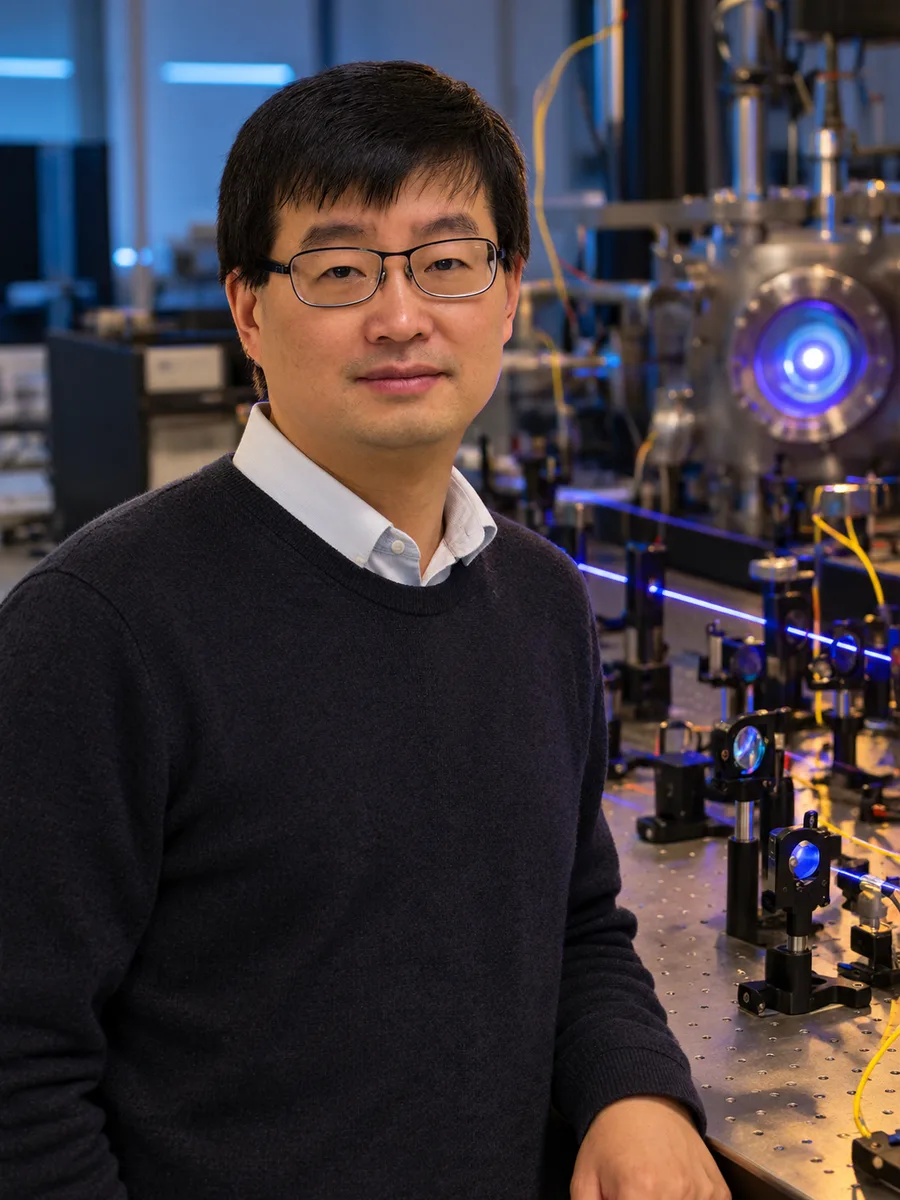
叶军的原子钟一百五十亿年不差一秒,他拿下了被称为诺奖风向标的沃尔夫物理学奖
Jun Ye's Atomic Clock Won't Lose a Second in 15 Billion Years. Now He Has Won the Wolf Prize, Often a Step Before the Nobel.
About this story
How Jun Ye's optical atomic clock works, why it can see gravity across one millimeter, and why the Wolf Prize hints at a Nobel. HSK 3 Chinese listening practice.
This is an HSK 3-4 Chinese listening episode that runs about 4 minutes. The full Mandarin script is shown with tap-for-pinyin and a line-by-line English translation, so you can listen and read at once — comprehensible input in the sense of Stephen Krashen's i+1 theory. It teaches 17 key vocabulary words such as 研究、科学、技术 and walks through 6 grammar patterns, each explained in English with examples. The same news story is retold at 4 difficulty levels — use the level selector above to find the version that is challenging but still understandable for you.
Read at your level
原文Read the complete story in Chinese. Reveal pinyin and English only when you need them.
English transcript reference
If a clock started running at the moment the universe was born and kept going until today, how far off would it be?
The answer: less than a second.
A clock like that really exists.
The man who made it is Jun Ye, a Shanghai-born physicist.
On October 1st, he had just won the 2026 Wolf Prize in Physics.
Let's start with the clock.
Ordinary clocks run on batteries and quartz, and can be off by more than ten seconds a month.
The best older atomic clocks rely on atoms: atoms 'vibrate' at an extremely steady rate, like a metronome that never gets tired.
Count how many times it has vibrated, and you know how much time has passed.
What Jun Ye makes is a newer kind of atomic clock, called an optical atomic clock.
Using lasers, he cools about a hundred thousand strontium atoms to near absolute zero.
Absolute zero is the coldest temperature possible in theory, about minus 273 degrees.
At that cold, the atoms barely move, and their 'ticking' becomes especially clean and precise.
Jun Ye's team has broken records again and again.
America's National Institute of Standards and Technology says their clocks won't gain or lose a second in fifteen billion years.
Fifteen billion years is roughly the age of the universe.
What's the use of such a precise clock?
The most direct use is satellite navigation.
Your phone's map knows where you are because satellites carry atomic clocks.
If the time is off by a billionth of a second, your position could be off by thirty centimeters.
But Jun Ye's clock is precise enough to do something even more amazing: see gravity.
More than a hundred years ago, Einstein put forward the theory of relativity.
One of its ideas is: the stronger gravity is, the slower time runs.
The closer you are to the ground, the stronger the gravity, so the slower time runs; the farther from the ground, the faster.
When you stand, your head is farther from the ground than your feet, so your head ages a tiny bit faster.
How small is this difference?
Over a whole lifetime, it adds up to less than a millionth of a second between head and feet.
In 2022, Jun Ye's team did an experiment.
They stacked atoms in layers, with the top and bottom layers only one millimeter apart.
Sure enough, the clock measured it: the atoms on top 'ticked' slightly faster.
A height of one millimeter, and they measured a difference in time.
It was the first time humans saw what Einstein described over such a tiny distance.
Jun Ye said the most exciting part of the result is that it might link quantum physics and gravity.
Physicists have wanted to connect these two theories for a hundred years.
Back to the prize.
The Wolf Prize has been awarded since 1978, and many call it 'the weathervane of the Nobel Prize.'
A weathervane is something that tells you in advance which way the wind is blowing.
Why call it that?
So far, of the seventy-two Wolf Prize laureates in physics, twenty-six later won a Nobel Prize.
That's about one in three.
Sharing the prize with Jun Ye this year is German physicist Immanuel Bloch, who uses lasers to 'arrange' atoms into grids to simulate complex matter.
Jun Ye is also the second ethnically Chinese scientist to win this physics prize.
The first was Chien-Shiung Wu, winner of the very first prize in 1978.
From Chien-Shiung Wu to Jun Ye, forty-eight years passed.
Jun Ye was born in Shanghai in 1967, graduated from Shanghai Jiao Tong University in 1989, then went to America and earned his PhD at the University of Colorado in 1997.
Over all these years, much of his work has served one goal: making clocks a little more precise, and then a little more.
This year's Nobel Prize in Physics will be announced on October 6th — next Tuesday.
What do you think a clock that won't be off by a second in fifteen billion years should be used for most?
Listen again
Try it without the transcript and notice what sounds clearer.
What vocabulary does this episode teach?
词汇HSK 3. 美国国家标准与技术研究院 = NIST, literally a research institute.
HSK 3. 华人科学家 = ethnically Chinese scientist.
HSK 3. 标准与技术 = standards and technology.
HSK 3. 你手机地图能知道你在哪儿.
HSK 3/4. 结果,钟真的测出来了.
HSK 3. 模拟复杂的物质 = simulate complex matter.
HSK 3. 原子几乎就不动了 = the atoms barely move.
HSK 2/3. 变得特别干净、特别准.
HSK 2. 非常稳定的速度 = an extremely steady rate.
光学原子钟 = optical atomic clock.
用激光把原子降温 = cool atoms with lasers.
About −273 °C.
卫星 = satellite, 导航 = navigation (GPS).
引力越大,时间走得越慢.
Einstein's theory.
能提前告诉你风往哪边吹的东西.
宇宙诞生 = the birth of the universe.
* beyond level超纲词
What grammar patterns appear in this episode?
语法越 A,越 B
The more A, the more B.
引力越大,时间走得越慢。
离地面越近,引力越大,所以时间走得越慢。
靠 + means
To rely on something.
一般的钟,靠电池、靠石英……
最好的老式原子钟,靠的是原子。
把 + object + verb + 到/成 + result
Do something to an object to bring it to a state.
他用激光,把大约十万个锶原子降温到接近绝对零度。
他们把原子排成一层一层。
Adj + 到 + 可以/什么程度
So Adj that…; how Adj.
可是叶军的钟,准到可以做一件更神奇的事。
这个差别小到什么程度?
被 + 很多人 + 叫作 X
Is called X by many people (passive).
沃尔夫奖从一九七八年开始颁发,被很多人叫作诺贝尔奖的风向标。
是为了 + goal
For the purpose of.
都是为了同一个目标:让钟更准一点,再准一点。
Proper nouns
专有名词Free account
Keep learning from this story
Create a free account to keep saved words and your preferred level together.
- Keep words with their story context
- Remember your preferred level
- Build your vocabulary over time