
A Chinese podcast · Same story, 4 levels
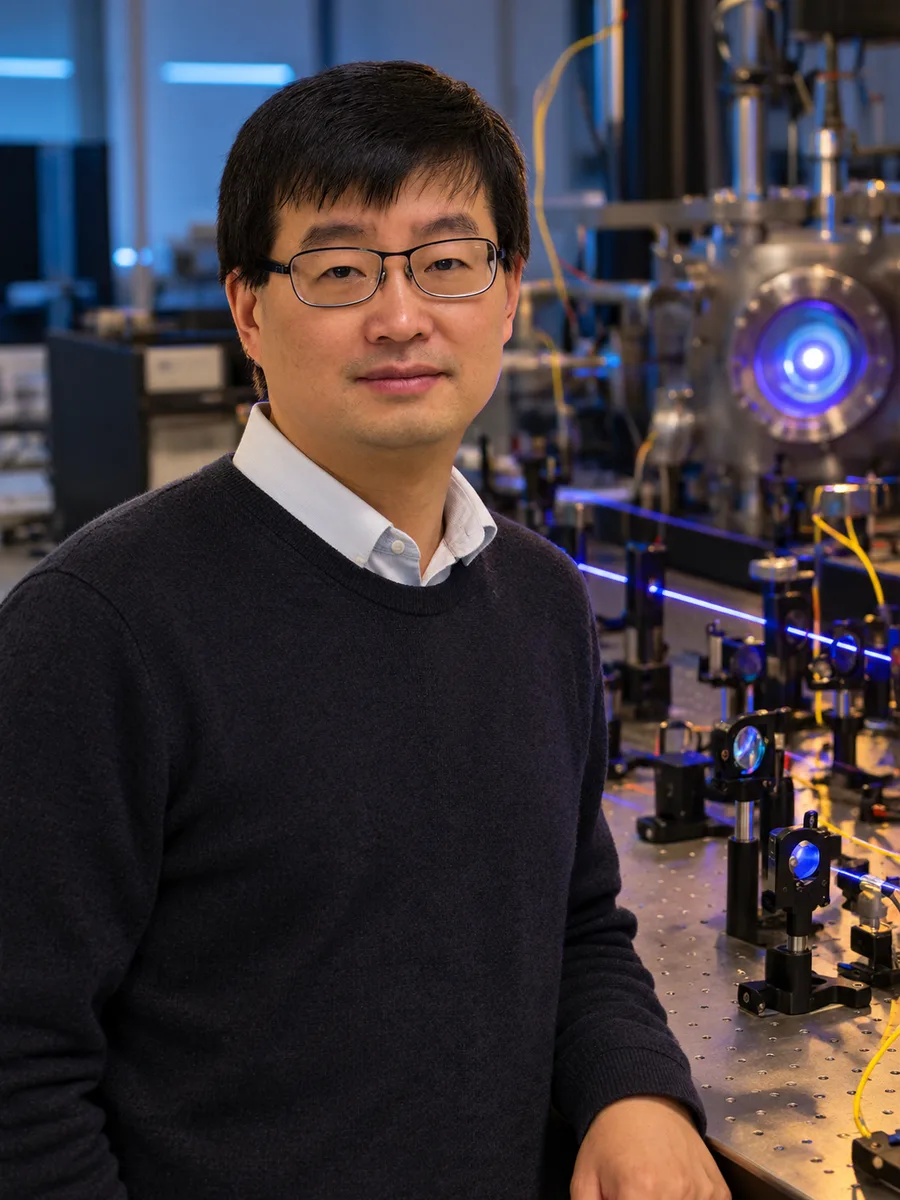
叶军的原子钟一百五十亿年不差一秒,他拿下了被称为诺奖风向标的沃尔夫物理学奖
Jun Ye's Atomic Clock Won't Lose a Second in 15 Billion Years. Now He Has Won the Wolf Prize, Often a Step Before the Nobel.
About this story
Shanghai-born physicist Jun Ye wins the 2026 Wolf Prize for a clock that won't lose a second in 15 billion years. HSK 1 Chinese listening practice.
This is an HSK 1 Chinese listening episode that runs about 5 minutes. The full Mandarin script is shown with tap-for-pinyin and a line-by-line English translation, so you can listen and read at once — comprehensible input in the sense of Stephen Krashen's i+1 theory. It teaches 16 key vocabulary words such as 知道、现在、点 and walks through 6 grammar patterns, each explained in English with examples. The same news story is retold at 4 difficulty levels — use the level selector above to find the version that is challenging but still understandable for you.
Read at your level
原文Read the complete story in Chinese. Reveal pinyin and English only when you need them.
English transcript reference
Do you have a clock at home?
You look at the clock, and you know what time it is.
Is your clock any good?
Lots of clocks are off by more than ten seconds a month.
A second is very, very short.
A minute has sixty seconds.
What does it mean to be off by one second?
It's eight o'clock, but your clock says: eight o'clock and one second.
Your clock is off by one second.
Today, let's talk about a very, very good clock.
This clock won't be off by even one second in fifteen billion years.
How long is fifteen billion years?
Look: a hundred years is already long.
Fifteen billion years is much, much, much longer than a hundred years.
Who made this clock?
The man who made this clock is called Jun Ye.
Jun Ye is Chinese; he's from Shanghai.
Jun Ye was born in Shanghai in 1967.
Shanghai is in China, and it's very, very big.
Jun Ye studied at a university in Shanghai.
Then he went to America.
Now he works in America, and his job is making clocks.
On October 1st, Jun Ye won a very big prize.
What is a prize?
You do your work very well, and lots of people say: you're amazing, this is yours.
That thing is called a prize.
Jun Ye's prize is called the 沃尔夫奖.
沃尔夫奖 is the Wolf Prize.
There are several Wolf Prizes; Jun Ye's is the one for physics.
物理 is physics.
There's another prize that lots of people know, called the 诺贝尔奖.
诺贝尔奖 is the Nobel Prize.
What's the connection between the Wolf Prize and the Nobel Prize?
Listen: up to today, seventy-two people have won the Wolf Prize in physics.
Of those seventy-two people, twenty-six later won a Nobel Prize too.
So lots of people say: if you've won the Wolf Prize, you might win the Nobel too.
Who will win this year's Nobel Prize?
On October 6th, we'll find out.
How many Chinese people won the Wolf Prize before Jun Ye?
The first was in 1978.
That person was called Chien-Shiung Wu.
Chien-Shiung Wu was a woman professor; she was Chinese too, and also worked in America.
Forty-eight years later, Jun Ye is the second.
Why is Jun Ye's clock so good?
It's so good that it can see something very, very tiny.
You're standing here.
Your head is up top, and your feet are down below.
Did you know?
Time doesn't run at the same speed for your head and your feet.
Up top, your head is a tiny bit faster.
Down below, your feet are a tiny bit slower.
This tiny bit is far too small; your clock can't see it.
But Jun Ye's clock can.
Two clocks, one higher and one lower, with only a tiny difference in height.
Jun Ye's clock says: the higher clock is a tiny bit faster.
Your head is a tiny bit faster than your feet.
Interesting, isn't it?
A clock that won't be off by a second in fifteen billion years.
The man who made it is Jun Ye from Shanghai.
On October 6th, let's see whether he wins the Nobel Prize too.
Think about it: how many seconds is the clock in your home off by each month?
Listen again
Try it without the transcript and notice what sounds clearer.
What vocabulary does this episode teach?
词汇HSK 1. 你看钟,就知道现在几点了。
HSK 1. 现在是八点 = it's eight o'clock now.
HSK 1. 几点 = what time; 八点 = eight o'clock.
HSK 1. 一分,有六十秒 = a minute has sixty seconds.
HSK 1. 这个钟,是谁做的? = who made this clock?
HSK 1. 他的工作,是做钟 = his job is making clocks.
HSK 1. 叶军是中国人.
HSK 1. 一百五十亿年 = fifteen billion years.
HSK 1. 一百年,很长了 = a hundred years is already long.
你家里,有钟吗? Measure word: 一个钟 / 一只钟.
一分,有六十秒。
差一秒 = off by one second.
沃尔夫奖 = Wolf Prize; 诺贝尔奖 = Nobel Prize.
你的头在上面 = your head is up top.
你的脚在下面 = your feet are down below.
叶军的这个奖,是物理的.
* beyond level超纲词
What grammar patterns appear in this episode?
语法A 比 B + Adj
Compares two things: A is more Adj than B.
一百五十亿年,比一百年,长很多很多很多。
你的头,比你的脚,快一点点。
一 + measure + 也/都 + 不
Not even one — strong negation.
这个钟,一百五十亿年,也不会差一秒。
Adj + 一点点
Just a tiny bit more Adj.
上面的头,快一点点。
下面的脚,慢一点点。
会 + verb
Will / is likely to happen.
很多钟,一个月会差十几秒。
十月六号,我们会知道。
……,是谁做的?
Asks who made or did something.
这个钟,是谁做的?
会不会 + verb
Whether or not something will happen.
他会不会也有诺贝尔奖。
Proper nouns
专有名词Free account
Keep learning from this story
Create a free account to keep saved words and your preferred level together.
- Keep words with their story context
- Remember your preferred level
- Build your vocabulary over time