
A Chinese podcast · Same story, 4 levels
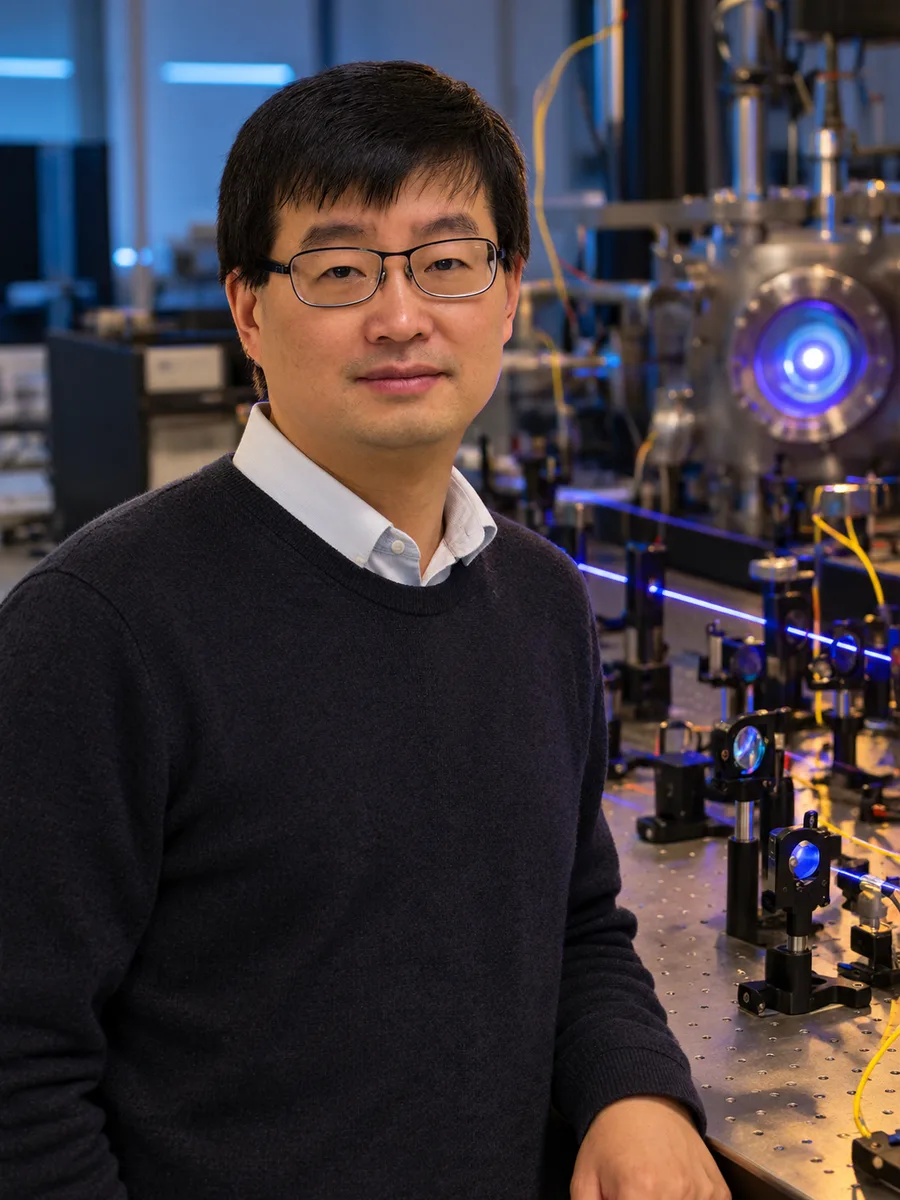
叶军的原子钟一百五十亿年不差一秒,他拿下了被称为诺奖风向标的沃尔夫物理学奖
Jun Ye's Atomic Clock Won't Lose a Second in 15 Billion Years. Now He Has Won the Wolf Prize, Often a Step Before the Nobel.
About this story
Jun Ye's strontium optical lattice clock, frequency combs, millimeter-scale gravity, and his odds at next week's Nobel. HSK 5-6 Chinese listening practice.
This is an HSK 5-6 Chinese listening episode that runs about 5 minutes. The full Mandarin script is shown with tap-for-pinyin and a line-by-line English translation, so you can listen and read at once — comprehensible input in the sense of Stephen Krashen's i+1 theory. It teaches 18 key vocabulary words such as 实验室、稳定、重复 and walks through 7 grammar patterns, each explained in English with examples. The same news story is retold at 4 difficulty levels — use the level selector above to find the version that is challenging but still understandable for you.
Read at your level
原文Read the complete story in Chinese. Reveal pinyin and English only when you need them.
English transcript reference
From the Big Bang to today is about 13.8 billion years.
If a clock had started running at that moment and kept going until today, how far off would it be?
Less than a second.
This clock really exists — it sits in a laboratory in Colorado, in the United States.
The man who made it is Jun Ye, born in Shanghai, now fifty-eight.
On October 1st, he and German physicist Immanuel Bloch won the 2026 Wolf Prize in Physics.
This is worth noticing because the prize has a nickname: the bellwether of the Nobel Prize.
So far, of seventy-two physics laureates, twenty-six later won a Nobel — about a third.
And this year's Nobel Prize in Physics will be announced next Tuesday, October 6th.
So what makes this clock so precise?
First, what a clock fundamentally is.
Any clock, in the end, counts something that repeats steadily: a pendulum clock counts swings; a quartz watch counts the vibrations of a quartz crystal.
The faster it counts and the steadier the repetition, the more accurate the clock.
Traditional atomic clocks count the vibrations of caesium atoms in the microwave band — about nine billion times a second.
Since 1967, the international definition of 'one second' has been based on the caesium atom.
What Jun Ye builds is the next generation: the optical atomic clock.
It counts the vibrations of visible light — for strontium atoms, about 429 trillion times a second.
With a frequency tens of thousands of times higher, each second can be sliced more finely, so the error naturally shrinks.
But the problem is: light vibrates so fast — what do you count it with?
The answer is the optical frequency comb, a key technology Jun Ye helped advance early in his career.
You can picture it as a ruler made of laser light, with extremely fine markings, that converts light's ultra-high frequency into one electronics can read.
With the ruler in hand, you still need to make the atoms sit still.
Jun Ye's team uses lasers to cool around a hundred thousand strontium atoms to near absolute zero — roughly minus 273 degrees.
Then a 'optical lattice' formed by crossing laser beams holds the atoms in place one by one, like eggs in an egg carton.
With the atoms not jostling around, their 'ticking' is especially clean.
In the words of America's National Institute of Standards and Technology, these clocks would neither gain nor lose a second in fifteen billion years.
At this level of precision, a clock is no longer just for telling time.
It starts to become an instrument for measuring the world.
The classic example is Einstein's general relativity.
One conclusion of relativity is: the stronger gravity is, the slower time runs.
On the first floor, time passes a little slower than on the tenth; your feet age a little slower than your head.
Physicists call this gravitational time dilation; it used to take a height difference of tens of centimeters or more to measure it.
In 2022, Jun Ye's team published an experiment in Nature: within a single cloud of atoms, they compared two layers just one millimeter apart.
They measured it: the upper layer 'ticked' a little faster.
One millimeter — the first time humans directly saw gravity slowing time at such a tiny scale.
Jun Ye said at the time that the most exciting part was that it might become a bridge linking quantum physics and gravity.
Remember, quantum mechanics and general relativity are the two biggest pillars of modern physics, yet they've never fit together, and physicists have been struggling with that for nearly a hundred years.
A clock that can sense gravity at the millimeter scale is an experimental tool that can touch both pillars at once.
On the practical side, such clocks might one day measure changes in density underground — magma under volcanoes, groundwater flows — or be used to hunt for dark matter, or to redefine 'one second.'
International metrology bodies are already discussing replacing the caesium atom with optical atomic clocks to redefine the second.
Back to Jun Ye himself.
He was born in Shanghai in 1967, graduated in applied physics from Shanghai Jiao Tong University in 1989, later went to America, and earned his PhD at the University of Colorado in 1997.
He has stayed at JILA ever since — the joint institute of the University of Colorado and NIST.
In 2011 he was elected to the US National Academy of Sciences; in 2022 he shared the three-million-dollar Breakthrough Prize with Japanese scientist Hidetoshi Katori.
This Wolf Prize makes him the second ethnically Chinese winner of the physics prize.
The first was Chien-Shiung Wu, who won the very first prize in 1978 — a full forty-eight years earlier.
So next Tuesday morning, when Sweden announces the Nobel Prize in Physics, quite a few people will be watching for one name.
Of course, a bellwether is only a bellwether: only one in three ended up winning the Nobel.
But whatever happens, he has already built a clock more 'patient' than the universe.
One last question for you: if you had a clock at home that wouldn't be off by a second in fifteen billion years, what would you most want to measure with it?
Listen again
Try it without the transcript and notice what sounds clearer.
What vocabulary does this episode teach?
词汇HSK 4/5. 一间实验室.
HSK 5. 稳定重复的东西.
HSK 4. 数得越快、重复得越稳定.
HSK 5. 误差自然就更小.
HSK 5. 测量世界的仪器.
HSK 5. 相对论里有一个结论.
HSK 4. 最让人兴奋的地方.
HSK 5. 未来可能用来……
HSK 4. 国际计量组织已经在讨论.
Counts visible-light vibrations instead of microwaves.
The atom the SI second has been defined by since 1967.
The atom in Jun Ye's optical lattice clocks.
A 'ruler of laser light' for counting optical frequencies.
A grid of crossed laser beams that holds atoms in place.
Time runs slower where gravity is stronger.
One of the two pillars of modern physics.
寻找暗物质 = search for dark matter.
诺贝尔奖的风向标.
* beyond level超纲词
What grammar patterns appear in this episode?
语法凭什么 + Adj/verb?
On what basis? — asks what makes something possible.
那么,这只钟凭什么这么准?
说到底
In the final analysis; fundamentally.
任何钟,说到底都是在数一个稳定重复的东西。
越 A、越 B,就越 C
The more A and B, the more C.
数得越快、重复得越稳定,钟就越准。
既不 A,也不 B
Neither A nor B.
这些钟一百五十亿年既不会快一秒,也不会慢一秒。
不只是……了
No longer merely…
准到这个程度,钟就不只是用来看时间了。
往 + direction + 说
Speaking from a certain angle.
往实用的方向说,这样的钟未来可能用来测量地下的密度变化。
不管 A 怎样,都/已经 B
No matter A, B holds.
但不管结果怎样,他已经做出了一只比宇宙还耐心的钟。
Proper nouns
专有名词Free account
Keep learning from this story
Create a free account to keep saved words and your preferred level together.
- Keep words with their story context
- Remember your preferred level
- Build your vocabulary over time