
A Chinese podcast · Same story, 4 levels
拉萨:先有寺,后有宫
Lhasa: 3,650 Metres, and the Body Decides
About this story
What 3,650 metres does to your plans, why the Jokhang predates the Potala by a thousand years, and what butter tea is actually for. HSK 3 Chinese listening practice.
This is an HSK 3-4 Chinese listening episode that runs about 5 minutes. The full Mandarin script is shown with tap-for-pinyin and a line-by-line English translation, so you can listen and read at once — comprehensible input in the sense of Stephen Krashen's i+1 theory. It teaches 12 key vocabulary words such as 海拔、高原、呼吸 and walks through 3 grammar patterns, each explained in English with examples. The same news story is retold at 4 difficulty levels — use the level selector above to find the version that is challenging but still understandable for you.
Read at your level
原文Read the complete story in Chinese. Reveal pinyin and English only when you need them.
English transcript reference
The first lesson Lhasa gives a traveller has nothing to do with scenery.
The lesson is about the body.
Lhasa sits at about three thousand six hundred and fifty metres, and the oxygen in the air is roughly two-thirds of what you get on the plains.
On the day you arrive, the best plan is to do nothing.
My friend warned me right at the airport: don't walk fast, don't shower, drink plenty of water, go to bed early.
At the time I thought it was a bit much.
Half a day later, my head started aching, and twenty steps of stairs left me stopping to catch my breath.
The plateau doesn't negotiate with you; it directly changes what you can do.
That fact sets the rhythm of the whole city.
In another city you can pack your schedule full.
Here, your schedule is decided by your breathing.
The next morning I was much better.
The sky was a very deep blue, the sunlight was strong, and yet the wind was cold.
My friend said: in Lhasa, under the sun and in the shade are two kinds of weather.
In the light you have to take your jacket off; step into the shade and you immediately put it back on.
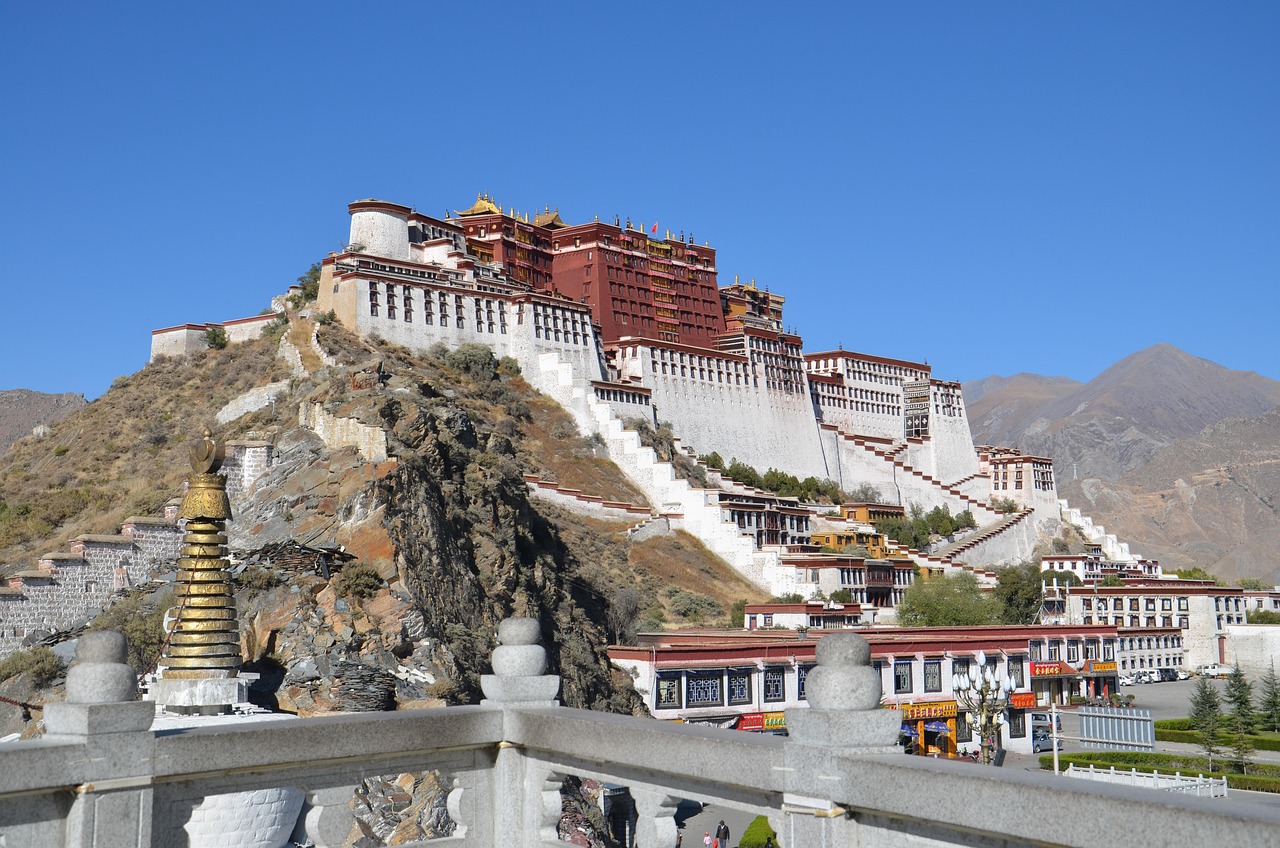
In the morning we went to the Potala Palace.
It is built on Red Hill, one hundred and seventeen metres tall, thirteen floors in all.
You can see it from many parts of the city.
Construction began in 1645, overseen by the Fifth Dalai Lama.
The white sections and the red sections were built in different periods and served different purposes.
In December 1994, the Potala was inscribed on the World Heritage list.
Visitor numbers are limited and the route is fixed.
There aren't that many steps, but at this altitude, every stretch needs a pause.
I stopped three times before I finished.
In the afternoon we went to the Barkhor.
It's a circular street running around the Jokhang Temple, about one kilometre round.
The Jokhang was built in 647, under the Tibetan king Songtsen Gampo — over thirteen hundred years ago.
So the centre of this circuit predates the Potala by nearly a thousand years.
Everyone on the street walks in the same direction, clockwise.
This practice is called kora.
Some carry a prayer wheel, walking and reciting at once.
Others prostrate the whole way: stand straight, palms together, then lay the whole body flat on the ground, rise, and move forward one body length.
Covering a kilometre that way takes a very long time.
My friend said many people do several circuits a day, and by five in the morning there are already people out.
We walked one circuit.
Afterwards I sat down at the roadside and found I was out of breath.
The meaning of this road isn't in its length.
Its meaning is in repetition: the same road, the same direction, every day, for many years.
Someone in a roadside shop handed me a cup of butter tea.
The tea is pale white, salty, with a distinctly oily feel.
It's made by churning strong tea, butter and salt together until they combine.
The first mouthful is unfamiliar; the second is better.
Somewhere high, cold and short of oxygen, fat and salt are what the body actually needs.
A lot of so-called local flavour is really a product of the climate.
Two kinds of people walk the Barkhor at the same time.
Tourists move fast, phones up, stopping to photograph any good-looking doorway.
Local people move slowly and steadily, and most don't look at the shops on either side.
Two groups share one street, doing entirely different things.
This street has become fairly commercial in recent years, with plenty of shops selling things.
But come once at dawn and you see a different picture: before it's even light, people are already walking the kora.
Tourism only occupies part of this street's day.
At dusk we went back to the square below the Potala.
The lights came on, and the white walls turned a warm gold.
I thought again about that first-day headache.
In this city, your body reaches a verdict before your plans do.
You want to go fast; it says no.
A palace of a hundred and seventeen metres, a temple over thirteen hundred years old, a circle of one kilometre, an altitude of three thousand six hundred and fifty metres.
Those numbers added together are why this city slows everyone down.
If a place forces you to slow down from your very first day, would you feel restricted, or relieved?
Listen again
Try it without the transcript and notice what sounds clearer.
What vocabulary does this episode teach?
词汇HSK 2. It reaches a verdict before your plans do.
HSK 4. Not many, and still enough to stop you three times.
HSK 4. Where everyone stands to look at the Potala.
HSK 4. Overruled by the body, daily.
About 3,650 metres, and it reorganizes the city.
It doesn't negotiate with you.
What sets the itinerary, in place of willpower.
The direction of the kora.
Repetition rather than arrival is the point.
One way of covering the kilometre.
What the body actually needs at this altitude.
Much of what we call local flavour is written by it.
* beyond level超纲词
What grammar patterns appear in this episode?
语法由 … 决定
Names what determines the outcome.
在这里,行程由呼吸决定。
不在 …,在 …
Relocates where significance lies.
这条路的意义不在长度。
只要 …,就 …
A sufficient condition and its result.
但只要清晨来一次,就会看到另一种情形:天还没亮,转经的人已经在走了。
Proper nouns
专有名词Free account
Keep learning from this story
Create a free account to keep saved words and your preferred level together.
- Keep words with their story context
- Remember your preferred level
- Build your vocabulary over time