
A Chinese podcast · Same story, 4 levels
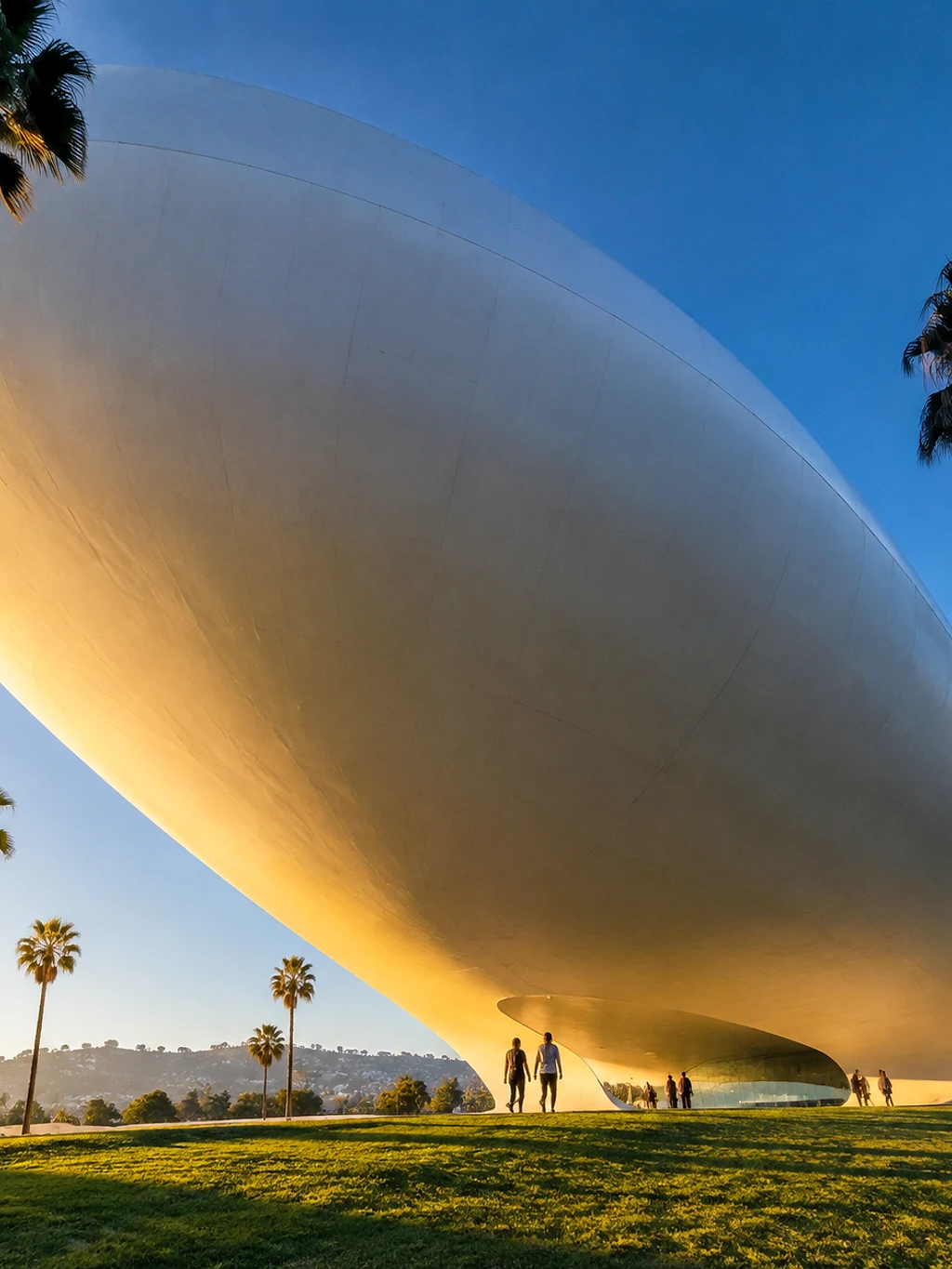
一家博物馆没把他想看的画挂出来,于是乔治·卢卡斯用十五年和十亿美元,自己盖了一座
A Museum Wouldn't Show George Lucas the Painting He Asked For, So He Spent Fifteen Years and a Billion Dollars Building His Own
About this story
George Lucas once asked a museum to see its Norman Rockwell and was told it was not on view — illustration being widely dismissed as commercial rather than fine art. The Lucas Museum of Narrative Art opened in Los Angeles on 22 September 2026: fifteen years in the making, 28,000 square metres, a reported $1bn, with 7% of gallery space given to Star Wars props. Rejected first by San Francisco and then Chicago, it now displays those failed designs in a gallery of their own. Both director and chief curator left in 2025 and Lucas has been curating it himself; there is almost no wall text, which is his insistence. Chinese listening practice at four levels. HSK 5-6 Chinese listening practice.
This is an HSK 5-6 Chinese listening episode that runs about 6 minutes. The full Mandarin script is shown with tap-for-pinyin and a line-by-line English translation, so you can listen and read at once — comprehensible input in the sense of Stephen Krashen's i+1 theory. It teaches 12 key vocabulary words such as 艺术、普通、解释 and walks through 3 grammar patterns, each explained in English with examples. The same news story is retold at 4 difficulty levels — use the level selector above to find the version that is challenging but still understandable for you.
Read at your level
原文Read the complete story in Chinese. Reveal pinyin and English only when you need them.
English transcript reference
This billion-dollar building began with a very specific piece of unpleasantness.
A man walked into a museum and asked a staff member: do you have any Norman Rockwell here?
Rockwell is one of the best known American painters of the twentieth century.
Almost everything he painted was the daily life of ordinary Americans.
The staff member's answer was: we do, but it is not currently on display.
The answer carried no malice and is extremely common in museums.
Behind it sits a judgement that has been around a long time: Rockwell was a commercial illustrator and does not belong to serious art.
Illustration has always occupied an awkward position in the gallery world, where being kept in storage is the norm rather than the exception.
The man who asked was deeply dissatisfied, and on the spot he made a response that only a very small number of people could afford.
He decided to build his own museum.
For the overwhelming majority of people, that is a remark made in irritation and then dropped.
But he is George Lucas, the creator of Star Wars.
From that moment to today, the project has taken fifteen years.
On the twenty-second of September this year, the Lucas Museum of Narrative Art opened in Los Angeles.
A few numbers establish its scale.
The floor area is around twenty-eight thousand square metres, and the cost reported externally is one billion dollars.
For comparison, the new galleries at another Los Angeles art museum cost seven hundred and twenty-four million dollars.
Which is to say, this is one of the most conspicuous private museum projects anywhere this century.
Its exterior leaves no room for neutrality.
It is hard to have no opinion about it.
From outside, the whole building resembles a white spaceship about to leave the solar system.
Once you go in, the feeling changes completely.
It is more like a Hollywood film set carefully dressed to look like a museum.
The galleries have screens playing digital reproductions of famous works held elsewhere.
There is Trajan's Column, there are the ceiling frescoes of the Sistine Chapel, and there are holdings from the Louvre.
There are also two well-appointed screening rooms where visitors can sit down for documentaries and older films.
The entrance hall has been named the portal, it contains no right angles at all, and glass lifts run straight up to the galleries.
And the most compelling part of the whole museum is almost certainly none of the above.
Seven per cent of the gallery space is given over specifically to Star Wars.
What is displayed there are props genuinely used at the time: Luke's landspeeder, Anakin's podracer, costumes, and a robot standing quietly in a corner.
The remaining galleries hold what the gallery world has long overlooked: children's book illustration and comics.
Lucas and his wife Mellody Hobson group all of this under the term narrative art, meaning images capable of telling a story.
That formulation immediately raises a question: which category of image is not telling a story?
The site selection process is itself a piece of history worth recording.
Lucas originally hoped to build the museum in San Francisco, and met local opposition.
He then chose Chicago, and was rejected over the building's appearance and its use of public park land.
Los Angeles was the third choice and the final landing point.
The museum has set aside one gallery specifically to display those two unrealised designs.
This is clearly not merely a display of architectural history.
It is simultaneously addressed to the objectors of the time: what you missed was jobs and visitor spending.
Judging by the result, though, landing in Los Angeles may be entirely fitting.
The cinematic quality, the commercial quality and the deliberate popular appeal sit very comfortably in a city that has both the Hollywood hills and its tills.
The criticism concentrates on one very specific point: there is almost no explanatory text on the walls.
A visitor sees a work but has no way of knowing who made it, why it matters, or why it has been placed next to the one beside it.
The museum does not dodge this.
The head of the museum states that reducing the labels was Lucas's own insistence.
He wants visitors looking at the image itself, rather than at the history lesson beside it.
There is a contradiction here that is difficult to reconcile.
The people who most need the context are precisely those unfamiliar with art history.
And they are exactly the people Lucas says he wants to attract.
Another detail is equally worth recording: the museum's director and chief curator both left last year.
The person now actually deciding what is shown, and how, is Lucas himself.
An art history professor offers a fairly restrained judgement about institutions of this kind.
She does not call it good, and she does not call it bad.
She says a museum like this is both extremely selfish and extremely public, and which side prevails will take time to answer.
And the answer depends in large part on how it is run once the founder is gone.
Pulling it together, the core of this is actually very simple.
Lucas's own words are: illustration is images created for ordinary people; it requires no special knowledge and needs no explaining.
That sentence is the entire reason he put in fifteen years and a billion dollars, and it is precisely the point he is now criticised for.
Critics who look down on it are free to sneer, but a great many ordinary visitors will enjoy themselves inside.
It is just that what they will want is more explanation of how Lucas understands these works, not less.
Now put yourself back into that original scene.
There is a painter you love, and you make a special trip to a museum to see his work.
They tell you: the collection has it, but it is not on display today.
What would you do?
Listen again
Try it without the transcript and notice what sounds clearer.
What vocabulary does this episode teach?
词汇HSK 3. 不算严肃艺术 — the judgement that is the episode's inciting incident.
HSK 3. Runs from 普通美国人的日常生活 at the start to 为普通人创作的图像 at the end.
HSK 3. 不需要被解释 — and the closing line notes that visitors want more explanation, not less.
HSK 3. 不需要专门的知识 — the load-bearing claim of the whole institution.
HSK 3. 既有好莱坞山也有收银台的城市 — the sharpest description of Los Angeles in the piece.
HSK 3. 批评意见集中在一个非常具体的地方 — specific criticism, not atmosphere.
叙事艺术 — the museum's own coinage, and a term the episode immediately interrogates.
馆长与首席策展人均于去年离职 — two departures that tell you who is really deciding.
既有好莱坞山也有收银台 — one noun doing all the work of a paragraph about commerce.
插画在美术馆里的位置一向尴尬 — the precise word for a status that is neither accepted nor rejected.
这个回答本身没有任何恶意 — the episode is careful to say the museum did nothing wrong.
既极其自私,又极其公共 — the unresolved verdict the episode ends its argument on.
* beyond level超纲词
What grammar patterns appear in this episode?
语法……本身没有任何……
The thing in itself carries no X. Used to separate an action from the motive an angry person might read into it.
这个回答本身没有任何恶意,在博物馆里也非常常见。
……的余地
Room for X. 不留下中立的余地 says a thing forces you to take a side, which is a claim about the object rather than the viewer.
它的外观不给人留下中立的余地。
在很大程度上取决于……
Depends to a large degree on… A hedged causal claim, and the correct register for a judgement that cannot yet be made.
而答案在很大程度上要看创办人不在以后,它会被怎么经营。
Proper nouns
专有名词Free account
Keep learning from this story
Create a free account to keep saved words and your preferred level together.
- Keep words with their story context
- Remember your preferred level
- Build your vocabulary over time