
A Chinese podcast · Same story, 4 levels
一家博物馆没把他想看的画挂出来,于是乔治·卢卡斯用十五年和十亿美元,自己盖了一座
A Museum Wouldn't Show George Lucas the Painting He Asked For, So He Spent Fifteen Years and a Billion Dollars Building His Own
About this story
George Lucas once asked a museum to see its Norman Rockwell and was told it was not on view — illustration being widely dismissed as commercial rather than fine art. The Lucas Museum of Narrative Art opened in Los Angeles on 22 September 2026: fifteen years in the making, 28,000 square metres, a reported $1bn, with 7% of gallery space given to Star Wars props. Rejected first by San Francisco and then Chicago, it now displays those failed designs in a gallery of their own. Both director and chief curator left in 2025 and Lucas has been curating it himself; there is almost no wall text, which is his insistence. Chinese listening practice at four levels. HSK 2 Chinese listening practice.
This is an HSK 2 Chinese listening episode that runs about 3 minutes. The full Mandarin script is shown with tap-for-pinyin and a line-by-line English translation, so you can listen and read at once — comprehensible input in the sense of Stephen Krashen's i+1 theory. It teaches 12 key vocabulary words such as 生气、地方、意思 and walks through 3 grammar patterns, each explained in English with examples. The same news story is retold at 4 difficulty levels — use the level selector above to find the version that is challenging but still understandable for you.
Read at your level
原文Read the complete story in Chinese. Reveal pinyin and English only when you need them.
English transcript reference
This story begins with someone being annoyed.
A man went to a museum.
He asked: do you have any Rockwell paintings?
Rockwell was an American painter.
Everything he painted was the life of ordinary people.
The museum said: we do, but it is not on display today.
The man was angry when he heard that.
Because in a lot of people's eyes, Rockwell just drew illustrations and was not a real artist.
So his paintings often sat in storage and were never hung.
The man thought right then: in that case I will open my own museum.
An ordinary person thinks that and lets it go.
But he was not an ordinary person.
His name is Lucas.
He made Star Wars.
He had the money, and he had the time.
From then on, he and his wife spent fifteen years on it.
On the twenty-second of September this year, the museum opened.
It is in Los Angeles, in America.
How big is this museum?
About twenty-eight thousand square metres.
How much did it cost?
One billion dollars.
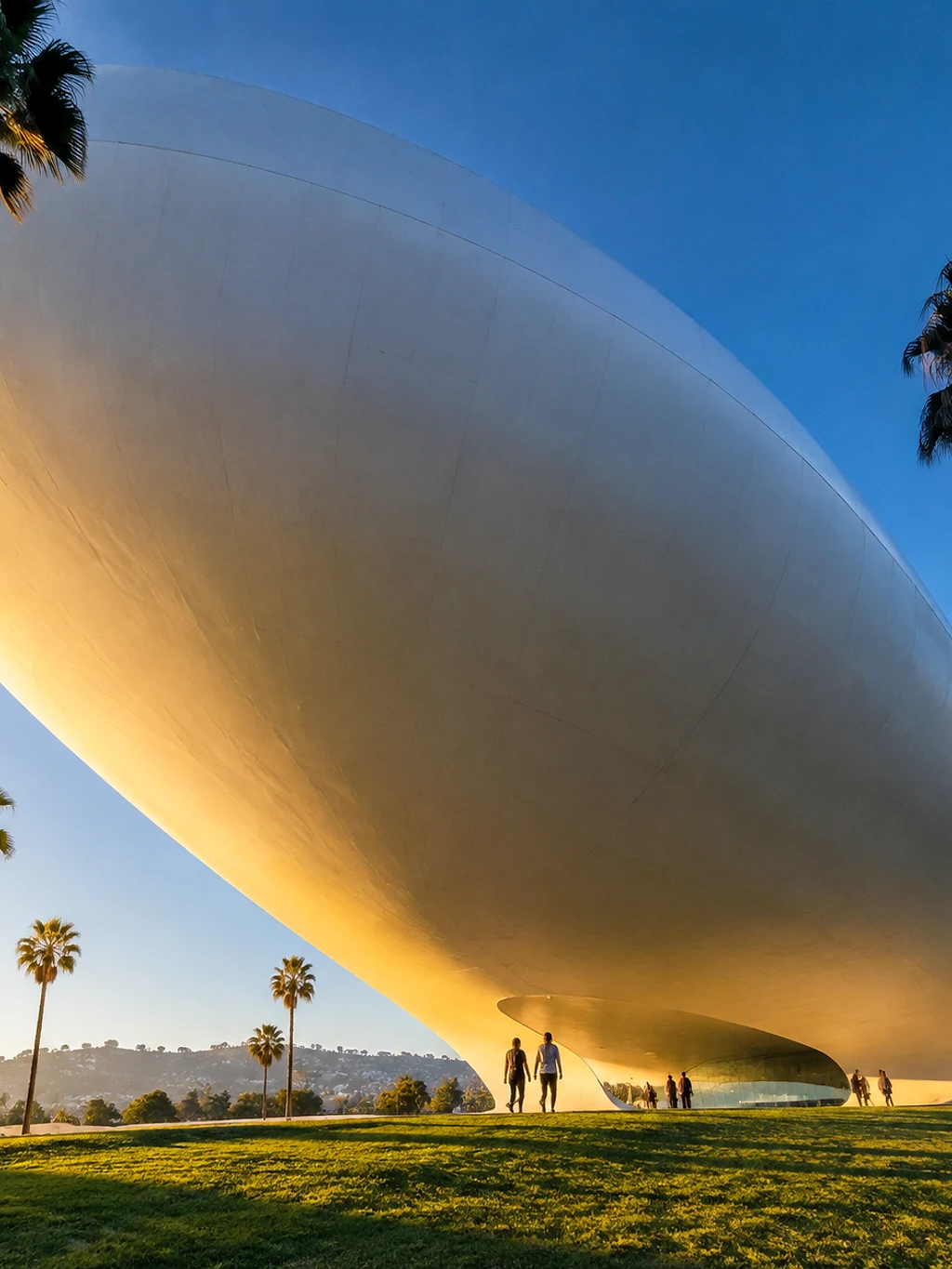
From outside, it looks like a white spaceship.
From inside, it looks like a film set.
Inside there are paintings, illustrations and comics.
Lucas says these are all pictures that tell a story.
What he means is: there has to be a story inside a picture.
The museum also has two cinemas.
You can sit down and watch a film.
But the part most people go to is somewhere else.
Seven per cent of the museum is given over to things from Star Wars.
Real vehicles, real costumes, real robots.
Not newly made ones — the actual ones used to shoot the films.
The road here was not smooth.
He originally wanted to open it in San Francisco, and the people there said no.
Then he wanted Chicago, and the people there said no as well.
So in the end it opened in Los Angeles.
The interesting part is that the museum has a room specially for this.
What is in that room is the two designs that never got built.
There are people who do not like this museum.
The biggest complaint is that there are almost no words on the walls.
You see a painting, but you do not know who painted it.
You also do not know why it matters.
The head of the museum says this is what Lucas himself wanted.
He wants you to look at the painting, not at the words beside it.
There is one more thing people have noticed.
The museum's director and the person who chose the art both left last year.
The person choosing the art now is Lucas himself.
A teacher of art said something very precise.
She said: a museum like this is both very selfish and very public-spirited.
Which side weighs more will take many years to find out.
Now have a think.
There is a painter you love.
You go to a museum wanting to see his work.
They say: we have it, but it is not hung today.
What would you do?
Listen again
Try it without the transcript and notice what sounds clearer.
What vocabulary does this episode teach?
词汇HSK 2. 这个人听了很生气 — the emotion the whole museum is built out of.
HSK 2. Used for the city, for the gallery, and for the 7% given to Star Wars.
HSK 2. 他的意思是:一张画里面要有一个故事 — the definition of narrative art in plain words.
HSK 2. 你也不知道它为什么重要 — precisely what the missing labels fail to tell you.
HSK 3. 那里的人不同意 — said twice, for two cities, and that repetition is the story.
HSK 2. 博物馆里专门有一个房间 — the room for the two designs that never got built.
HSK 3. Appears in the first line and the last; the episode is a loop.
只是画插画的,不是真正的艺术家 — the dismissal that started everything.
The 家 suffix makes a practitioner: 艺术 plus 家, the same pattern as 画家.
会讲故事的画 — the museum's entire organising idea, in five characters.
差不多两万八千平方米 — the unit that makes a building size imaginable.
真的车,真的衣服,真的机器人 — the 真的 repeated three times is what sells it.
* beyond level超纲词
What grammar patterns appear in this episode?
语法一般人……也就算了
An ordinary person would let it go at that. Sets up a baseline expectation specifically so the next line can break it.
一般人这样想一想也就算了。
可是他不一般。
从外面看……,从里面看……
Seen from outside… seen from inside… Two parallel vantage points, which is the most economical way to describe a building.
从外面看,它像一条白色的飞船。
从里面看,它像一个拍电影的地方。
又很……,又很……
Both very X and very Y, where X and Y pull against each other. The episode saves it for the closing judgement.
她说:这种博物馆,又很自私,又很为大家。
Proper Nouns
专有名词Free account
Keep learning from this story
Create a free account to keep saved words and your preferred level together.
- Keep words with their story context
- Remember your preferred level
- Build your vocabulary over time