
A Chinese podcast · Same story, 4 levels
麻省理工做出了一块可以吞下去的电池:它在猪的身体里工作了三天,然后自己化掉了
MIT Built a Battery You Can Swallow. It Powered a Device Inside a Pig for Three Days, Then Dissolved.
About this story
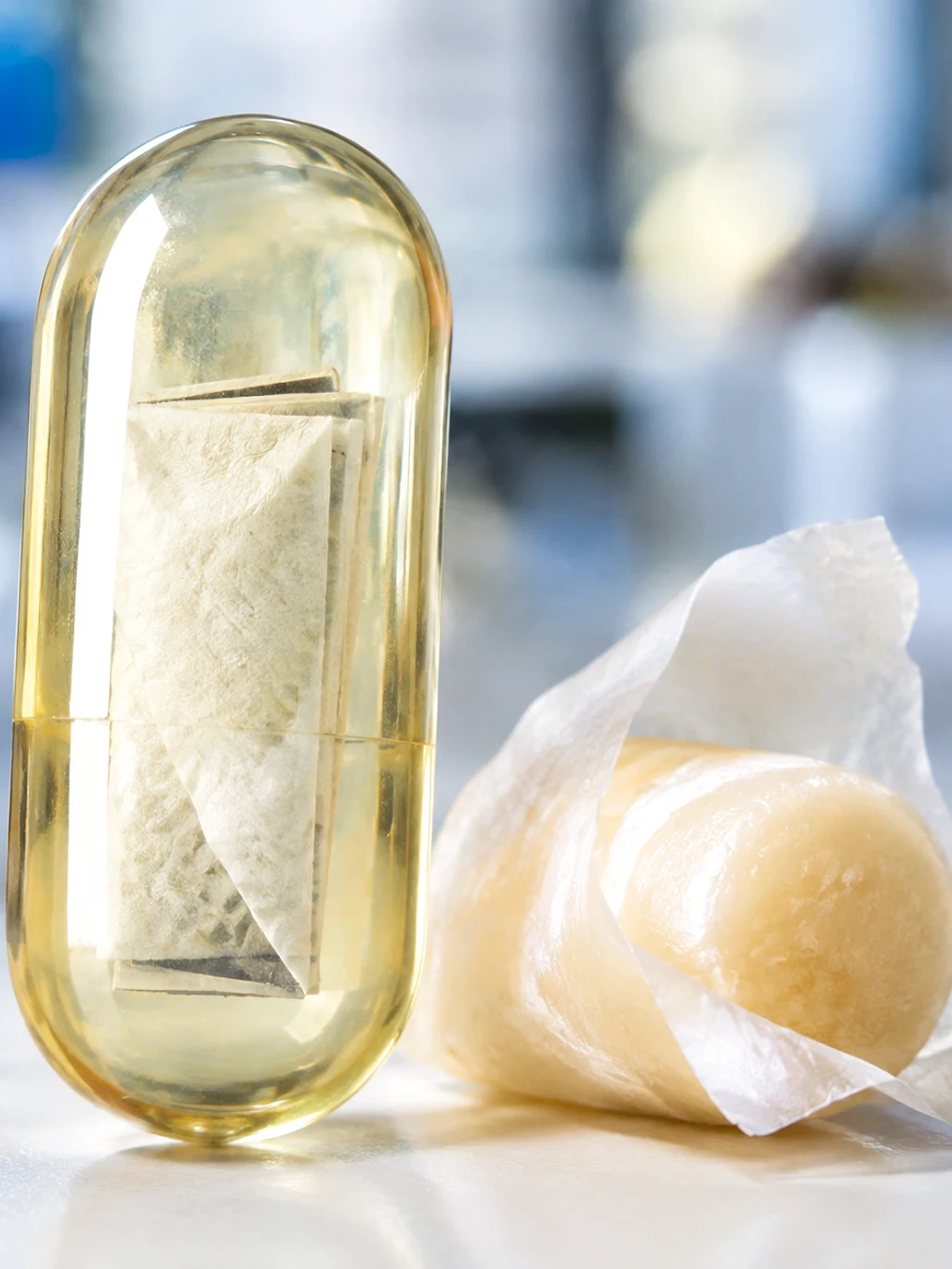
Swallowing a battery is one of the things every child is warned about. On 21 September 2026 a team led by Giovanni Traverso at MIT published a paper battery designed to be swallowed: magnesium and molybdenum trioxide on paper, wrapped in a cellulose film inspired by the edible rice paper around a sweet. It delivers about 1.84 V — more than a household AA — occupies a quarter of a capsule, and powered both a signal tag and a gastric stimulator inside pigs for three days before dissolving. One caution from outside the study: degrading is not the same as disappearing. Chinese listening practice at four levels. HSK 1 Chinese listening practice.
This is an HSK 1 Chinese listening episode that runs about 2 minutes. The full Mandarin script is shown with tap-for-pinyin and a line-by-line English translation, so you can listen and read at once — comprehensible input in the sense of Stephen Krashen's i+1 theory. It teaches 12 key vocabulary words such as 电视、电话、电脑 and walks through 3 grammar patterns, each explained in English with examples. The same news story is retold at 4 difficulty levels — use the level selector above to find the version that is challenging but still understandable for you.
Read at your level
原文Read the complete story in Chinese. Reveal pinyin and English only when you need them.
English transcript reference
You have a television.
You have a telephone.
You also have a computer.
A television, a telephone, a computer — there is electricity inside all of them.
The electricity sits inside one small thing.
That small thing is called a battery.
A battery is very small.
But you cannot eat a battery.
If you swallow a battery, you will be in a very bad way.
Everybody knows this.
Now, someone has made a new battery.
This new battery, you can eat.
Why would anyone want to eat a battery?
Because doctors want to see inside your body.
In the past, you had to go to the hospital.
The hospital has a very big machine.
The doctor uses the big machine to look at you.
Now it is not the same.
Now there is a small thing, like a pill.
You swallow it.
It looks around inside your body.
When it is done, it comes out by itself.
But this small thing needs electricity.
It needs a battery.
Doctors in America made a new battery.
This battery is made of paper.
A battery made of paper!
When you eat sweets, some sweets have paper on the outside.
That paper — you can eat it too.
The outside of this new battery is that same kind of paper.
The doctors fed this battery to pigs.
After a pig swallowed it, the battery worked for three days.
After three days, the battery slowly disappeared.
It dissolved inside the pig's body.
The doctors say: this is very good.
But we still have to look.
After the battery dissolves, where does it go?
That, we still do not know.
Now have a think.
A doctor hands you a pill.
Inside the pill there is a battery.
Do you swallow it?
Listen again
Try it without the transcript and notice what sounds clearer.
What vocabulary does this episode teach?
词汇HSK 1. Used as an anchor: 电视、电话、电脑,里面都有电 — three words you own, to reach one you do not.
HSK 1. The second leg of the same anchor. The 电 in all three is the point.
HSK 1. The third leg — after this, 电池 needs no translating.
HSK 1. Every claim in the episode is attributed to them, including the one about what nobody knows yet.
HSK 1. 医院里有很大的机器 — the old way of looking inside a body.
HSK 1. The most repeated verb here, and the one the whole episode turns on: 电池不能吃 → 这个新电池,你可以吃。
Built from 电 plus 池, and introduced only after 电视/电话/电脑 have made 电 familiar.
电在一个小东西里面 — the abstraction is given a location before it is given a name.
纸做的电池!— the sentence the episode is built to make you disbelieve, then accept.
医生给猪吃了这个电池 — pigs, because their guts are close enough to ours.
HSK 2. 像药一样 — the shape of the thing you swallow, given before its function.
HSK 2. 它在你的身体里面看 — where the whole story happens.
* beyond level超纲词
What grammar patterns appear in this episode?
语法A、B、C,里面都有……
Listing three familiar things and stating what they share is how Chinese introduces a new idea without defining it. Here it teaches 电 before 电池 arrives.
电视、电话、电脑,里面都有电。
可是……不能……
可是 marks the turn, and 不能 states a prohibition rather than an inability. The episode uses it to set up the thing it will then overturn.
可是电池不能吃。
可是这个小东西要用电。
V 了以后,……
After doing something, the next thing happens. Placing the time clause first is the normal Chinese order and the spine of the final third.
猪吃了以后,电池工作了三天。
电池化了以后,去了哪里?
Proper nouns
专有名词Free account
Keep learning from this story
Create a free account to keep saved words and your preferred level together.
- Keep words with their story context
- Remember your preferred level
- Build your vocabulary over time