
A Chinese podcast · Same story, 4 levels
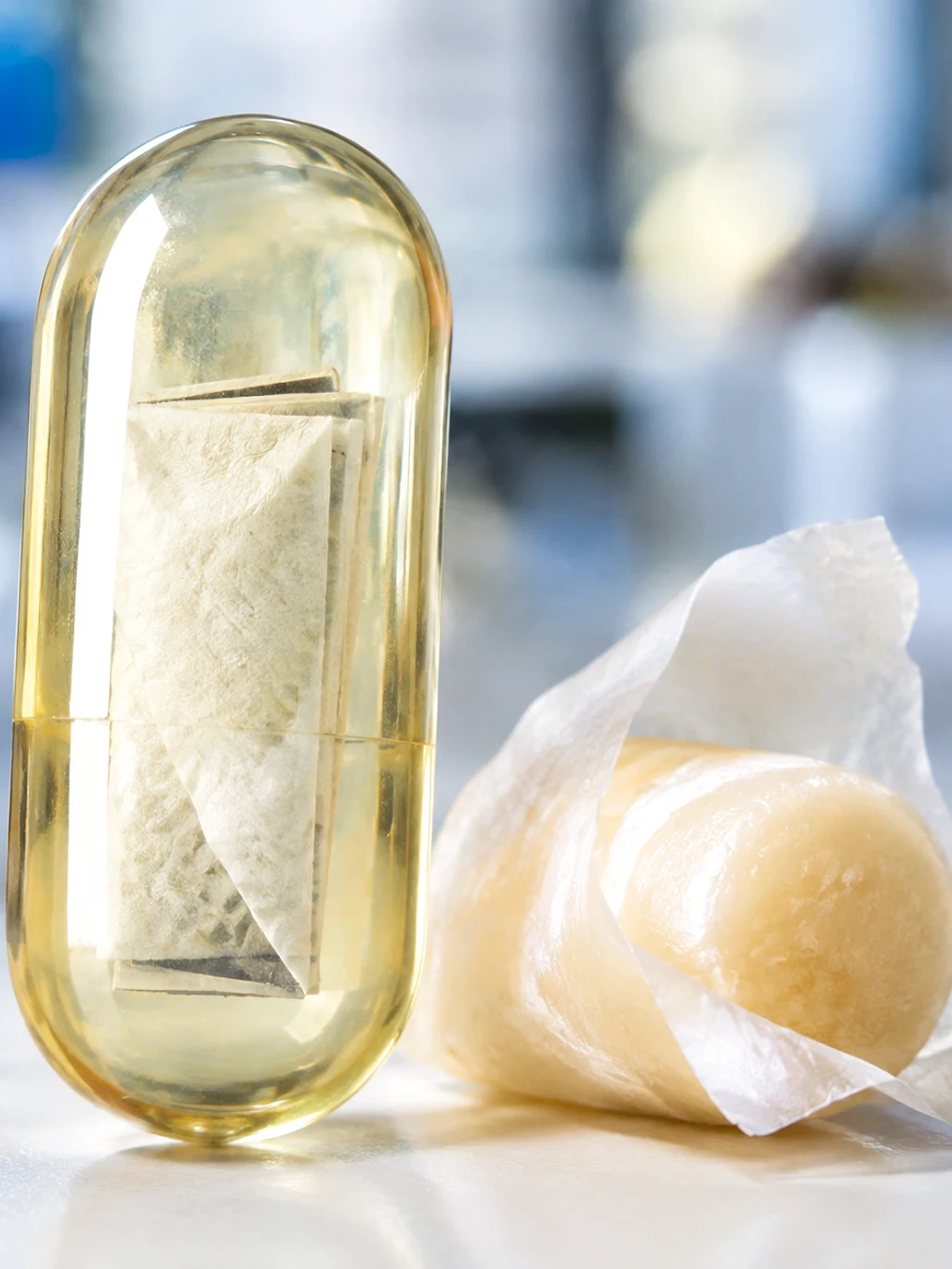
麻省理工做出了一块可以吞下去的电池:它在猪的身体里工作了三天,然后自己化掉了
MIT Built a Battery You Can Swallow. It Powered a Device Inside a Pig for Three Days, Then Dissolved.
About this story
Swallowing a battery is one of the things every child is warned about. On 21 September 2026 a team led by Giovanni Traverso at MIT published a paper battery designed to be swallowed: magnesium and molybdenum trioxide on paper, wrapped in a cellulose film inspired by the edible rice paper around a sweet. It delivers about 1.84 V — more than a household AA — occupies a quarter of a capsule, and powered both a signal tag and a gastric stimulator inside pigs for three days before dissolving. One caution from outside the study: degrading is not the same as disappearing. Chinese listening practice at four levels. HSK 5-6 Chinese listening practice.
This is an HSK 5-6 Chinese listening episode that runs about 6 minutes. The full Mandarin script is shown with tap-for-pinyin and a line-by-line English translation, so you can listen and read at once — comprehensible input in the sense of Stephen Krashen's i+1 theory. It teaches 12 key vocabulary words such as 设备、实验、环境 and walks through 3 grammar patterns, each explained in English with examples. The same news story is retold at 4 difficulty levels — use the level selector above to find the version that is challenging but still understandable for you.
Read at your level
原文Read the complete story in Chinese. Reveal pinyin and English only when you need them.
English transcript reference
Let's begin with a piece of common sense almost everyone has been taught.
Do not swallow batteries.
A small child swallowing a button battery is one of the situations an emergency department least wants to see.
The reason is that the chemicals inside will burn the oesophagus and stomach wall within a very short time.
So when a research team announces they have made a battery you can swallow, the first reaction is that the sentence itself is faulty.
On the twenty-first of September this year, the work was formally published.
The test subjects were pigs; the result was that it worked inside the body for three days and then dissolved.
It sounds like a joke, but it is real.
To understand why anyone would set out to make an edible battery, you first have to see clearly what problem it solves.
For several decades, progress in medical imaging has followed essentially one path: looking in from outside the body.
But that path has its limits.
So a second line of thinking emerged: stop looking through the body and send the instrument in directly.
The capsule endoscope is what that line produced once it worked.
It is a camera the size of a capsule; the patient swallows it, it photographs the whole way, and it is passed naturally at the end.
This entire category is called ingestible electronic devices, and they are all stuck on the same problem: power.
Any electronic device needs electricity, and a standard battery contains chemicals that must not contact human tissue.
The current approach is really avoidance: seal the battery tightly so it never touches the body at any point, and pass it out with the device.
In the overwhelming majority of cases, this is safe.
The trouble is that the approach depends on that outer layer not breaking.
The seal can fail, and the device can lodge in the digestive tract and fail to pass.
If either of those happens, the risk that was being avoided immediately becomes a real accident.
Which is to say, part of whether this approach is safe comes down to luck.
So a genuinely complete solution has only one direction: make the battery out of materials that are not toxic to begin with.
Better still, have it degrade safely inside the body once its work is finished.
The answer from the MIT team is a battery made of paper.
More precisely, a degradable paper-based battery using magnesium and molybdenum trioxide as electrodes.
Choosing magnesium was not incidental.
Magnesium is an element the body needs anyway, which fundamentally changes the starting point of any safety discussion.
The battery is wrapped in a thin cellulose film, whose job is to hold off stomach acid for a set period.
The inspiration for this design is remarkably plain.
The researchers mention that what they had in mind was the edible rice paper wrapped around a sweet.
That paper dissolves over time, and that is exactly what they wanted.
In other words, what they wanted was for it to fail at the end.
Two numbers are worth remembering.
The first is volume.
The whole battery occupies only a quarter of a standard capsule.
Which means the other three quarters remain available for sensors, transmitters, or the drug itself.
The second is voltage.
Inside the body it can output around one point eight four volts, slightly above a household AA.
Validation proceeded in two stages, and they deliberately chose two tasks with very different power demands.
The first was the low-power kind.
They sealed the battery into a capsule alongside an electronic tag that transmits a signal, and had a pig swallow it.
A receiver outside the body successfully read the tag's signal, proving the power chain was intact.
The second was the power-hungry kind.
They used the battery to drive a device delivering electrical stimulation inside the stomach.
Clinically, that kind of stimulation is used to promote gastric emptying.
In the experiment, the pig's hunger hormone levels rose, showing the device really was having an effect.
Together the two stages establish one thing: this battery genuinely works.
Last comes the time dimension.
The battery supplied power inside the pig for about three days.
After three days, gastric fluid penetrated the coating and the electrode materials began to corrode and dissolve.
It should be stressed that this is exactly the result the design was aiming for, not a failure.
But one academic who was not involved in the research raised the hardest question this work currently faces.
He pointed out that degrading is not the same as disappearing.
We still need to know what it actually breaks down into, how much the body absorbs, and whether those products irritate or damage the gut.
Repeated use matters especially here, because a patient may need to swallow such devices again and again.
There is no answer to that at present.
So it cannot yet be said that this is ready for use in people.
Worth adding: making the battery edible is only one of the technical routes.
The other route runs on the opposite logic: use food to make the battery directly, rather than making the battery resemble food.
A team in Milan has already built a degradable battery from riboflavin, caper extract and nori seaweed.
Its output is still nowhere near enough to drive anything practically useful, but it has already been certified as edible.
The end point of both routes is in fact the same.
Turning an electronic device that enters the body from a foreign object requiring careful isolation into something the body was always capable of handling.
Once you have thought all that through, only one question is left.
Now put yourself in the scene.
A doctor hands you a capsule and tells you there is a battery inside, that it will work for three days, and that it will then dissolve in your body.
Do you swallow it, or not?
Listen again
Try it without the transcript and notice what sounds clearer.
What vocabulary does this episode teach?
词汇HSK 4. 可吞服电子设备 — naming the category is what turns one gadget into a field.
HSK 4. 实验对象是猪 — stated in the second paragraph, because who it was tested on is part of the claim.
HSK 3. 在身体内部的环境下 — voltage is only meaningful relative to where it is measured.
HSK 3. 在绝大多数情况下,这套方案是安全的 — the qualifier doing all the work in that sentence.
HSK 3. Implicit throughout: the swallowed battery is dangerous, which is why the paper one matters.
HSK 3. 真正彻底的方案只有一个方向 — a direction rather than a solution, which is the honest formulation.
降解并不等同于消失 — the single most important sentence in the episode.
一层纤维素做的薄膜 — the same material as the sweet wrapper that inspired it.
约一点八四伏,略高于家用五号电池 — the comparison is what makes the number mean something.
The device that already exists, and therefore the reason the power problem is urgent.
电极材料开始腐蚀并溶解 — presented as the design working, not failing.
从一件需要被小心隔开的异物 — the medical term, and the thing the whole field is trying to stop being.
* beyond level超纲词
What grammar patterns appear in this episode?
语法与其说……,不如说……(的变体:其实是回避)
Reframing what something actually is. Here the episode refuses to call the current approach a solution and names it avoidance instead.
现在的办法其实是回避:把电池严密地包起来,让它全程不碰到身体。
问题在于,……
The trouble is that… A discourse marker that isolates the single load-bearing assumption in an argument.
问题在于,这套办法要靠外面那层不破。
需要强调的是,……
What must be emphasised is… Used to stop the listener drawing the obvious wrong inference, here that dissolving equals malfunction.
需要强调的是,这正是设计想要达到的结果,而非一次失效。
Proper nouns
专有名词Free account
Keep learning from this story
Create a free account to keep saved words and your preferred level together.
- Keep words with their story context
- Remember your preferred level
- Build your vocabulary over time