
A Chinese podcast · Same story, 4 levels
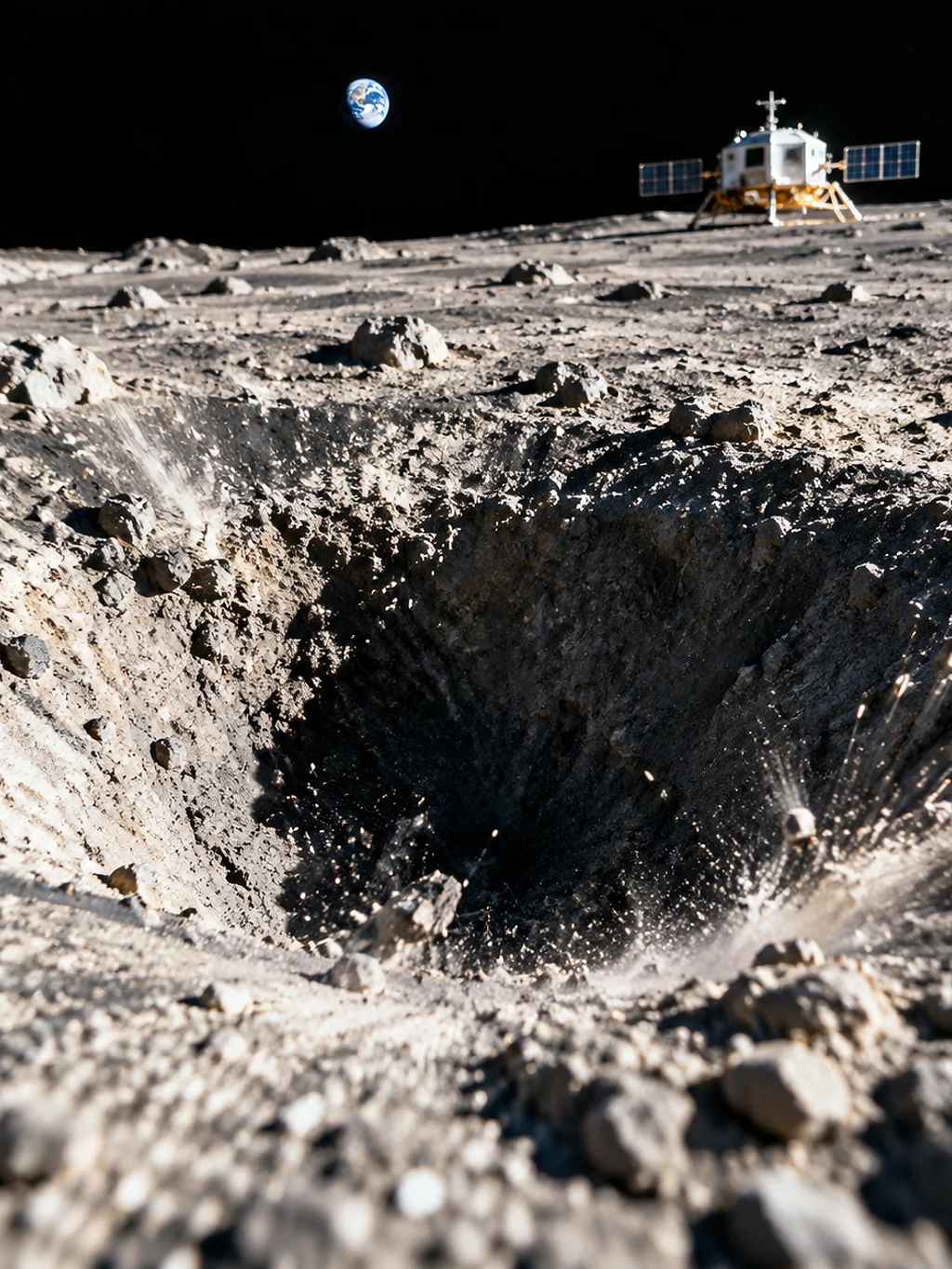
美国航天局发现月球多年来最大的新坑:未来的月球基地要小心了
NASA Spots the Moon's Biggest New Crater in Years — a Warning for Future Moon Bases
About this story
NASA's Lunar Reconnaissance Orbiter has found the largest fresh crater seen on the Moon since at least 2009: McGetchin crater, 222 meters wide, punched in spring 2024 by an object only 9 to 21 meters across. Impacts that big come about once every 132 years, but with the US and China planning bases at the lunar south pole in the 2030s, the crater's 100-kilometer spray of debris shows why small, hard-to-spot rocks are a real risk. Chinese listening practice at four levels. HSK 3 Chinese listening practice.
This is an HSK 3-4 Chinese listening episode that runs about 3 minutes. The full Mandarin script is shown with tap-for-pinyin and a line-by-line English translation, so you can listen and read at once — comprehensible input in the sense of Stephen Krashen's i+1 theory. It teaches 12 key vocabulary words such as 比较、计划、保护 and walks through 3 grammar patterns, each explained in English with examples. The same news story is retold at 4 difficulty levels — use the level selector above to find the version that is challenging but still understandable for you.
Read at your level
原文Read the complete story in Chinese. Reveal pinyin and English only when you need them.
English transcript reference
We tend to think of the moon as a quiet place.
But in fact, the moon is being hit all the time.
Space is full of rocks, along with fragments that break off comets.
They keep slamming into the moon, leaving it with fresh wounds.
This week, NASA said it had found a big new crater.
It's the largest new crater seen on the moon since 2009.
The crater is more than 220 meters wide — longer than two American football fields.
One planetary scientist said that by modern standards, it's a monster of a crater.
So how did they find it?
NASA has a spacecraft called the Lunar Reconnaissance Orbiter, which has been flying above the moon for more than ten years, taking photos the whole time.
Scientists compared older photos with recent ones.
In October 2025, they first noticed this crater.
After comparing the images, they worked out when the impact happened: sometime between April and May 2024.
The object that hit the moon was roughly ten to twenty meters across.
It was moving extremely fast, and the moment it struck, it gave off an intense flash of light.
The energy of the impact was roughly equal to fifteen thousand tons of explosives.
The crater was later named McGetchin crater, in honor of a scientist who studied the moon.
It lies on the moon's eastern side, near an area called the Sea of Crises.
Scientists calculate that an impact this big happens only once every 132 years on average.
If it's so rare, why does it matter?
Because humans are preparing to return to the moon.
America and China are both planning to send astronauts to the moon.
If the plans hold, in the 2030s there could be several bases at the moon's south pole.
Astronauts would live there for a few weeks, or even a few months.
On Earth, the air protects us.
Rocks around ten meters across usually burn up in the air before they reach the ground.
But the moon has almost no air, so rocks of any size can hit it directly.
Scientists estimate that about 140 small craters, ten meters wide, appear on the moon every year.
The chance of a base being hit on any given day is small — but it isn't zero.
This new crater also points to another problem.
A rock doesn't need to hit a base directly to put it in danger.
An impact throws out a great deal of rubble.
This time, the rubble flew as far as a hundred-plus kilometers.
So even if the impact site is far from a base, flying rubble could still damage it.
There's an even trickier problem.
Big asteroids can be spotted in advance — we might even find a way to change their course.
But rocks a dozen meters across are very hard to see ahead of time, and there'd be no time to deal with them.
A physicist who studies impacts said this is a major risk for living on the moon long-term.
He also said the danger from small rocks is very real.
The moon looks calm, but before humans can settle there, there are a lot of problems left to solve.
If you were designing a moon base, which problem would you solve first?
Listen again
Try it without the transcript and notice what sounds clearer.
What vocabulary does this episode teach?
词汇HSK 3. 把以前的照片和最近的照片放在一起比较 — the discovery method.
HSK 3. 按照计划,二零三零年代,月球南极可能会有好几个基地。
HSK 3. 在地球上,我们有空气保护。
HSK 3. 月亮上几乎没有空气 — "almost none", which is the scientific truth.
HSK 3. 想办法让它改变方向 — deflecting an asteroid.
HSK 3. 人类还有很多问题要解决 — and the closing question.
The formal word for an asteroid impact; the everyday verb is 撞.
HSK 4. 它的速度非常快 — why a 20-meter rock makes a 220-meter crater.
宇航员会在那里住几个星期,甚至几个月。
月球南极可能会有好几个基地 — the thing at risk.
科学家估计,每年月亮上会出现一百四十个左右的小坑。
The physicist's verdict: 一个很大的风险.
* beyond level超纲词
What grammar patterns appear in this episode?
语法既然……,为什么……?
Since X is true, why Y? Sets up the "so why does it matter" turn.
既然这么少见,为什么这件事很重要?
就算……,也……
Even if… still… — a concession that keeps the risk alive.
就算撞击点离基地很远,飞过来的碎石也可能打坏基地。
Proper Nouns
专有名词Free account
Keep learning from this story
Create a free account to keep saved words and your preferred level together.
- Keep words with their story context
- Remember your preferred level
- Build your vocabulary over time