
A Chinese podcast · Same story, 3 levels
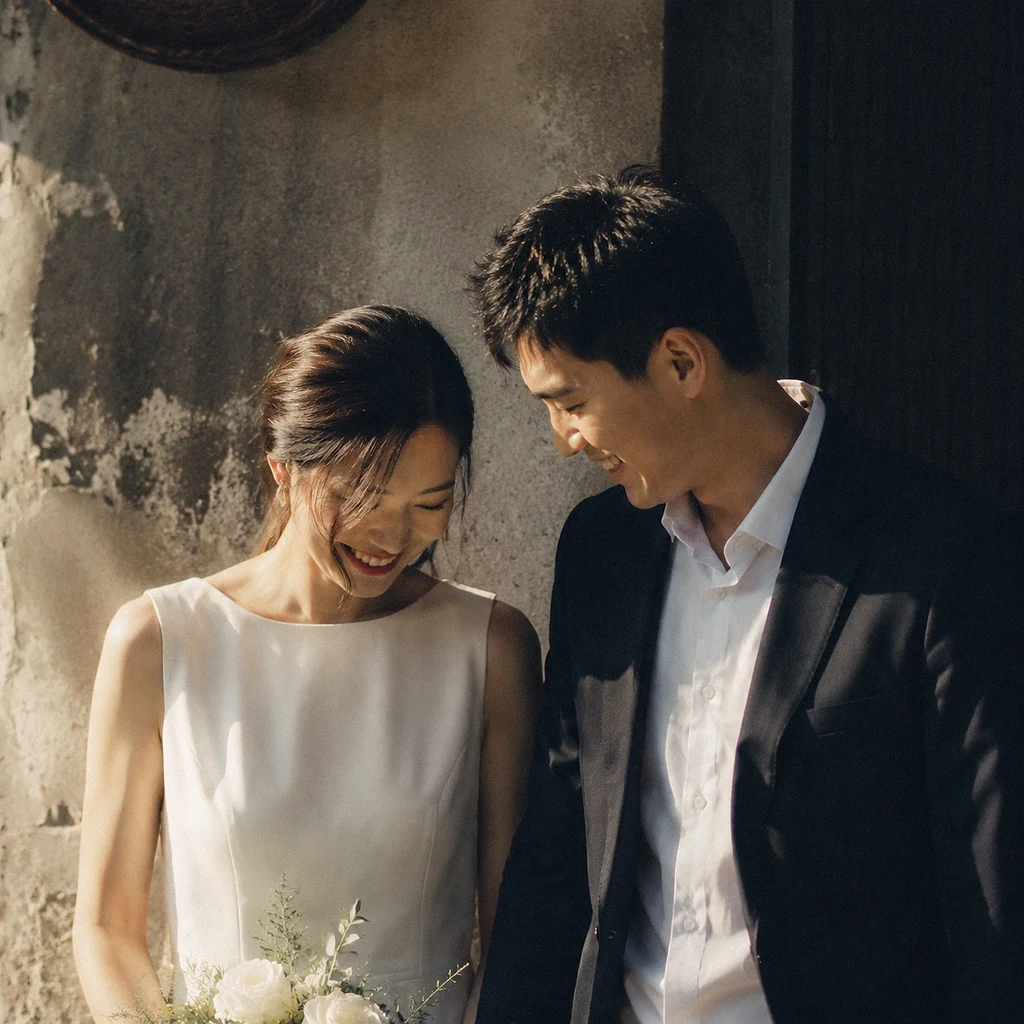
中国年轻人的新式婚礼
China's New-Style Weddings — Miss Bao, Mr. Lü and Sichuan Couples Choose Simple Over Showy
About this story
Miss Bao, Mr. Lü and Sichuan couples on China's new-style weddings — small, simple, happy ceremonies. HSK 2 Chinese listening practice.
This is an HSK 2 Chinese listening episode that runs about 6 minutes. The full Mandarin script is shown with tap-for-pinyin and a line-by-line English translation, so you can listen and read at once — comprehensible input in the sense of Stephen Krashen's i+1 theory. It teaches 16 key vocabulary words such as 结婚、年轻、简单 and walks through 5 grammar patterns, each explained in English with examples. The same news story is retold at 3 difficulty levels — use the level selector above to find the version that is challenging but still understandable for you.
Read at your level
原文Read the complete story in Chinese. Reveal pinyin and English only when you need them.
English transcript reference
Speaking of recent marriage trends among young Chinese people, there is a big change.
In the past, getting married in China was a very expensive affair.
Many people had to spend hundreds of thousands of yuan.
They had to eat at very large restaurants.
We had to invite very many people.
This was not just a matter between two people.
This was also a matter between two families.
Parents felt this was very important.
Because this made them feel they had 'face' (reputation).
However, the situation is different now.
Many young people are starting to dislike this.
They don't want to spend that much money.
They don't want to do things just for others to see.
They want a simple wedding.
This is not because they don't have money.
This is because they want true happiness.
They want to be themselves on this important day.
Let's look at three real stories.
The first story is about Miss Bao and Mr. Lu.
They are a pair of young lovers.
Originally, they wanted to listen to their parents.
They prepared to get married.
However, things became very troublesome.
The woman's parents wanted a lot of money.
This is called the 'bride price' (caili).
This is a traditional Chinese custom.
The man's side has to give money to the woman's family.
Miss Bao's parents also wanted a big house.
They asked: "Have you bought a house?"
Miss Bao and Mr. Lu had not bought a house.
Because they had not yet decided where to live.
They both work away from home.
The parents were very unhappy when they heard this.
They said: "Then there will be no marriage!"
Miss Bao felt very sad.
She felt her parents didn't understand her.
She felt her parents only cared about money.
So, she made a decision.
She didn't want that kind of traditional wedding anymore.
She and Mr. Lu drove off to travel.
They went to a very faraway place.
That place is called Sichuan.
There are very high mountains there.
There is a very blue sky there.
They got married there.
There weren't many guests.
It was just the two of them.
They didn't wear expensive clothes.
They wore comfortable clothes.
They took photos at the foot of the mountain.
They smiled very happily.
This was what they really wanted.
This trip only cost twenty thousand yuan.
It was much cheaper than eating at a restaurant.
After returning home, they invited friends to hang out.
This was also a small party.
Friends talked together.
Everyone didn't drink alcohol.
Everyone drank milk tea.
Because Miss Bao likes to drink milk tea.
Although it was simple, everyone was very happy.
Miss Bao feels that marriage is a matter between two people.
There is no need to spend money for others.
The second story is about Miss Shi and Mr. Chen.
They like music very much.
Especially rock music.
If getting married, one must take photos.
In China, taking wedding photos is very expensive.
Moreover, the people in the photos all look the same.
Everyone wears the same clothes.
Everyone does the same poses.
Miss Shi felt this was very boring.
That is fake, not real.
Later, a friend gave a suggestion.
The friend said: "You guys should go to a music festival."
Music festivals have many singers.
It is very lively there.
Miss Shi thought this was a very good idea.
So they went to the music festival.
That day, they wore wedding clothes.
They were in the crowd.
There were many people they didn't know nearby.
Everyone was listening to music.
Everyone was dancing.
When others saw them, they were all very happy.
Strangers said to them: "Congratulations!"
Everyone sang together.
Everyone danced together.
A photographer took photos of them.
In the photos, they were smiling very happily.
This was much better than taking photos in a studio.
Because this was real happiness.
Miss Shi's parents saw the photos.
They also liked them very much.
Because they saw their daughter's smiling face.
This is the most important thing about getting married.
The third story is about Miss Qian.
Miss Qian is a special person.
She doesn't like to eat meat.
She likes to eat vegetables.
She feels traditional weddings are too wasteful.
Many people can't finish the food.
Although this costs a lot of money, it is not good.
She wanted a "green" wedding.
She wants to protect the environment.
So, she got married in a garden.
This is a very beautiful garden.
She invited many friends.
She also invited some strangers.
Everyone ate vegetables together.
Everyone talked together.
This wedding was very cheap.
Each person only cost a bit over one hundred yuan.
This is very cheap in China.
In other restaurants, one person costs five hundred yuan.
Miss Qian's parents did not come.
Because they felt this didn't look like a wedding.
But Miss Qian didn't care.
She felt this is her life.
She and her husband both like it this way.
They don't want many things.
They don't want a lot of money.
They just want to live simply.
They feel happiness is more important than money.
This is the mindset of young Chinese people now.
What do these three stories tell us?
This tells us that times have changed.
In the past, marriage was for the family.
Marriage was for others to see.
Now, marriage is for oneself.
Young people are starting to think about a question.
This question is: "Whose life is this?"
This is our own life.
What kind of family do we want to build?
What kind of lover do we want to find?
This is more important than spending money.
Although parents might not understand.
Although others might think it's strange.
But young people persist in their own choices.
They don't want a wedding costing hundreds of thousands.
What they want is love.
What they want is freedom.
What they want is true happiness.
What we just talked about is actually a new phenomenon in China.
This is called "minimalist wedding".
The meaning is a very simple wedding.
Or it's called "Three-No Wedding".
It means no motorcade, no bride escort, no groomsmen or bridesmaids.
This is becoming a new trend.
This shows that young Chinese people are growing up.
They know what they want.
They are changing Chinese traditions.
This is today's story about weddings.
Listen again
Try it without the transcript and notice what sounds clearer.
What vocabulary does this episode teach?
词汇A common verb/noun meaning to marry or marriage. Usage: A 和 B 结婚 (A marries B).
Adjective describing age. Often used in '年轻人' (young people).
Adjective meaning uncomplicated or simple in nature.
Adjective used to describe something of great significance.
Can be used as a verb (to make up one's mind) or a noun.
Adjective/Noun used for happiness or joy.
Measure word is '张' (zhāng).
Noun referring to surroundings or the ecological environment.
Cultural term. Money or gifts given by the groom's family to the bride's family before marriage.
Cultural concept referring to one's dignity or social standing. '有面子' means to have prestige/respect.
Refers to rock music genre.
People one does not know. '陌生' (unfamiliar) is HSK 5.
Professional title for someone who takes photos.
Adjective meaning extremely simple or minimalist style.
Specific roles in a wedding party.
A line of cars, often used in traditional weddings to pick up the bride.
* beyond level超纲词
What grammar patterns appear in this episode?
语法虽然 (suīrán) ... 但是 (dànshì) ...
A conjunction pair meaning 'Although..., but...'. It expresses a concession or contrast. Note that in Chinese, both conjunctions are often present, whereas in English you usually only use one.
虽然很简单,但是大家都很高兴。
这虽然有很多钱,但是不好。
虽然爸爸妈妈可能不理解。
A + 比 (bǐ) + B + Adjective (+ Complement)
The standard structure for making comparisons. It means 'A is more [adjective] than B'.
比在饭馆吃饭便宜多了。
这比在照相馆拍得好多了。
他们觉得快乐比钱更重要。
Verb + 得 (de) + Adjective/Complement
The complement of degree/state. It follows a verb to describe *how* an action is performed or the state resulting from it.
他们笑得很开心。
照片里,他们笑得非常开心。
这比在照相馆拍得好多了。
Subject + 让 (ràng) + Object + Verb/Adjective
A causative structure meaning 'to let', 'to make', or 'to allow' someone to do or feel something.
因为这让他们觉得很有面子。
结婚是为了让别人看。
Verb + 不 + 完 (wán)
A potential complement structure indicating inability to finish an action. '完' means 'to finish'.
很多人吃不完饭菜。
Proper Nouns
专有名词Sources
来源Free account
Keep learning from this story
Create a free account to keep saved words and your preferred level together.
- Keep words with their story context
- Remember your preferred level
- Build your vocabulary over time