
A Chinese podcast · Same story, 4 levels
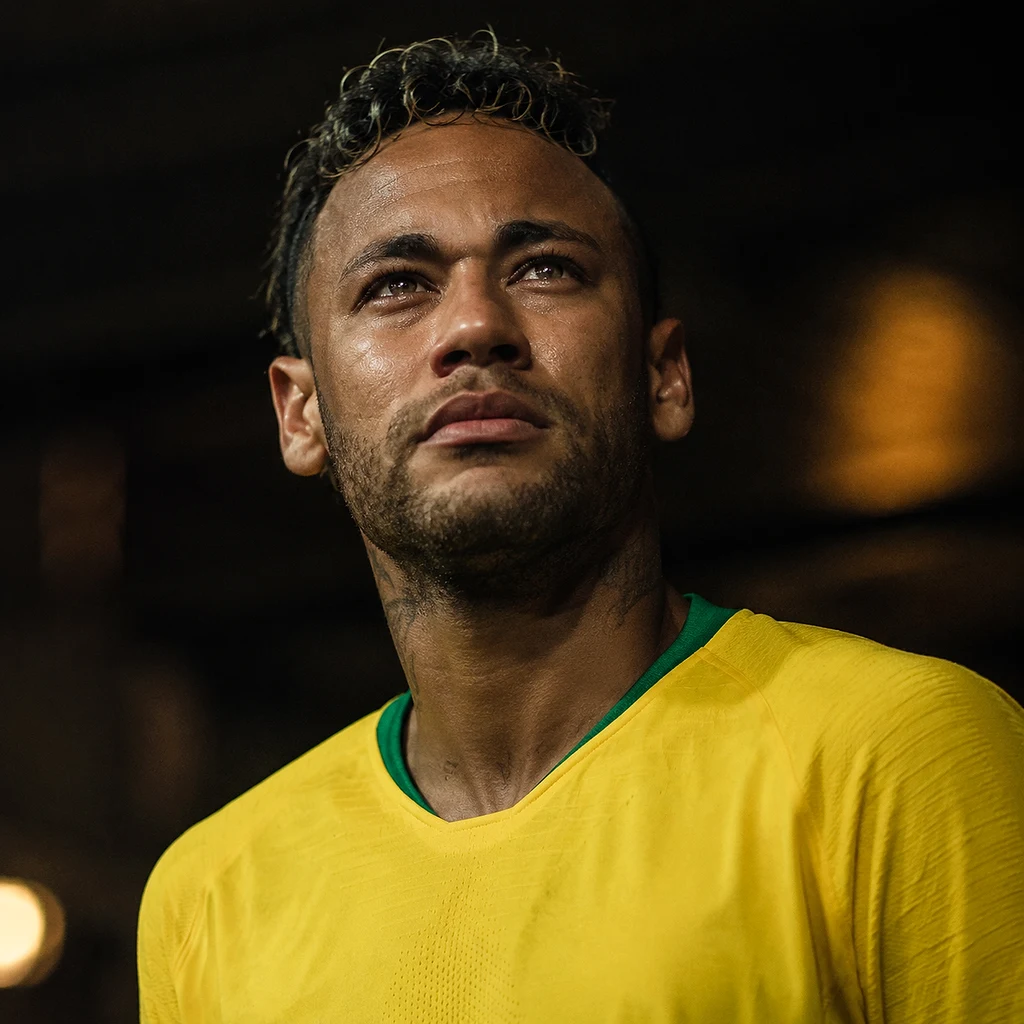
内马尔与他的最后一届世界杯——选人到底在选什么
Neymar Faces Possible Final World Cup
About this story
Neymar Faces Possible Final World Cup. HSK 5-6 Chinese listening practice.
This is an HSK 5-6 Chinese listening episode that runs about 8 minutes. The full Mandarin script is shown with tap-for-pinyin and a line-by-line English translation, so you can listen and read at once — comprehensible input in the sense of Stephen Krashen's i+1 theory. It teaches 12 key vocabulary words such as 数据、关键、影响 and walks through 4 grammar patterns, each explained in English with examples. The same news story is retold at 4 difficulty levels — use the level selector above to find the version that is challenging but still understandable for you.
Read at your level
原文Read the complete story in Chinese. Reveal pinyin and English only when you need them.
English transcript reference
On May 19, 2026,
in Rio de Janeiro, Brazil,
the Brazil national team announced
the 26-man squad for the 2026 World Cup.
When head coach Ancelotti
read out the name "Neymar,"
the venue erupted
in the loudest cheer of the whole event.
In that moment,
Neymar himself cried.
According to reports,
he cried for a long time.
Today, starting from this squad list,
we'll discuss a topic bigger
than "Neymar got selected":
when a team picks its players,
what is it really picking.
First let's get the facts clear.
Neymar
is 34 years old this year.
He is the top scorer in the history of the Brazil national team,
having scored 79 goals for the country.
That number
surpasses Pelé.
He is one of the most gifted players
of his generation.
But talent
and fate
are two different things.
Neymar's career
is, in fact, a story of
"always very good, but always just short."
When he was very young,
at Santos
he made his name.
Later,
he went to Barcelona
and, with Messi
and Suárez,
formed a famous attacking trio.
In 2017,
Paris, for a
record-breaking sky-high price,
bought him.
That was, in the history of football,
the most expensive transfer ever.
Everyone thought
that Neymar would, there,
win that most important trophy
and become the world's number one.
But that
never happened.
At the World Cup,
his story
is even more regrettable.
In 2014,
the World Cup was held on Brazilian home soil.
Everyone expected
him to lead the team to the title.
But he was injured during a match
and could not finish the tournament.
In 2018
and 2022,
Brazil also could not go all the way.
In that 2022 edition,
Brazil, in the knockout round,
lost a penalty shootout to Croatia.
The image of Neymar sitting on the grass crying
is one many people remember to this day.
You could say
Neymar has won everything,
yet also seems
to have always been missing that one trophy
he most wanted.
And then
came that injury.
In October 2023,
while Neymar was playing for Brazil,
his knee was seriously injured.
The doctors' diagnosis
was that the anterior cruciate ligament in his knee
had torn.
This is one of the injuries
athletes fear most.
Many people who suffer this kind of injury
never come back.
The two years after the injury
were the low point of Neymar's career.
He first went to
a club in Saudi Arabia,
but because of injuries
he hardly played at all.
Later,
he returned to Santos —
the place where he started out.
This February,
he had surgery once again.
After his return,
in the Brazilian league
he scored only four goals
and made two assists.
For someone who was once
a world-class player,
this kind of data
is fairly low.
So,
before the squad was announced,
many professionals
and many retired players judged:
Neymar
would very likely be left out this time.
And yet,
Ancelotti chose him.
And that brings us to
today's real question.
Ancelotti
is a very experienced,
old-school coach.
He has coached
almost every top club in Europe
and won countless titles.
In explaining why he chose Neymar,
the reasons he gave
are well worth pondering.
He did not say
Neymar was in the best form.
He said three things.
First,
he had watched Neymar for a whole year
and found that his physical condition
had been steadily improving recently.
Second,
it is experience.
This will be Neymar's
fourth World Cup.
The pressure of an elite tournament —
he knows it all too well.
Third,
and the most interesting point,
is Neymar's effect on the team's "atmosphere."
Ancelotti said
that in the dressing room, Neymar
is loved and respected by his teammates,
and he can make the whole team's environment
better.
Here,
there appears, within modern football,
a real contradiction.
Football today
relies more and more on data.
How much a player runs,
how many passes succeed,
how many goals he scores —
all of it can be precisely calculated.
By pure data,
Neymar's current performance
is indeed not good enough.
But what Ancelotti values —
some other things:
experience,
leadership,
the dressing-room atmosphere,
the team's "environment" —
these things
can hardly be measured with numbers.
So,
is Ancelotti's pick
a kind of romanticism,
or a kind of wisdom?
Both views,
in fact, have their merit.
Those who call it a gamble
have a clear case.
Neymar is 34,
just out of surgery,
and after the squad was announced,
in a club match
he again had a slight
calf injury.
To send a player like this
to play a long
and intense World Cup —
the risk is real.
But those who say it makes sense
also have a strong case.
Football in the knockout stage
is often decided
by a few moments.
And a player like Neymar
is exactly the kind
who, at the crucial moment,
can do what others cannot.
There is another point.
A team
is never just
the eleven players on the pitch.
It is a collective.
A veteran with prestige,
the lift he gives to young players,
his effect on the whole team's spirit,
is real —
it just cannot
be written into a data sheet.
What's more,
there is another layer of meaning
that nobody will say openly,
but everybody understands.
Neymar is 34.
This is almost certainly
his last World Cup.
A man who, for the national team,
scored 79 goals,
an idol of a generation —
his country
will want, in a
dignified
and warm way,
to bid him farewell.
Picking him for the squad,
to some degree,
is also a country
answering a question:
how do we
say goodbye to a great player.
Of course,
Ancelotti also left
one very clear-eyed sentence.
He said
Neymar will not necessarily be a starter:
"he plays if he plays well enough."
Being selected
does not equal getting on the field.
This shows
that this is not
a purely sentimental choice.
The door
has opened for Neymar,
but how far he can go
still depends on himself.
To close,
I want to step outside football
and say something more general.
This world
is becoming more and more "quantifiable."
We have grown used to using numbers
to evaluate a person:
grades,
performance,
all kinds of metrics.
Numbers have their advantages.
They are fair,
they are clear.
But this time,
Neymar's selection reminds us:
some important things
do fall outside the numbers.
A person's experience,
his effect on the people around him,
the way he does not give up
in hard times —
these things
are hard to score,
but they are real.
Finally,
I want to ask you two questions.
The first:
if you were Ancelotti,
would you choose Neymar?
The second,
and perhaps more important:
when we evaluate a person,
besides the things
that can be calculated,
should we
also leave a place
for the things that cannot?
These two questions
have no standard answer.
But they are worth
thinking about slowly.
Okay.
That's all for today.
See you in the next story.
Listen again
Try it without the transcript and notice what sounds clearer.
What vocabulary does this episode teach?
词汇Data. The episode's modern tension: 今天的足球,越来越依赖数据 — football increasingly relies on what can be precisely measured.
Crucial, key. The case for Neymar: 能在关键瞬间,做出别人做不到的事 — he can do the impossible at the crucial moment.
Influence, effect. 他对周围人的影响 — a person's effect on those around him, one of the things data cannot capture.
To fear. An ACL tear is described as 运动员最害怕的伤病之一 — 'one of the injuries athletes fear most.'
To respect. In the dressing room, Neymar 受到队友的喜爱和尊重 — loved and respected by teammates.
Experience. Ancelotti's second stated reason: a fourth World Cup means Neymar knows 顶级大赛的压力 — the pressure of an elite tournament.
Natural talent. Beyond HSK4. The episode's framing line: 天赋,和命运,是两件事 — talent and fate are two different things.
Fate, destiny. Beyond HSK4. Paired against 天赋 to set up Neymar's story of 'always good, but always just short.'
Ligament. Beyond HSK4. The diagnosis: 膝盖里的前十字韧带,撕裂 — a torn anterior cruciate ligament (ACL).
To measure, to weigh up. Beyond HSK4. The episode's core idea: leadership and atmosphere 几乎没办法用数字衡量 — can hardly be measured in numbers.
An idol. Beyond HSK4. 一个一代人的偶像 — 'an idol of a generation,' which is why his country wants a dignified farewell.
To quantify — turn something into numbers. Beyond HSK4. The closing reflection: the world is becoming ever more 可量化 — quantifiable.
* beyond level超纲词
What grammar patterns appear in this episode?
语法从 A 出发
从…出发 marks a starting point for a discussion or line of reasoning. The episode announces its method this way — beginning from the squad list to reach a bigger question.
我们就从这一份名单出发。
从这个故事出发,我们可以想得更远。
越来越 + adjective/verb
越来越 marks a steady, ongoing increase. The episode uses it for football's growing reliance on data and the world's growing 'quantifiability.'
今天的足球,越来越依赖数据。
这个世界,正在变得越来越"可量化"。
到底是 A 还是 B?
到底 sharpens a question, pressing for the real answer between two options. The episode poses the central judgment with it.
安切洛蒂这样选,到底是一种浪漫,还是一种智慧?
选人的时候,我们到底应该看什么?
更何况
更何况 adds a further, stronger point on top of what was already said. The episode uses it to layer in the unspoken farewell argument.
更何况,还有一层意思,谁都不会明说。
一个球员能做的事很多,更何况是内马尔。
Proper Nouns
专有名词Free account
Keep learning from this story
Create a free account to keep saved words and your preferred level together.
- Keep words with their story context
- Remember your preferred level
- Build your vocabulary over time