
A Chinese podcast · Same story, 4 levels
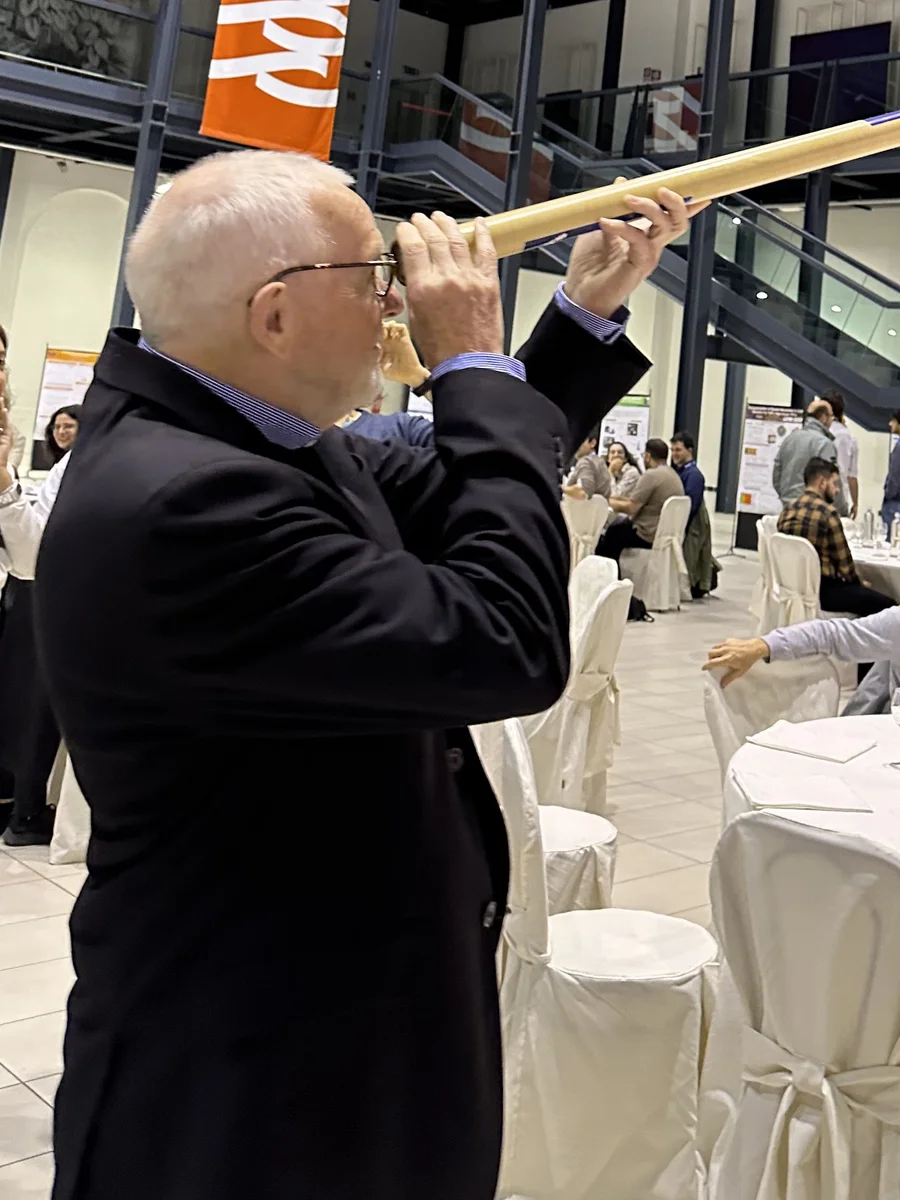
Photo: Mauro Mezzetto · CC BY-SA 4.0
哈尔岑获诺贝尔物理学奖:他把南极的冰变成了捕捉幽灵粒子的望远镜
Francis Halzen Wins the Physics Nobel for Turning a Cubic Kilometer of Antarctic Ice Into a Telescope for Ghost Particles
About this story
Halzen's solo 2026 physics Nobel: IceCube, Cherenkov light, cosmic neutrinos and multi-messenger astronomy. HSK 5-6 Chinese listening practice.
This is an HSK 5-6 Chinese listening episode that runs about 5 minutes. The full Mandarin script is shown with tap-for-pinyin and a line-by-line English translation, so you can listen and read at once — comprehensible input in the sense of Stephen Krashen's i+1 theory. It teaches 16 key vocabulary words such as 宣布、原理、突破 and walks through 6 grammar patterns, each explained in English with examples. The same news story is retold at 4 difficulty levels — use the level selector above to find the version that is challenging but still understandable for you.
Read at your level
原文Read the complete story in Chinese. Reveal pinyin and English only when you need them.
English transcript reference
In the second or two it takes you to hear this sentence, about a billion neutrinos have passed through your hand, and you feel nothing.
Neutrinos have no charge, a mass so small it's nearly negligible, and interact only through the weak force, so they can pass through a wall, a mountain, even the entire Earth, usually without touching a single atom.
Physicists have given them a fitting nickname: ghost particles.
On October 6th, the Royal Swedish Academy of Sciences announced that the 2026 Nobel Prize in Physics goes to 82-year-old Belgian-born physicist Francis Halzen, for 'decisive contributions to the IceCube Neutrino Observatory,
and the discovery of high-energy neutrinos of astrophysical origin.'
One detail worth mentioning: this is the first time since French physicist Charpak in 1992 that a single person has won the physics prize alone.
Halzen was born in Tienen, Belgium, in 1944, earned his PhD at Leuven in 1969, and has taught at the University of Wisconsin-Madison since 1972—more than half a century.
His contribution boils down to one 'crazy' idea.
Since neutrinos so rarely react with matter, the only way to catch them is to build an absurdly huge detector and trade volume for probability.
In 1988, Halzen proposed: why not just use the Antarctic ice?
Deep Antarctic ice, compressed over tens of thousands of years, is extremely pure and transparent—a natural, free detection medium in itself.
It took more than twenty years to turn the idea into reality.
Near the Amundsen-Scott South Pole Station, scientists used hot water to drill eighty-six deep holes into the ice, each lowering a string of light sensors, 5,160 in total,
spread between about 1,450 and 2,450 meters below the surface, covering a full cubic kilometer of ice.
IceCube was completed in December 2010 at a total cost of 279 million dollars, backed by more than 450 researchers from more than fifty institutions in fourteen countries.
The detection principle is actually elegant.
Occasionally, a neutrino hits an atomic nucleus in the ice and produces a charged particle; that particle moves through the ice faster than light does in ice, so it emits a cone of pale blue light, which physicists call Cherenkov radiation.
The sensors record when this light reaches different positions, and from that they can work out the neutrino's energy and direction.
The breakthrough came faster than many expected.
In 2013, just two years into full operation, the team announced the discovery of twenty-eight high-energy neutrinos from beyond the solar system, the first confirmed capture of neutrinos from deep space.
In 2018, they traced a high-energy neutrino to a blazar about four billion light-years from Earth—a galaxy with a supermassive black hole at its center and a jet pointed straight at Earth.
In 2023, IceCube produced the first image of the Milky Way in neutrinos.
The significance of these results is that they opened a new window.
For centuries, astronomy relied almost entirely on light: visible light, radio, X-rays.
But light can be blocked by dust and absorbed, while neutrinos travel almost unimpeded, carrying information from the universe's most extreme environments to Earth intact.
Add gravitational waves, detected since 2015, and today's astronomers can observe the same event with light, neutrinos and gravitational waves at once—what's called multi-messenger astronomy.
When the Nobel committee says Halzen founded 'a whole new astronomy,' this is exactly what it means.
Finally, a word about ourselves.
Last week we covered Wolf Prize winner Jun Ye, said the Wolf Prize is a bellwether for the Nobel, and that he had a chance.
In the end, this year's physics prize went to Halzen.
A bellwether is only a bellwether, but it's interesting to look at the two together: one measures time so precisely it wouldn't be off by a second over the age of the universe, the other turned a cubic kilometer of Antarctic ice into a telescope;
both use extreme patience to measure things we normally can't feel at all.
If you could build a detector in the Antarctic ice, what in the universe would you most want to 'listen' to with it?
Listen again
Try it without the transcript and notice what sounds clearer.
What vocabulary does this episode teach?
词汇HSK 4/5. 瑞典皇家科学院宣布.
HSK 5. 探测原理其实很优雅.
HSK 5. 突破来得比很多人预想的快.
HSK 5. 这些成果的意义.
HSK 5. 观察同一个事件.
HSK 5. 传感器记录下这道光.
HSK 4/5. 用极端的耐心.
HSK 5. 变成现实.
幽灵粒子.
只参与弱相互作用.
巨大到离谱的探测器.
淡蓝色的光.
距离地球约四十亿光年的耀变体.
二零一五年开始被探测到的引力波.
光、中微子和引力波.
用数量去换概率.
* beyond level超纲词
What grammar patterns appear in this episode?
语法自……之后,第一次……
The first time since….
这是自一九九二年法国物理学家夏帕克之后,第一次只有一个人独得物理学奖。
既然……,那……
Since… (given that), then….
既然中微子极少和物质发生反应,那要抓住它,唯一的办法就是准备一个巨大到离谱的探测器
何不……?
Why not…? (rhetorical, formal).
一九八八年,哈尔岑提出:何不直接用南极的冰?
比……还……
Even more … than ….
这个粒子在冰里的速度比光在冰里的速度还快
……的意义,在于……
The significance of … lies in ….
这些成果的意义,在于打开了一扇新窗户。
再加上……
Add to that….
再加上二零一五年开始被探测到的引力波
Proper nouns
专有名词Free account
Keep learning from this story
Create a free account to keep saved words and your preferred level together.
- Keep words with their story context
- Remember your preferred level
- Build your vocabulary over time