
A Chinese podcast · Same story, 4 levels
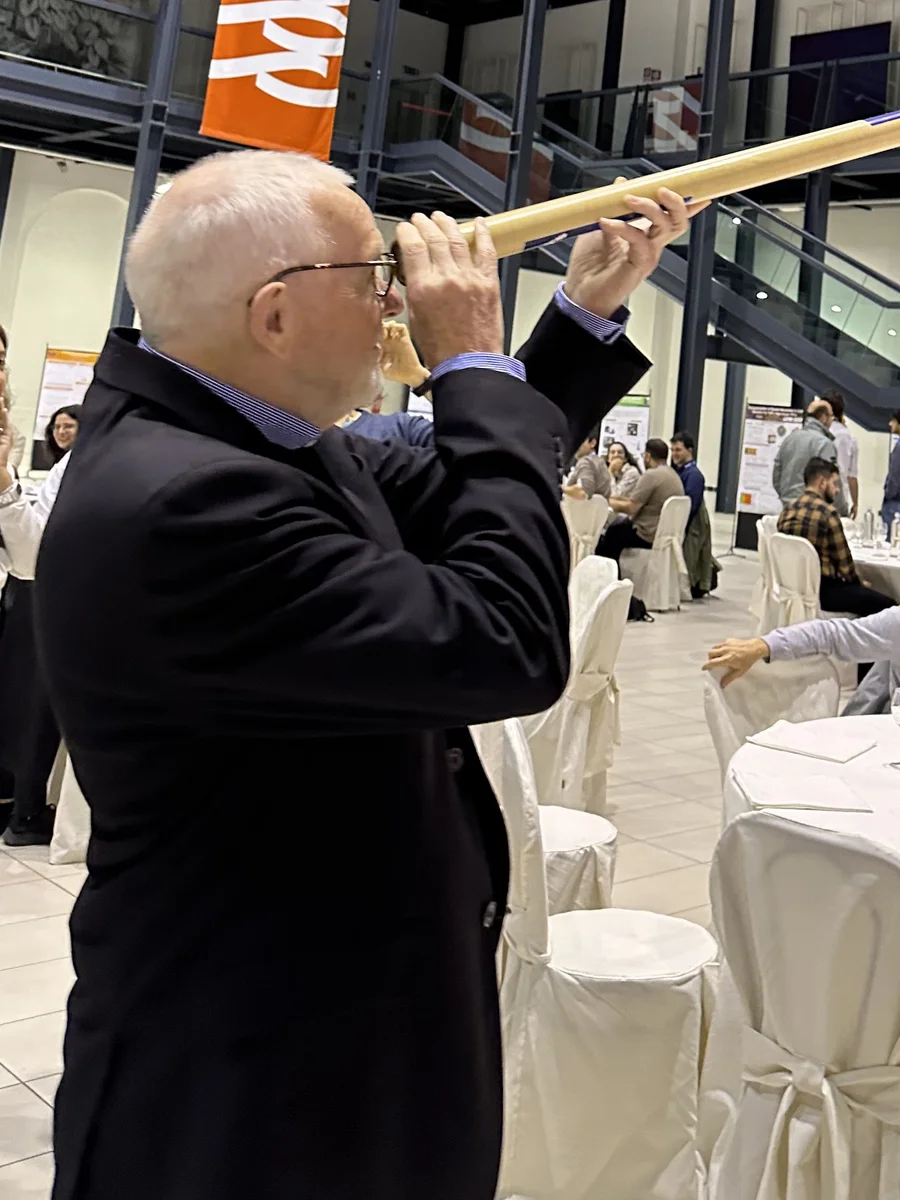
Photo: Mauro Mezzetto · CC BY-SA 4.0
哈尔岑获诺贝尔物理学奖:他把南极的冰变成了捕捉幽灵粒子的望远镜
Francis Halzen Wins the Physics Nobel for Turning a Cubic Kilometer of Antarctic Ice Into a Telescope for Ghost Particles
About this story
Halzen wins the physics Nobel for spotting neutrinos with small computers buried in Antarctic ice. HSK 1 Chinese listening practice.
This is an HSK 1 Chinese listening episode that runs about 3 minutes. The full Mandarin script is shown with tap-for-pinyin and a line-by-line English translation, so you can listen and read at once — comprehensible input in the sense of Stephen Krashen's i+1 theory. It teaches 16 key vocabulary words such as 看见、知道、电脑 and walks through 6 grammar patterns, each explained in English with examples. The same news story is retold at 4 difficulty levels — use the level selector above to find the version that is challenging but still understandable for you.
Read at your level
原文Read the complete story in Chinese. Reveal pinyin and English only when you need them.
English transcript reference
Look at your hand.
Right now, many, many tiny things are passing through your hand.
You can't see them, and you don't know.
These tiny, tiny things are called neutrinos.
While you listen to me, more than a billion neutrinos have passed through your hand.
A billion is very, very, very many.
Neutrinos are tiny, tiny; they can pass through anything: your hand, your home, your school.
You can't see neutrinos.
For many, many years, nobody could see neutrinos.
Today, let's talk about a man.
He thought for many years: how can we see neutrinos?
This man is called Halzen.
Halzen works in America; he's eighty-two now.
On October 6th, Halzen won a very, very big prize: the Nobel Prize.
His Nobel Prize is in physics.
物理 is physics.
This year's physics Nobel Prize is his alone.
How did he see neutrinos?
Listen.
There is a very, very cold place called the South Pole.
南极 is the South Pole.
The South Pole has lots and lots of ice.
Ice is very, very cold water.
Halzen said: let's put many small computers in the ice at the South Pole.
These small computers are two thousand meters under the ice.
There are 5,160 small computers in the ice.
Many, many neutrinos pass through the ice and do nothing.
But sometimes, a neutrino in the ice makes a tiny bit of light.
光 is light.
The small computers see this tiny bit of light.
When it sees the light, Halzen knows: a neutrino has come.
He also knows where this neutrino came from.
In 2013, Halzen and his friends saw twenty-eight neutrinos that came from very, very far away in the sky.
Now, everyone has one more way to look at the sky.
We look at stars with our eyes.
Now, we can also look at stars with neutrinos.
Do you still know Jun Ye?
Last week, we said: Jun Ye might win the Nobel Prize.
But this year's physics Nobel Prize is Halzen's.
Halzen waited many, many years.
In 1988, he already wanted to look for neutrinos at the South Pole; it has been thirty-eight years now.
Think about it: right now, neutrinos are passing through your hand—what do you want to say to them?
Listen again
Try it without the transcript and notice what sounds clearer.
What vocabulary does this episode teach?
词汇HSK 1. 你不能看见.
HSK 1. 你也不知道.
HSK 1. 很多小电脑.
HSK 1. 他现在八十二岁.
HSK 1. 很小的东西.
HSK 1. 哈尔岑和他的朋友.
HSK 1. 哈尔岑在美国工作.
HSK 1. 什么都能穿过.
一个很小很小的东西.
穿过你的手.
冰,是很冷很冷的水.
有一个很冷很冷的地方,叫南极.
一点点光.
一个很大很大的奖.
哈尔岑得了诺贝尔奖.
物理的诺贝尔奖.
* beyond level超纲词
What grammar patterns appear in this episode?
语法什么都能 + verb
Can do anything.
中微子很小很小,什么都能穿过:你的手,你的家,你的学校。
……的时候
When / while….
你听我说话的时候,有十多亿个中微子,穿过了你的手。
是从哪里来的
Where something came from.
他也知道:这个中微子,是从哪里来的。
X,是 Y
Defines a word.
冰,是很冷很冷的水。
得了 + prize
Won (a prize).
十月六号,哈尔岑得了一个很大很大的奖:诺贝尔奖。
用 + tool + verb
Use something to do something.
现在,我们也能用中微子,看星星。
Proper nouns
专有名词Free account
Keep learning from this story
Create a free account to keep saved words and your preferred level together.
- Keep words with their story context
- Remember your preferred level
- Build your vocabulary over time