
A Chinese podcast · Same story, 4 levels
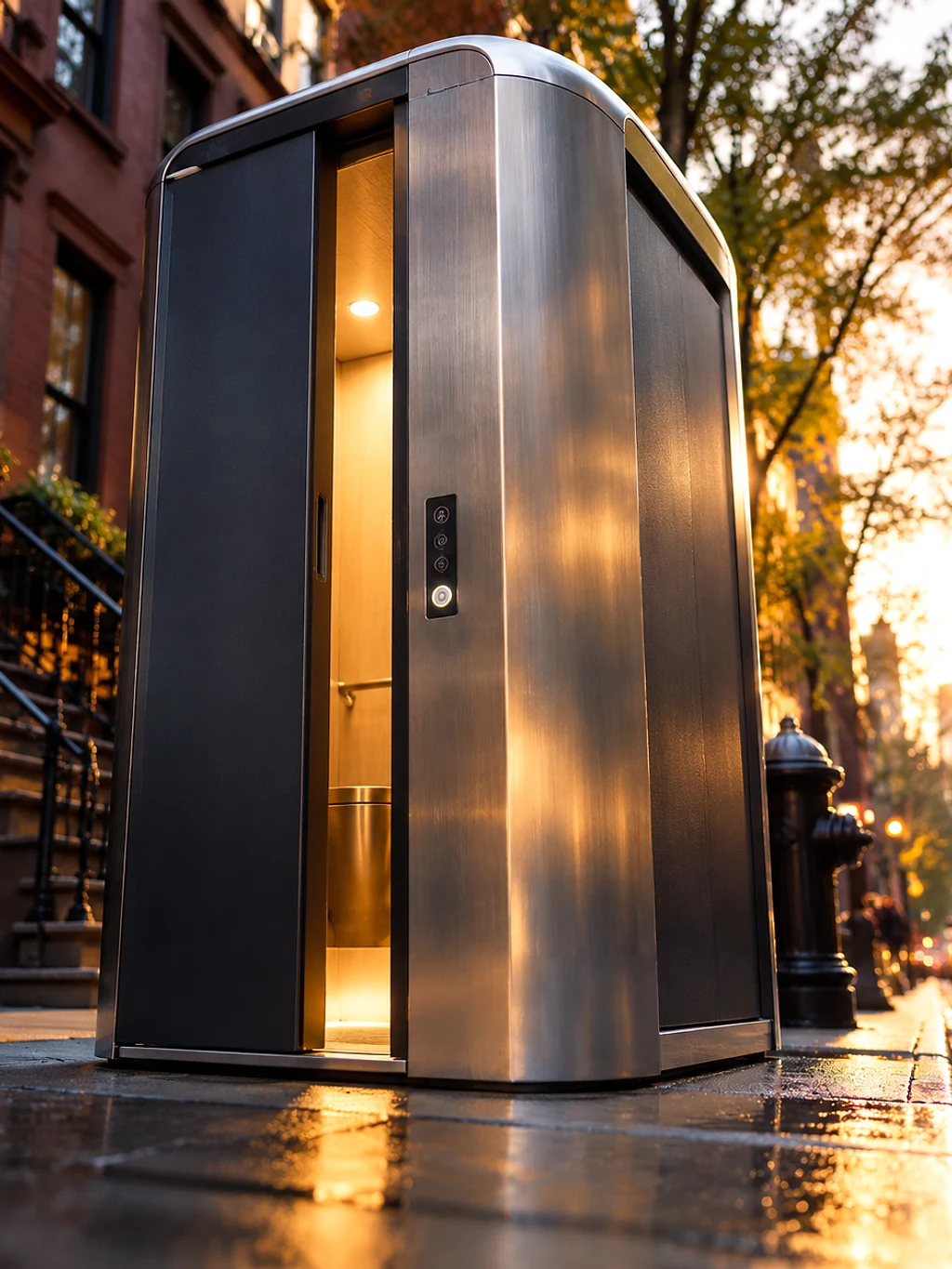
纽约街头的免费机器人厕所:十分钟一到,门自己打开,不管你好了没有
New York Put Free Toilets on the Street, and the Door Slides Open by Itself After Exactly Ten Minutes — Finished or Not
About this story
New York City has roughly 1,000 public toilets for more than eight million residents, and issued over 10,000 public-urination summonses last year. In September 2026 it put the first of a new kind on the sidewalk: free, unlocked by a text message or a tap card, and hard-capped at ten minutes, after which the door slides open on its own. Two are live in Brooklyn and Queens; seventeen more are coming on a $4 million pilot. Chinese listening practice at four levels. HSK 2 Chinese listening practice.
This is an HSK 2 Chinese listening episode that runs about 3 minutes. The full Mandarin script is shown with tap-for-pinyin and a line-by-line English translation, so you can listen and read at once — comprehensible input in the sense of Stephen Krashen's i+1 theory. It teaches 12 key vocabulary words such as 门、手机、分钟 and walks through 3 grammar patterns, each explained in English with examples. The same news story is retold at 4 difficulty levels — use the level selector above to find the version that is challenging but still understandable for you.
Read at your level
原文Read the complete story in Chinese. Reveal pinyin and English only when you need them.
English transcript reference
You are in New York, walking down the street.
You badly need a toilet.
But you cannot find one.
This is not a small matter.
New York has more than eight million people.
But the toilets everyone can use number only about a thousand.
Eight million people, a thousand toilets.
That is far too few.
So a lot of people are out on the street needing a toilet with nowhere to go.
Last year alone, New York issued fines to more than ten thousand people.
Why the fines?
Because they had urinated outside.
More than ten thousand tickets.
What that says is not that there is something wrong with people. It says there is something wrong with the toilets.
Now the city has come up with a plan.
It has put a new kind of toilet out on the street.
This kind of toilet costs nothing. It is free.
The door is normally locked.
You have to write a few words on your phone, and only then does it open.
What about people who have no phone?
The city also made a kind of card.
Touch the card to the door, and the door opens too.
Inside there is water, there is paper, and it is neither cold nor hot.
People with a small child can go in as well.
All of this is good.
But there is one rule a lot of people did not expect.
Once you are inside, you get ten minutes at most.
As the ten minutes runs down, it warns you once first.
When the ten minutes is up, it speaks.
It says: your time is up, the door is about to open.
Then the door opens by itself.
Whether you are finished or not, the door does not know, and does not ask.
Some people might think: I simply will not come out.
Not coming out will not help.
The company that makes these toilets will know.
If you stay in a long time, they may call the police.
Why exactly ten minutes?
Because there are few toilets and a lot of people.
If one person stays inside for an hour, everyone behind them cannot get in at all.
Ten minutes is the answer the city came up with.
Two of these toilets are already on the street.
One of them is in Brooklyn.
Seventeen more will be put out later.
The whole plan cost four million dollars.
New York's mayor said that too many New Yorkers know that feeling.
You are already out on the street, and there is nowhere you can go.
Now you are inside, and you are not finished.
You hear that voice: your time is up.
The door starts to open.
What will you do?
Listen again
Try it without the transcript and notice what sounds clearer.
What vocabulary does this episode teach?
词汇HSK 2. 门平时是关的 — locked by default, which is the design decision the episode examines.
HSK 2. 你要用手机写几个字,门才会开 — and the episode immediately asks who has no phone.
HSK 2. 最多只有十分钟 — 最多 is what turns a duration into a rule.
HSK 2. 这说的不是人的问题,是厕所的问题 — the sentence the first third of the episode exists to earn.
HSK 2. 没有地方去 — said twice, once about the street and once in the mayor's words.
HSK 2. 一个人在里面一个小时 — the hour is what makes the ten minutes necessary.
The subject, and the noun the episode counts: 八百多万人,一千个厕所。
这种厕所不要钱,是免费的 — the gloss sits in the same sentence as the word.
一万多张罚单 — note the measure word 张, which is what a ticket takes.
HSK 3. 可是有一个规定,很多人没想到 — the hinge of the episode.
里面会先提醒你一次 — one warning, then the door.
他们可能会叫警察 — what happens at the far end of refusing to leave.
* beyond level超纲词
What grammar patterns appear in this episode?
语法……才会……
Only then will it happen. 才 placed before the verb marks a condition that must be met first, and nothing less will do.
你要用手机写几个字,门才会开。
这说的不是 A,是 B
What this really tells you is not A but B. A spoken move for redirecting the blame in a statistic, used here on ten thousand tickets.
这说的不是人的问题,是厕所的问题。
就是不……
就是 before a negated verb marks flat refusal rather than inability. 我就是不出去 is "I simply will not", not "I cannot".
有的人可能会想:我就是不出去。
Proper nouns
专有名词Free account
Keep learning from this story
Create a free account to keep saved words and your preferred level together.
- Keep words with their story context
- Remember your preferred level
- Build your vocabulary over time