
A Chinese podcast · Same story, 4 levels
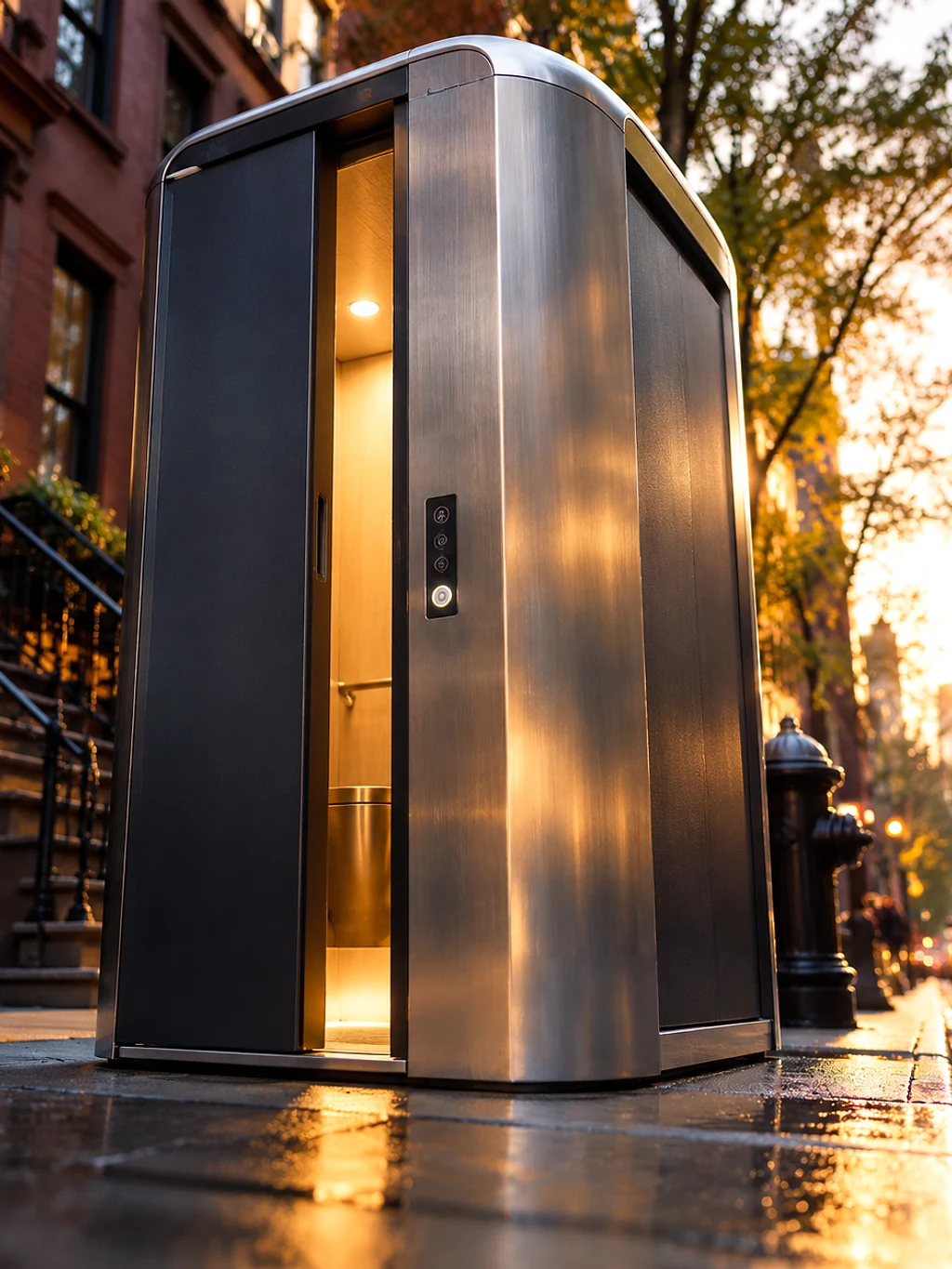
纽约街头的免费机器人厕所:十分钟一到,门自己打开,不管你好了没有
New York Put Free Toilets on the Street, and the Door Slides Open by Itself After Exactly Ten Minutes — Finished or Not
About this story
New York City has roughly 1,000 public toilets for more than eight million residents, and issued over 10,000 public-urination summonses last year. In September 2026 it put the first of a new kind on the sidewalk: free, unlocked by a text message or a tap card, and hard-capped at ten minutes, after which the door slides open on its own. Two are live in Brooklyn and Queens; seventeen more are coming on a $4 million pilot. Chinese listening practice at four levels. HSK 1 Chinese listening practice.
This is an HSK 1 Chinese listening episode that runs about 2 minutes. The full Mandarin script is shown with tap-for-pinyin and a line-by-line English translation, so you can listen and read at once — comprehensible input in the sense of Stephen Krashen's i+1 theory. It teaches 12 key vocabulary words such as 开、关、水 and walks through 3 grammar patterns, each explained in English with examples. The same news story is retold at 4 difficulty levels — use the level selector above to find the version that is challenging but still understandable for you.
Read at your level
原文Read the complete story in Chinese. Reveal pinyin and English only when you need them.
English transcript reference
You are not at home.
You are outside.
Right now you badly need a toilet.
Where is the toilet?
You look, and you look. There is no toilet.
You walk, and you walk. Still no toilet.
New York has a great many people.
More than eight million of them.
But New York does not have many toilets.
A lot of people are unhappy about it.
Now New York has a new kind of toilet.
This new toilet is not inside a home.
This new toilet is not inside a shop either.
It is outside.
You walk down the street, and you can see it.
This new toilet costs no money.
When something costs no money, we can also say: free.
This toilet is free.
You want to use it — so how do you get in?
You need a phone.
You write a few words on your phone.
The door opens.
You can go in.
You go in, and the door closes.
Open, closed.
Inside there is water.
This water is not for drinking.
This water is for washing your hands.
You can wash your hands.
Inside it is not cold and not hot.
Very nice.
But this new toilet is not like the others.
Once you are inside, you have ten minutes.
Ten minutes is not much.
Ten minutes goes fast.
As the ten minutes runs out, a voice speaks.
The voice says: your time is almost up.
Then the ten minutes is gone.
The voice speaks again: time is up, the door is opening now.
The door opens by itself.
If you are finished, the door opens.
If you are not finished, the door opens anyway.
The door does not ask you.
You do not want to leave — is that allowed?
It is not.
The people outside will know.
New York has two of these new toilets right now.
Seventeen more are coming.
Now you are inside.
The ten minutes is almost up.
The door is about to open.
What will you do?
Listen again
Try it without the transcript and notice what sounds clearer.
What vocabulary does this episode teach?
词汇HSK 1. The single most repeated word in the episode — 门开了, 门自己开了, 门也开. Everything turns on it.
HSK 1. Taught as the pair to 开 in one line: 你进去,门就关了。开,关。
HSK 1. 这个水不是喝的。这个水是洗手的。— two uses of one noun, separated on purpose.
HSK 1. 这个新厕所不要钱 — the episode defines 免费 out of this word rather than assuming it.
HSK 1. 你在手机上写几个字 — how you open a locked door in 2026.
HSK 1. 你走在路上,你可以看见它 — the whole point is that it is out where you can see it.
The subject. Introduced in line three, before any of the news, because the need comes first.
HSK 2. 门不问你 — the flattest, hardest line in the episode.
Taught, not assumed: 不要钱,我们也可以说:免费。
HSK 2. 十分钟 appears seven times. The number is the story.
HSK 2. The key to the door — no coin slot, no handle.
HSK 2. 十分钟快到了,有一个声音 — you never see who is speaking.
* beyond level超纲词
What grammar patterns appear in this episode?
语法A,B 也……
Whether A or B, the same thing happens anyway. Putting the two cases on consecutive lines and repeating the verb is how Chinese says a rule applies regardless.
你好了,门开。
你没好,门也开。
这个……不是……的,是……的
The 是……的 frame classifies what something is FOR. Used here to separate two uses of one noun without any new vocabulary.
这个水不是喝的。
这个水是洗手的。
快……了
About to happen, nearly here. Wrapped around a time expression it creates the countdown the whole episode runs on.
十分钟快到了。
你的时间快到了。
Proper Nouns
专有名词Free account
Keep learning from this story
Create a free account to keep saved words and your preferred level together.
- Keep words with their story context
- Remember your preferred level
- Build your vocabulary over time