
A Chinese podcast · Same story, 4 levels
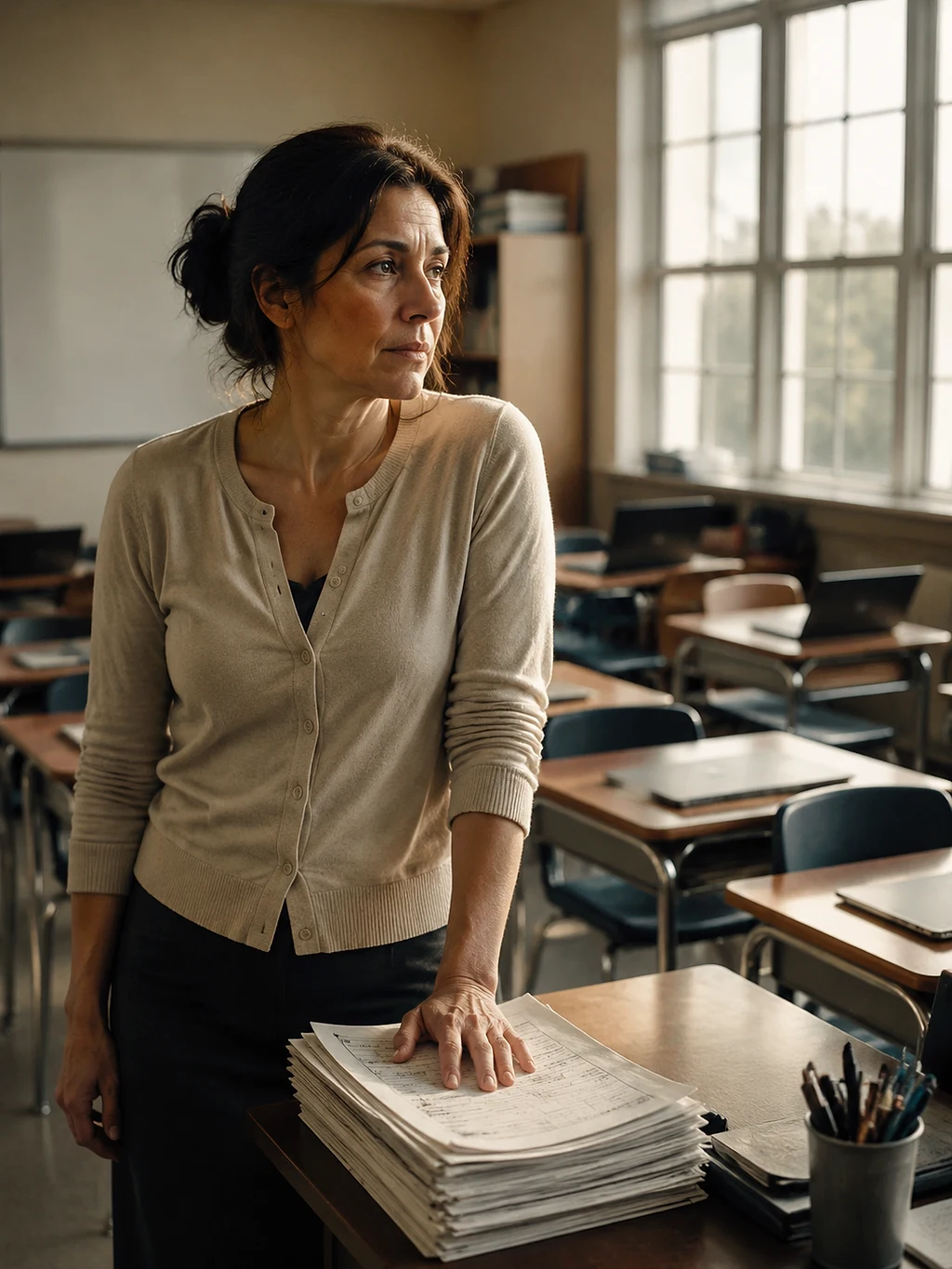
纽约禁止六十万中小学生在校用 AI:反对的人说,这还不够
NYC Bans AI in Schools for 600,000 Children
About this story
New York City, the largest school district in America, has banned generative AI for 600,000 students from pre-K through 8th grade — while letting teachers keep using it. The loudest objection is that one year is too short. Chinese listening practice at four levels. HSK 1 Chinese listening practice.
This is an HSK 1 Chinese listening episode that runs about 3 minutes. The full Mandarin script is shown with tap-for-pinyin and a line-by-line English translation, so you can listen and read at once — comprehensible input in the sense of Stephen Krashen's i+1 theory. It teaches 12 key vocabulary words such as 学校、学生、老师 and walks through 3 grammar patterns, each explained in English with examples. The same news story is retold at 4 difficulty levels — use the level selector above to find the version that is challenging but still understandable for you.
Read at your level
原文Read the complete story in Chinese. Reveal pinyin and English only when you need them.
English transcript reference
Today we are talking about schools.
In America there is a very big city called New York.
New York has a lot of people, and a lot of schools.
In those schools there are six hundred thousand students.
Six hundred thousand is a great many students.
Some of them are seven, some are ten, some are thirteen.
They go to school, they read, they write.
A few days ago, New York announced something.
New York said: at school, students may not use AI.
What is AI?
AI lives in the computer.
You ask AI a question, and AI gives you the answer.
You need to write something, and AI writes it for you.
AI writes fast, and it writes well.
A lot of students love AI.
Before, students were allowed to use AI.
A student had a question, so they asked AI.
A student had to write something, so they told AI to write it.
The student did not think for themselves, and still handed in good work.
Now New York says: no more.
Seven-year-olds may not use it.
Ten-year-olds may not use it.
Thirteen-year-olds may not use it either.
Why?
Listen.
New York says: students have to think for themselves.
Students have to write for themselves.
Students have to read for themselves.
When you are small, the thing you are learning is how to think.
AI can write, and AI can give you an answer.
But AI cannot think for you.
If you do not think yourself, you do not learn.
There is something here a lot of people do not expect.
Students may not use it — teachers may.
What do teachers use AI for?
Teachers use AI to make the things students will look at.
The teacher looks it over, then teaches the students.
What the students learn is what the teacher taught.
New York also said: students should not look at a screen too long each day.
Eight, nine and ten-year-olds: thirty minutes a day.
Eleven, twelve and thirteen-year-olds: forty-five minutes a day.
New York says: in a year, we will look at this again.
In a year, New York will say whether this was good or not.
Some people are very glad.
Some people say: one year is too little.
They want New York to go further.
Think about it: back when you were small and learning to write.
Somebody writes it for you.
You write beautifully, and quickly.
But you yourself — did you learn?
Listen again
Try it without the transcript and notice what sounds clearer.
What vocabulary does this episode teach?
词汇HSK 1. Where the whole story happens: 在学校里,学生不可以用 AI。
HSK 1. Six hundred thousand of them — 有六十万个学生。
HSK 1. The turn of the episode: 学生不可以用,老师可以用。
HSK 1. Where AI lives, in the script's own words: AI 在电脑里。
HSK 1. The thing AI does for you, and the thing you stop learning: AI 就给你写。
HSK 1. The heart of the argument: 可是 AI 不会帮你想。
The verb the whole policy turns on — 不可以用 AI. Repeated throughout so it sticks.
Introduced with floor words: 在美国,有一个很大的城市,叫纽约。
What AI hands over for free: 你问 AI 一个问题,AI 就给你答案。
The word that carries the moral: 学生要自己想。
Used for the thing AI cannot do — 可是 AI 不会帮你想 — and again in the closing question.
What the teacher still does: 老师看了,再教学生。
* beyond level超纲词
What grammar patterns appear in this episode?
语法不可以 + verb
Says something is not permitted (as opposed to not possible). It is the sentence the whole news story is made of, so the episode repeats it many times.
在学校里,学生不可以用 AI。
七岁的学生,不可以用。
现在,纽约说:不可以用了。
A 就 B
B follows immediately from A. It is what makes AI sound effortless in this episode — you ask, and instantly the answer is there.
你问 AI 一个问题,AI 就给你答案。
学生有问题,就问 AI。
你自己不想,你就学不会。
要自己 + verb
Says you must do it yourself. 自己 sits between 要 and the verb, and repeating it is how the episode makes its argument without ever editorialising.
纽约说:学生要自己想。
学生要自己写字。
学生要自己看书。
Proper nouns
专有名词Sources
来源Free account
Keep learning from this story
Create a free account to keep saved words and your preferred level together.
- Keep words with their story context
- Remember your preferred level
- Build your vocabulary over time