
A Chinese podcast · Same story, 4 levels
十二万分之一:用一百块赢了毕加索
Ari Hodara Wins Picasso in €100 Raffle
About this story
Ari Hodara paid 100 euros for a Paris raffle ticket and won a real Picasso painting of Dora Maar — odds 1 in 120,000. HSK 3 Chinese listening practice.
This is an HSK 3-4 Chinese listening episode that runs about 6 minutes. The full Mandarin script is shown with tap-for-pinyin and a line-by-line English translation, so you can listen and read at once — comprehensible input in the sense of Stephen Krashen's i+1 theory. It teaches 12 key vocabulary words such as 抽奖、运气、世界 and walks through 3 grammar patterns, each explained in English with examples. The same news story is retold at 4 difficulty levels — use the level selector above to find the version that is challenging but still understandable for you.
Read at your level
原文Read the complete story in Chinese. Reveal pinyin and English only when you need them.
English transcript reference
Speaking of the most heartwarming news recently, this story definitely makes the list.
A Frenchman spent one hundred and seventeen dollars.
And won a one-million-dollar original Picasso in a charity raffle.
One in 120,000 odds.
He won.
The main character of this story is Ari Hodara.
Fifty-eight years old.
Parisian.
Works as a sales engineer.
He's not some millionaire.
Not some collector.
Just an ordinary person who likes visiting museums.
How did he find out about this raffle?
He was eating at a restaurant in Paris.
While eating, he saw a piece of news.
About a charity event called "Win a Picasso for 100 Euros."
100 euros per ticket.
About 117 dollars.
All proceeds go to funding Alzheimer's research.
Alzheimer's is what we commonly call dementia.
A disease that gradually makes people lose memory and cognitive ability.
Very cruel.
Currently there's no cure.
The original purpose of this charity raffle was to raise money for research.
And incidentally give ordinary people a chance to own something impossible.
A real Picasso.
They issued 120,000 tickets total.
All sold out.
12 million euros.
About 14 million US dollars.
All going to Alzheimer's research.
Where was the raffle held?
At Christie's.
Christie's is one of the world's most famous auction houses.
The kind of place that sells paintings for tens of millions.
Getting to have a raffle at Christie's.
That sense of ceremony alone is quite unique.
120,000 tickets.
One drawn.
The result was Ari Hodara.
When he got the phone call he couldn't believe it.
He said he just happened to see the event while eating.
Thought 100 euros wasn't much.
It's for a good cause anyway.
So he bought one.
Then he won.
What's this painting called?
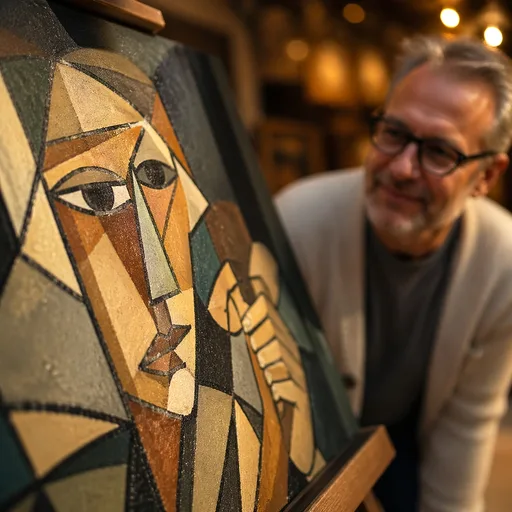
It's called "Head of a Woman."
Tête de femme.
Picasso painted it in 1941.
Who is the subject?
Dora Maar.
Dora Maar was one of Picasso's most important partners and sources of inspiration.
She herself was also an outstanding artist and photographer.
Picasso painted many portraits of her.
This "Head of a Woman" is one of them.
1941.
That was during World War II.
Paris was occupied by the Nazis.
Picasso painted this work in occupied Paris.
Eighty-five years later.
This painting, through a 100-euro raffle ticket.
Ended up in the hands of an ordinary Parisian.
Think about this image.
A Picasso painted in occupied Paris during World War II.
After eighty-five years.
After passing through countless collectors' hands.
Finally because of a charity event.
Because of someone's whim while eating at a restaurant.
It ended up in an engineer's home.
This kind of story only real life could write.
Ari calls himself an "amateur art enthusiast."
He likes Picasso.
But he never thought he could own a Picasso painting.
Because Picasso's works start at several million dollars on the market.
Top pieces have sold for over a hundred million.
This is a price ordinary people could never reach in a lifetime.
But this raffle broke through that barrier.
One hundred dollars.
One ticket.
A one in 120,000 chance.
He grabbed it.
Why does this story make people happy?
Because in a world full of bad news.
Occasionally there's a purely lucky story.
Nobody was hurt.
Nobody lost anything.
Money was used for good.
An ordinary person got something incredible.
The whole story is positive from beginning to end.
No twist.
No conspiracy.
Just pure good luck.
Sometimes life is just like this.
At your most casual moment.
While eating the most ordinary meal.
A random decision.
Can bring a lifetime of change.
One hundred and seventeen dollars.
One Picasso.
One in 120,000.
But it happened.
By the way, here's an interesting background.
Dora Maar is the woman in the painting.
She wasn't just Picasso's partner.
She was also a very accomplished artist and photographer in her own right.
She was well known in Surrealist circles.
The creation process of Picasso's famous painting "Guernica" was recorded by Dora Maar with her camera.
Those photographs themselves became important documents in art history.
But most people only know her as "Picasso's woman."
This "Head of a Woman" is a portrait of her.
But her story is much richer than what you can see in a painting.
Also, about this charity raffle model.
100 euros per ticket.
120,000 tickets all sold out.
Total raised: 14 million dollars.
The prize was only worth one million.
But the money raised was fourteen times the prize value.
This is a very clever approach.
Using people's desire for "what if" to raise money for good causes.
Each person only spent 100 dollars.
But added together it's a huge number.
One painting changed one person's life.
120,000 tickets funded Alzheimer's research.
That's why we say.
In this story.
Nobody lost.
Everyone won something.
Someone won a painting.
Someone won hope.
Someone won a good story that makes you smile.
In a world where every day is bad news.
Stories like this are too rare.
So I'm telling it to you.
I hope you smiled too.
Listen again
Try it without the transcript and notice what sounds clearer.
What vocabulary does this episode teach?
词汇An event where tickets are drawn randomly to determine a winner.
Good fortune that happens by chance.
HSK 1-3. world.
HSK 1-3. chance.
HSK 1-3. result; outcome.
HSK 1-3. event; activity.
One of the most famous painters in history. Spanish, 1881-1973.
A genuine artwork painted by the artist themselves.
A company that sells valuable items through bidding.
Giving money or help to those in need.
A brain disease that causes memory loss.
A person who collects valuable items.
* beyond level超纲词
What grammar patterns appear in this episode?
语法Proper Nouns
专有名词Sources
来源Free account
Keep learning from this story
Create a free account to keep saved words and your preferred level together.
- Keep words with their story context
- Remember your preferred level
- Build your vocabulary over time