
A Chinese podcast · Same story, 4 levels
巴黎一家医院地下挖出两千年前的古墙:巴黎可能就是从这里开始的
A 2,000-Year-Old Wall Dug Up Under a Paris Hospital May Show Where Paris Began
About this story
Works to shore up the Hôtel-Dieu hospital on Paris's Île de la Cité uncovered a 22-meter stone-and-wood Gallic wall, carbon-dated to 200–10 BC, with traces of fire, charred seeds and a spearhead. Julius Caesar wrote that Lutetia stood on an island in the Seine and that the Gauls burned it before Rome arrived in 52 BC — but for decades scholars doubted the island, some arguing for Nanterre. One archaeologist who once wrote it wasn't there now says he has no doubt. Chinese listening practice at four levels. HSK 3 Chinese listening practice.
This is an HSK 3-4 Chinese listening episode that runs about 4 minutes. The full Mandarin script is shown with tap-for-pinyin and a line-by-line English translation, so you can listen and read at once — comprehensible input in the sense of Stephen Krashen's i+1 theory. It teaches 12 key vocabulary words such as 发现、改变、研究 and walks through 3 grammar patterns, each explained in English with examples. The same news story is retold at 4 difficulty levels — use the level selector above to find the version that is challenging but still understandable for you.
Read at your level
原文Read the complete story in Chinese. Reveal pinyin and English only when you need them.
English transcript reference
Where exactly did Paris begin?
French scholars have argued over this question for many years.
Recently, an ancient wall found under a hospital may have given an answer.
In the center of Paris, there's a small island in the Seine called the Île de la Cité.
On the island is a very old hospital, the Hôtel-Dieu.
This summer, work was under way beneath the hospital to shore up the building.
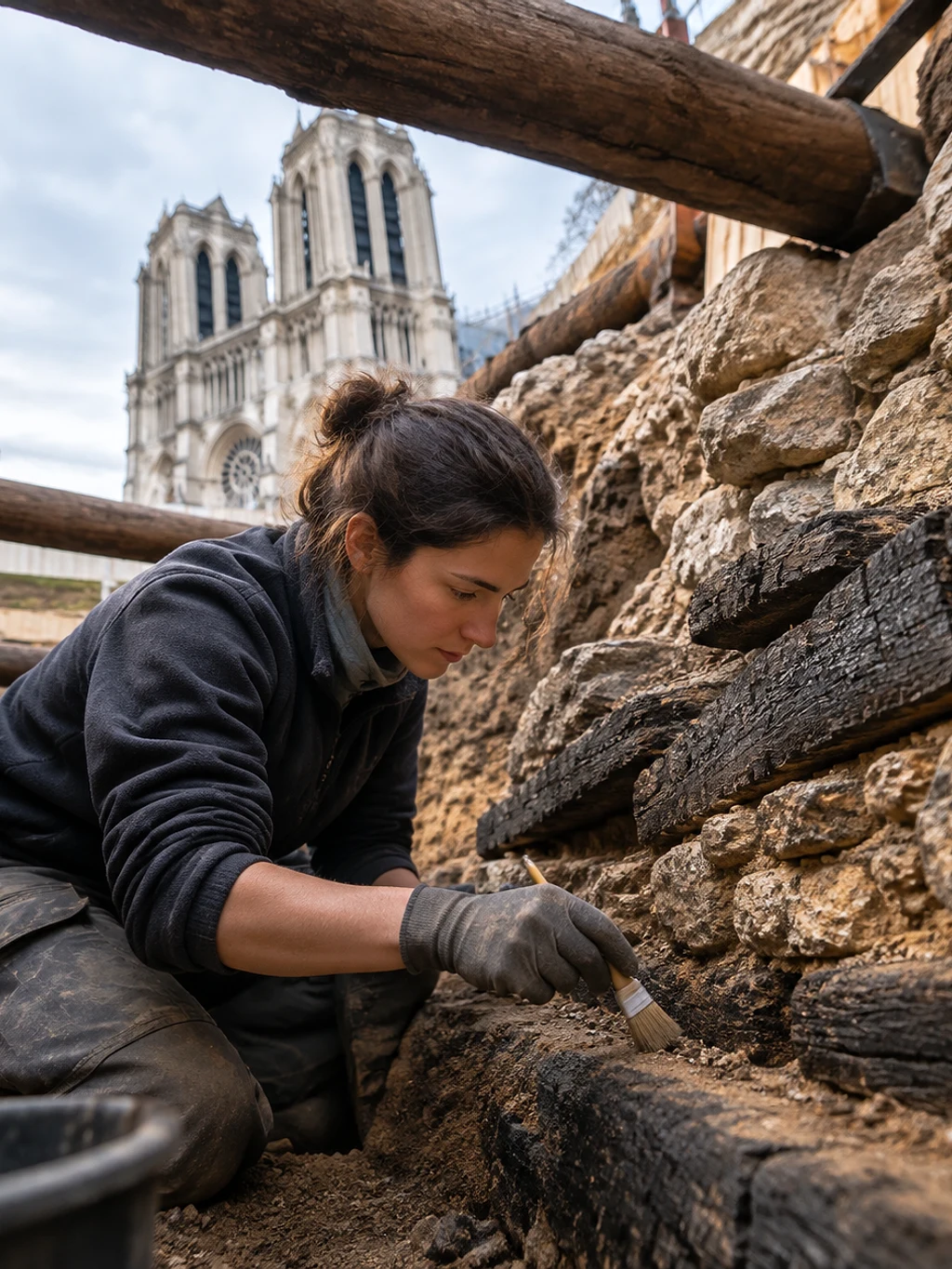
Workers on the site dug out a wall twenty-two meters long, built of stone and wood.
Next to it was a Gallic spearhead.
Archaeologists say this kind of wall is a typical late Iron Age Gallic fortification.
In a statement on Wednesday, France's culture minister said it's one of the most important archaeological finds for understanding Gallic-era Paris.
To understand why, we have to go back more than two thousand years.
Back then, Paris wasn't yet called Paris; its Latin name was Lutetia.
Lutetia was built by a Gallic tribe living along the Seine, who may have been there as early as the fourth century BC.
From 58 to 50 BC, the Romans and the Gauls fought for years.
The Roman general Julius Caesar wrote a book about the war.
In it, he described Lutetia as a town on an island in the Seine.
He also wrote that when the Gauls heard the Roman army was coming, they ordered Lutetia burned and cut down the town's bridges.
In 52 BC, Rome took the town.
The problem is that Caesar's description was very vague, and there had never been any archaeological proof.
So scholars argued for a long time: was Lutetia on the Île de la Cité or not?
Some believed it was actually in Nanterre, a suburb west of Paris, because important finds were made there in the 1990s.
Matthieu Poux, an archaeology professor at the University of Lyon II, once thought so too.
He says that in the 1990s the evidence was really very thin, so he wrote that Lutetia probably wasn't on the Île de la Cité.
But this discovery has changed his mind.
He says he now has no doubt at all that the ancient town was on the Île de la Cité.
Why so sure?
First, scientists carbon-dated wood from the wall, and the results show it was built between 200 BC and 10 BC.
That's exactly the period Caesar wrote about.
Second, the wall bears traces of fire.
The site also yielded charred seeds and the remains of a burned wooden building.
That may match what Caesar wrote: the Gauls set fire to their own town before fleeing.
Still, the culture minister also said the wall's purpose and date need more research to confirm.
In fact, a lot is already known about Roman-era Paris.
Many Roman artifacts have been found in today's Latin Quarter.
And a Roman residential area was found under the Luxembourg Gardens.
But Gallic-era Paris has always been a mystery.
Professor Poux says this one dig alone has multiplied the data on Gallic Paris tenfold.
France's culture ministry says digging will continue nearby, and the whole wall will eventually be moved for study and display.
The mayor of Paris also said the city will share this heritage with everyone who loves Paris.
If you went to Paris one day, would you rather see this wall, or the Eiffel Tower?
Listen again
Try it without the transcript and notice what sounds clearer.
What vocabulary does this episode teach?
词汇HSK 3. 最重要的考古发现之一.
HSK 3. 这次的发现,让他改变了看法.
HSK 3. 还需要更多研究来确认.
HSK 2. 有些人认为,它其实在楠泰尔.
HSK 3. 结果显示,这道墙建于公元前两百年到公元前十年之间.
HSK 2. 问题是,凯撒写得太模糊了.
考 (examine) + 古 (ancient). 考古学家 / 考古证据.
凯撒把这场战争写成了一本书 — the Gallic Wars.
公元前五十二年,罗马占领了这座城.
凯撒写得太模糊了 — why scholars argued.
一直没有考古证据.
要把这份遗产和所有热爱巴黎的人分享.
* beyond level超纲词
What grammar patterns appear in this episode?
语法到底……?
On earth, exactly — a question that has gone unanswered.
巴黎到底是从哪里开始的?
建于 + time
Formal "built in": 于 marks the time.
首先,科学家对墙里的木头做了碳测年,结果显示,这道墙建于公元前两百年到公元前十年之间。
首先……其次……
First… second… — lays out evidence.
首先,科学家对墙里的木头做了碳测年,结果显示,这道墙建于公元前两百年到公元前十年之间。
其次,墙上有被火烧过的痕迹。
Proper Nouns
专有名词Free account
Keep learning from this story
Create a free account to keep saved words and your preferred level together.
- Keep words with their story context
- Remember your preferred level
- Build your vocabulary over time