
A Chinese podcast · Same story, 4 levels
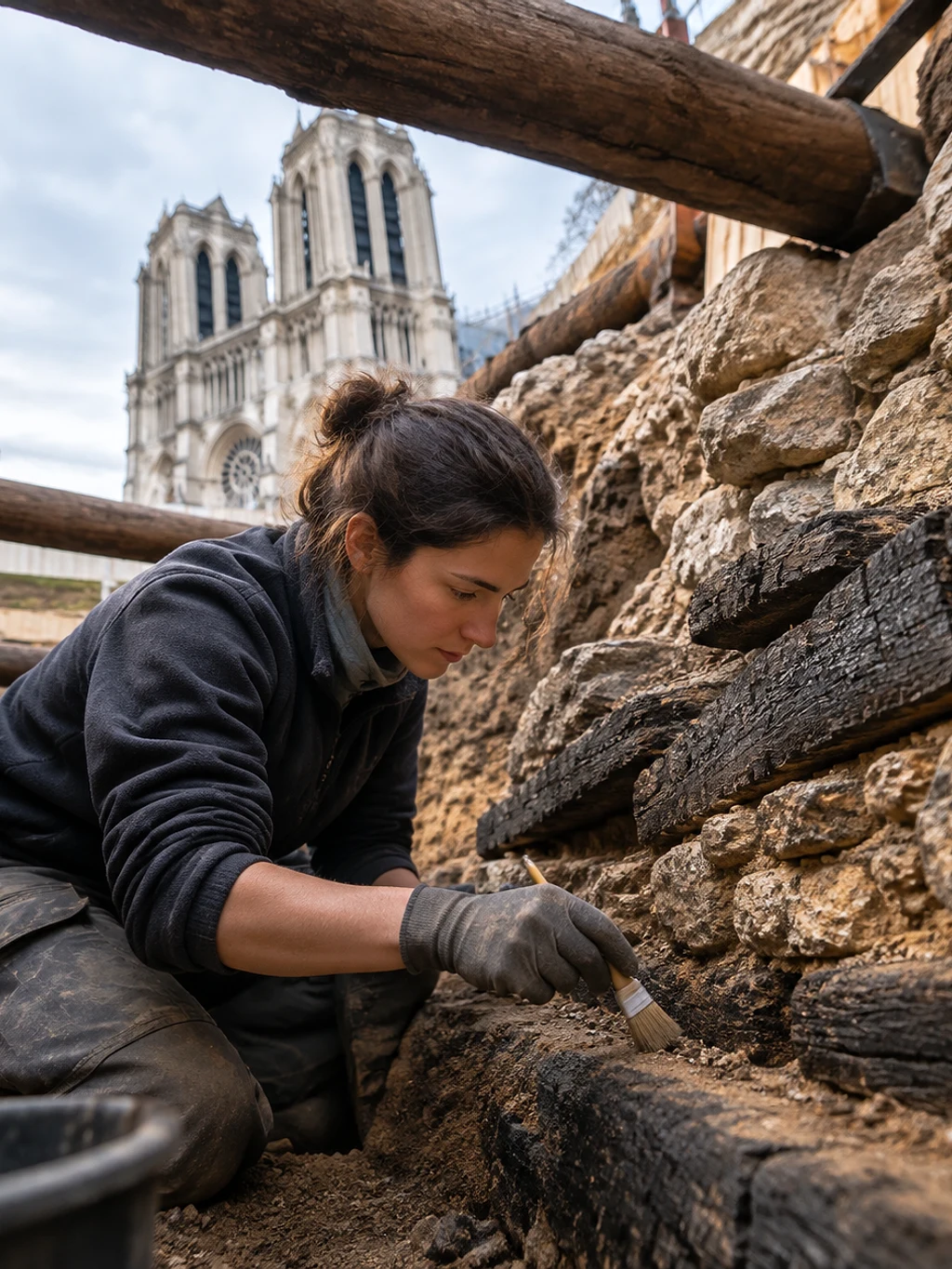
巴黎一家医院地下挖出两千年前的古墙:巴黎可能就是从这里开始的
A 2,000-Year-Old Wall Dug Up Under a Paris Hospital May Show Where Paris Began
About this story
Works to shore up the Hôtel-Dieu hospital on Paris's Île de la Cité uncovered a 22-meter stone-and-wood Gallic wall, carbon-dated to 200–10 BC, with traces of fire, charred seeds and a spearhead. Julius Caesar wrote that Lutetia stood on an island in the Seine and that the Gauls burned it before Rome arrived in 52 BC — but for decades scholars doubted the island, some arguing for Nanterre. One archaeologist who once wrote it wasn't there now says he has no doubt. Chinese listening practice at four levels. HSK 1 Chinese listening practice.
This is an HSK 1 Chinese listening episode that runs about 3 minutes. The full Mandarin script is shown with tap-for-pinyin and a line-by-line English translation, so you can listen and read at once — comprehensible input in the sense of Stephen Krashen's i+1 theory. It teaches 12 key vocabulary words such as 医院、书、老师 and walks through 3 grammar patterns, each explained in English with examples. The same news story is retold at 4 difficulty levels — use the level selector above to find the version that is challenging but still understandable for you.
Read at your level
原文Read the complete story in Chinese. Reveal pinyin and English only when you need them.
English transcript reference
Paris is big, and very beautiful.
Lots of people love going to Paris.
Did you know?
Long, long ago, Paris was a very, very small place.
Back then, where was Paris?
Lots of people want to know.
Today, we're talking about a wall.
This wall is under a hospital in Paris.
The hospital is very old, and very big.
Right now, people are working at the hospital, digging underneath it.
They found this wall.
The wall is long — more than twenty meters.
The wall has stone in it, and wood too.
How many years old is this wall?
More than two thousand years.
More than two thousand years ago, some people lived there.
Back then, the place wasn't called Paris.
Then the Romans came.
One Roman was called Caesar — everyone knows him.
Caesar wrote a book.
The book says: those people lived on a small island.
The island was in a river.
The book also says: when the Romans came, those people burned their own homes.
So where was this island?
For many years, nobody knew.
Paris has a river, and in the river there's a small island too.
Some people said: it's this island.
Others said: it's not this island, it's somewhere else.
One professor used to say it too: not this island.
Now, he has seen this wall.
He says: now I know — it's this island.
Why?
Because this wall is from more than two thousand years ago.
And there's burned wood there too.
That matches what Caesar wrote in his book.
So the Paris of two thousand years ago was very probably on this island.
And where is that hospital?
Right on this island.
Later, the wall will go to a new place, and everyone will be able to go and see it.
If you went to Paris, would you like to go and see this wall?
Listen again
Try it without the transcript and notice what sounds clearer.
What vocabulary does this episode teach?
词汇HSK 1. 这道墙在巴黎的一个医院下面 — and the payoff: the hospital is on that island.
HSK 1. 凯撒写了一本书 — the only written clue for 2,000 years.
HSK 1. 有一个老师,以前也说:不是这个小岛 — the scholar who changed his mind.
HSK 1. 很多年,大家都不知道 / 我现在知道了.
HSK 1. 巴黎很大,也很漂亮.
HSK 1. 很多人都喜欢去巴黎.
Measure word 道: 一道墙. The find at the center of the story.
他们在医院下面挖 — how the wall was found.
墙里有石头,也有木头.
小岛 — Caesar said the town was on one; the question was which.
巴黎有一条河 — measure word 条.
那些人烧了自己的家 / 那里还有烧过的木头 — the clue that matches Caesar.
* beyond level超纲词
What grammar patterns appear in this episode?
语法有 + 多少 + 年了?
Asks how long something has existed; the answer drops the verb: 两千多年了.
这道墙有多少年了?
就是……
Exactly, precisely — used for the answer to the mystery.
他说:我现在知道了,就是这个小岛。
和……一样
The same as — how the evidence matches the book.
这和凯撒书里写的一样。
Proper Nouns
专有名词Free account
Keep learning from this story
Create a free account to keep saved words and your preferred level together.
- Keep words with their story context
- Remember your preferred level
- Build your vocabulary over time