
A Chinese podcast · Same story, 4 levels
巴黎一家医院地下挖出两千年前的古墙:巴黎可能就是从这里开始的
A 2,000-Year-Old Wall Dug Up Under a Paris Hospital May Show Where Paris Began
About this story
Works to shore up the Hôtel-Dieu hospital on Paris's Île de la Cité uncovered a 22-meter stone-and-wood Gallic wall, carbon-dated to 200–10 BC, with traces of fire, charred seeds and a spearhead. Julius Caesar wrote that Lutetia stood on an island in the Seine and that the Gauls burned it before Rome arrived in 52 BC — but for decades scholars doubted the island, some arguing for Nanterre. One archaeologist who once wrote it wasn't there now says he has no doubt. Chinese listening practice at four levels. HSK 5-6 Chinese listening practice.
This is an HSK 5-6 Chinese listening episode that runs about 5 minutes. The full Mandarin script is shown with tap-for-pinyin and a line-by-line English translation, so you can listen and read at once — comprehensible input in the sense of Stephen Krashen's i+1 theory. It teaches 12 key vocabulary words such as 怀疑、城市、历史 and walks through 3 grammar patterns, each explained in English with examples. The same news story is retold at 4 difficulty levels — use the level selector above to find the version that is challenging but still understandable for you.
Read at your level
原文Read the complete story in Chinese. Reveal pinyin and English only when you need them.
English transcript reference
Where exactly did Paris begin?
It sounds like a simple question, but French scholars have been arguing about it for decades.
Recently, an old wall dug up beneath a hospital has, for the first time, begun to make the answer clear.
The hospital is the Hôtel-Dieu, on the Île de la Cité in the heart of Paris.
The Île de la Cité is a small island in the middle of the Seine; Notre-Dame Cathedral stands on it too.
This summer, work began underground to shore up the hospital building.
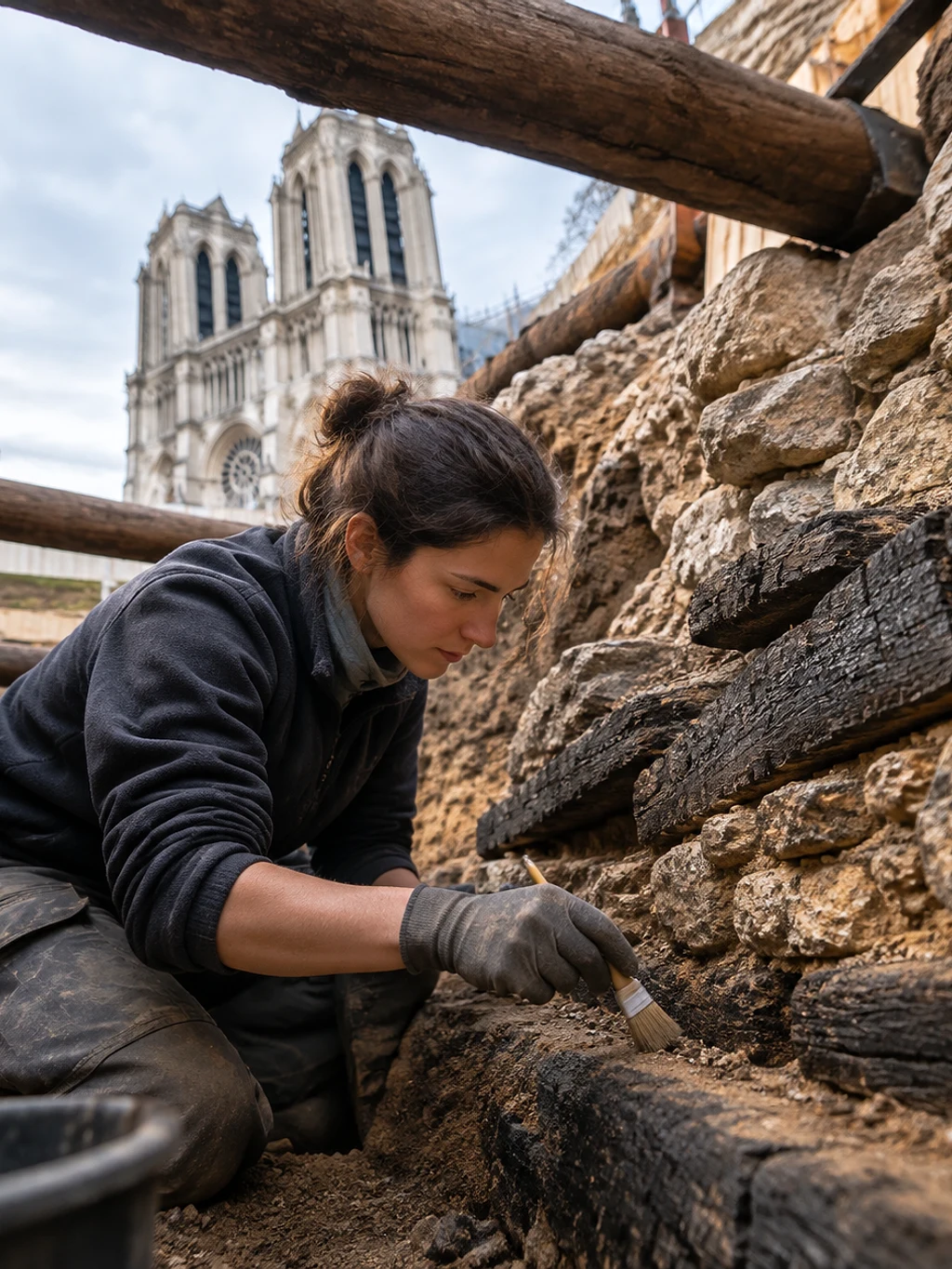
Archaeologists on the site discovered this wall.
It's about twenty-two meters long, built of stone and wood, and next to it lay a Gallic spearhead.
Experts say this kind of wall is a typical defensive structure of the Gauls in the late Iron Age.
The Iron Age ended around the first century BC.
In a statement on Wednesday, French culture minister Catherine Pégard said it was one of the most important archaeological finds for understanding Gallic-era Paris.
To see why this matters, we have to go back more than two thousand years.
Back then, Paris wasn't called Paris; its Latin name was Lutetia.
It was built by a Gallic tribe living along the Seine, who may have settled here as early as the fourth century BC.
From 58 BC to 50 BC, the Romans fought a series of wars against the Gallic tribes, known to history as the Gallic Wars.
The Roman general Julius Caesar later wrote a book about them.
In it, he said Lutetia was a town of the Parisii, built on an island in the Seine.
He also wrote that when the Gauls heard the Roman army was coming, they ordered Lutetia set on fire and cut down the bridges leading into the town.
In 52 BC, the Romans took the town.
The trouble is that Caesar's account is vague, and archaeology had never turned up any proof.
So where the Gallic town actually stood was debated for a long time in French academia.
Many doubted it was in what is now central Paris at all.
Some scholars, citing 1990s finds in Nanterre, a suburb west of Paris, argued that Lutetia was really in Nanterre.
Matthieu Poux, an archaeology professor at the University of Lyon II, says he thought so too at the time.
He says the evidence in the 1990s was really very scant, so he wrote that Lutetia probably wasn't on the Île de la Cité.
But this wall has changed his mind.
He says he now has no doubt at all that the ancient town was on the Île de la Cité.
Why is he so confident?
First, preliminary carbon dating of wood in the wall shows it was built between 200 BC and 10 BC.
That's exactly the period Caesar wrote about.
Second, the wall bears traces of fire.
The culture ministry says charred seeds and the remains of a burned wooden building were also dug up at the site.
This may well match the passage in Caesar: the Gauls set fire to their own town before the Romans arrived, and then fled.
Still, the culture minister stressed that more research is needed to confirm what the wall was for and exactly when it was built.
In fact, archaeologists already know a lot about Roman-era Paris.
Many Roman artifacts have been found beneath today's Latin Quarter.
A Roman residential area was also found under the Luxembourg Gardens, about a mile south of the Île de la Cité.
But Gallic-era Paris was almost a complete blank.
Professor Poux says this single excavation has multiplied the data on the period tenfold.
He believes it could be the starting point for a series of new discoveries on the island.
But he also cautions that digs on the island can only follow the pace of renovations to old buildings, so progress will be slow.
The culture ministry says more digging will take place nearby, and the whole wall will eventually be moved out for study and display.
Paris mayor Emmanuel Grégoire said the city will share this heritage with Parisians and with everyone who loves the city.
A city's earliest form is often hidden under the streets people walk every day.
If someone in your city dug up a two-thousand-year-old wall, what's the first thing you'd want to know?
Listen again
Try it without the transcript and notice what sounds clearer.
What vocabulary does this episode teach?
词汇HSK 4. 很多人怀疑,它根本不在今天的巴黎市中心.
HSK 3. 一座城市最早的样子,常常就藏在人们每天走过的路下面.
HSK 2. 历史上叫高卢战争.
HSK 3. 还需要更多研究来确认.
HSK 3. 可是这道墙改变了他的想法.
HSK 3. 西岱岛上一系列新发现的开始.
考古人员 / 考古发现 / 考古学教授.
墙上有被火烧过的痕迹.
一个住在塞纳河边的高卢部落.
在法国学术界争论了很久.
岛上的考古只能跟着老建筑的翻修一点一点做.
市政府会把这份遗产,和巴黎人……一起分享.
* beyond level超纲词
What grammar patterns appear in this episode?
语法问题在于……
The problem lies in… — names the core difficulty.
问题在于,凯撒写得很模糊,考古上又一直没有找到证据。
根据……,认为……
Based on X, holds that Y — reports a scholarly position.
有些学者根据九十年代在巴黎西边郊区楠泰尔的考古发现,认为卢泰西亚其实在楠泰尔。
只能……,所以……
Can only… so… — a constraint and its consequence.
不过他也提醒,岛上的考古只能跟着老建筑的翻修一点一点做,所以进展会很慢。
Proper Nouns
专有名词Free account
Keep learning from this story
Create a free account to keep saved words and your preferred level together.
- Keep words with their story context
- Remember your preferred level
- Build your vocabulary over time