
A Chinese podcast · Same story, 4 levels
五角大楼终于打开了UFO档案:但答案是"我们也不知道"
Pentagon Releases 162 UFO Files
About this story
Pentagon's PURSUE program declassifies 162 UAP files — AARO, orbs launching orbs, Apollo 17 lunar lights. HSK 5-6 Chinese listening practice.
This is an HSK 5-6 Chinese listening episode that runs about 9 minutes. The full Mandarin script is shown with tap-for-pinyin and a line-by-line English translation, so you can listen and read at once — comprehensible input in the sense of Stephen Krashen's i+1 theory. It teaches 20 key vocabulary words such as 档案、解密、归档 and walks through 8 grammar patterns, each explained in English with examples. The same news story is retold at 4 difficulty levels — use the level selector above to find the version that is challenging but still understandable for you.
Read at your level
原文Read the complete story in Chinese. Reveal pinyin and English only when you need them.
English transcript reference
Today we're talking about a piece of news — on May 8, the Pentagon released 162 UFO files all at once.
Yes, UFOs, unidentified flying objects — the things we used to scribble in the margins of our schoolbooks, the things countless movies have depicted.
But this isn't a movie, isn't an underground publication, isn't a blurry video shot by some random user online.
This is the US government itself releasing them — documents plus photos plus videos, 162 in total, hosted on an official site called war.gov/ufo, free for anyone to see.
This sounds like a joke, but it's actually a fairly serious policy action.
We'll talk today about — what's actually inside?
Why now?
And most critically: what does all this really mean?
First, some background.
The official US agency handling UFO matters is called the All-domain Anomaly Resolution Office — AARO for short — under the Pentagon.
Their job is to collect, investigate, and archive every "strange aerial object" case reported by the military, police, and intelligence systems.
In the past, these files were mostly internal documents, invisible to outsiders.
This year, the Trump administration pushed a new program called PURSUE — full name: the Presidential Unsealings and Reporting System for UAP Encounters.
The 162 files released on May 8 are PURSUE's first "opening of the floodgates," with more to come.
The official line is that these are all "unsolved mysteries" — meaning the government investigated, but couldn't figure them out.
So they release them to the public, letting the world decide together — in Trump's own words, "what the hell is going on."
This style of disclosure itself is interesting enough.
Now let's talk about what's inside.
There are several stories in the files that really stick.
The first is the 2023 "orbs spawning orbs" case.
It happened across several western US states, over roughly two days.
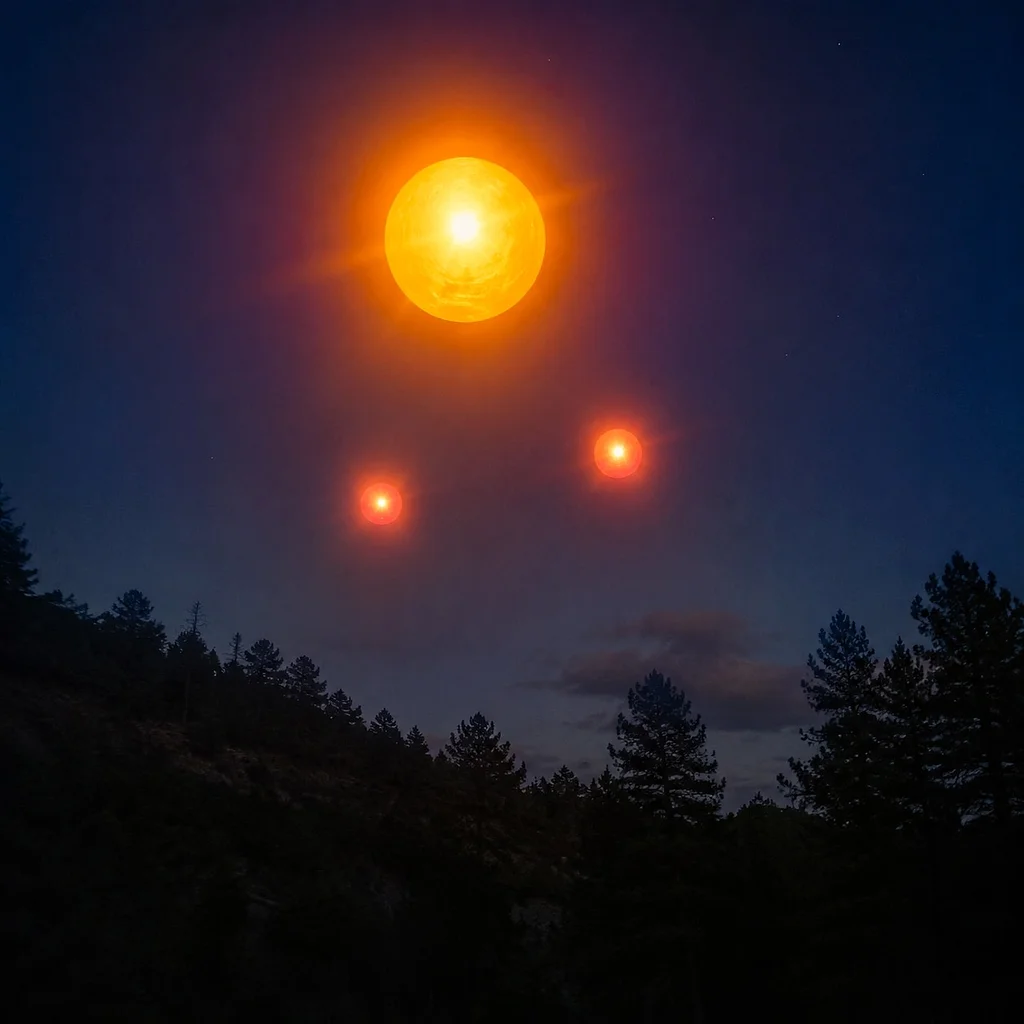
Seven federal law enforcement officers, each independently, reported a phenomenon they had never seen before — orange glowing orbs floating in the sky, "spawning" smaller red orbs.
A key phrase in the report was "orange orbs releasing smaller red orbs."
Beyond that, there was a huge glowing object hovering motionless in the air, and a "translucent kite"-like object.
More concretely, the FBI even produced a composite sketch — depicting a bronze ellipsoid object, estimated 40 to 60 meters long, bigger than a building.
AARO wrote in its assessment that this case is "among the most compelling currently in their holdings."
Notice their wording — "among the most compelling," not "the most compelling" — they still aren't saying this was an alien craft.
They're only saying: this case has many witnesses, the witnesses are professional, the phenomena are anomalous — enough to be "worth keeping an eye on."
The second story is the 2025 "thermal imaging" case — exact location redacted.
At the time, a military jet and a helicopter were flying together, and using infrared thermal imaging, they saw a "super hot" ellipsoid orb.
This object suddenly accelerated, then with a "snap" split into two, and immediately after, into four or five.
All ellipsoid, orange, with white-yellow centers.
The crew's description was very technical, no flowery language.
But imagine the scene — at night, at altitude, several orbs that split apart, hot enough to burn the infrared screen into a sheet of brightness.
That kind of thing sounds stranger than any sci-fi film.
The third part is the most spine-tingling section of the release — the Apollo lunar mission audio.
Yes, the Apollo program that put humans on the moon over fifty years ago.
The files include the Apollo 17 voice transcript, with this exchange:
"Wow, there's a whole bunch of bright ones outside my window — really bright."
"Once our eyes adjusted to darkness, we had light flashes basically continuously."
One crew member specifically emphasized: "These flashes — I believe they correspond to physical objects, not purely optical phenomena."
Just think about it — a person in lunar orbit, seeing glowing things he can't identify, and insisting "this isn't an illusion."
NASA has long stayed quiet about claims like this; now, this exchange is being formally archived and formally released by the Pentagon.
This level of "acknowledgment" is something the past sixty years had never seen.
Beyond that, the files also include: the clearest UFO photo ever, captured over Japan; and the clearest video, an infrared recording from 2024 by Indo-Pacific Command of a glowing orb — black and white, grainy,
but with a flight path that clearly violates common sense.
So let's return to the biggest question — are these aliens?
The Pentagon's answer is very restrained: to date, no assessment has been able to conclude that "this is extraterrestrial life."
They didn't say "yes" and they didn't say "no" — what they said is: "We've observed phenomena we can't explain."
This attitude is actually the most worth-tasting part of this release.
It's completely different from the "total denial" mode of the past several decades.
Before, ask about UFOs and you'd get "no comment"; now, ask about UFOs and you get "we'd like to know too."
This kind of position shift doesn't necessarily mean aliens have actually come.
What it means is: the US government has finally decided that, instead of continuing to keep secrets and be doubted, it's better to lay the uncertainty out in the open.
So why now?
I think three reasons are operating together.
First, congressional pressure.
Over the past few years, the US Congress has held several UFO hearings, with former intelligence officers, former pilots, and former contractors testifying that the government is still hiding things.
The public and lawmakers grew dissatisfied; releasing files is the government's response to that pressure.
Second, technological progress.
Today's sensors, infrared cameras, satellites, and AI image analysis are much stronger than twenty years ago.
What was unclear in the past is now partly clearer; the Pentagon is increasingly willing to say: "We saw real things — we just don't know what they are."
Third, it's a political posture.
The Trump administration likes to use "complete transparency" as language; the PURSUE program itself has a flashy name, and the release format is highly dramatic — website, Twitter, images, videos.
In other words, releasing files this time is half real policy, half political theater — and the two aren't contradictory.
As listeners, we can see both layers at once.
Finally, let's think — what does this disclosure really mean for ordinary people?
I think there are at least three things worth remembering.
First, "we don't know" is also a conclusion.
For a long time, we've assumed that things in the world can eventually be explained.
But these 162 files tell us: some phenomena, even for the most powerful nation with the most advanced sensors, currently have no answer.
"Currently no answer" is itself an important fact.
Second, professional witnesses matter.
The stories this time aren't roadside-uncle videos — they're reports from federal officers, military pilots, and astronauts.
Their training and their responsibilities make their words far weightier than typical leaks.
So the next time you see a "UFO video" online, you can ask: who saw it?
How did they see it?
With what equipment did they see it?
That question is more useful than "is this an alien?"
Third, disclosure itself is a sign of social maturity.
True maturity isn't saying "I know everything"; it's daring to say "we can't figure this one out either."
The Pentagon's attitude is a bit like: "Come on, take a look, you join the research too."
That posture is much healthier than the old "state secret, don't ask" stance.
So next time you look up at the sky and see an off-looking bright spot, don't immediately yell "aliens," and don't immediately blame your eyes.
You can quietly think: maybe this is a small case that will be archived into PURSUE in the future; maybe it's just a strange drone; maybe it's just a cloud with some reflection.
But whichever it is, you've already stood at a very special point in time — humanity has finally been willing to admit that the sky above our heads still hides things we can't read.
And for the first time, officials are willing to lay all of this, slowly, out for us to see.
That's enough.
Listen again
Try it without the transcript and notice what sounds clearer.
What vocabulary does this episode teach?
词汇HSK 6. The 162 official files released — keyword of the episode.
HSK 6. 解 (resolve) + 密 (secret). The verb at the heart of the PURSUE program.
HSK 6+. 归 (return/place) + 档 (file). 正式归档 = officially archived.
HSK 6. 目 (eye) + 击 (strike) + 者 (-er). Specifically eyewitnesses to events.
HSK 6. 五角大楼的回答非常克制 = the Pentagon's answer is very restrained.
HSK 6. 这种立场转变 = this kind of stance shift.
HSK 6. 政治姿态 = political posture. Often used for performative positioning.
HSK 5. 不是结论 = not a conclusion. Used in the editorial close.
HSK 4. 社会成熟的表现 = a sign of social maturity.
HSK 5. 不确定的东西 = things that are uncertain. Central to the episode's argument.
HSK 6. 异 (different) + 常 (normal). 'Anomaly' — the A in AARO and PURSUE.
HSK 6+. 联邦执法人员 = federal law enforcement officers. Specific to US/German political vocabulary.
Specialist (forensic). 合成 (composite) + 画像 (portrait). The FBI's bronze ellipsoid sketch.
Specialist (geometry). 椭 (oblong) + 球 (sphere) + 形 (shape). The shape from the FBI sketch.
Specialist. 红 (red) + 外 (outside, beyond). Refers to the heat-imaging technology used in the 2025 case.
HSK 6+. 传感 (transmit-sense) + 器 (instrument). Used in the 'why now' argument about technology.
Specialist. 听 (listen) + 证 (testify) + 会 (meeting). The Congressional UFO hearings that built pressure.
HSK 6+. 承包 (contract) + 商 (merchant). The defense contractors who testified about hidden programs.
HSK 5. 国家秘密、不许问 — the old posture of 保密.
Specialist. 地 (earth) + 外 (outside) + 生命 (life). The formal scientific term used by the Pentagon.
* beyond level超纲词
What grammar patterns appear in this episode?
语法X 不是 ... 而是 Y
Corrective: 'not X, but rather Y.' Heavy in argumentative prose.
他们没说"是",也没说"不是"——他们说的是:"我们看到了不能解释的现象。"
真的成熟,不是嘴上说"我什么都知道",而是敢于说"这件事我们也搞不清楚"。
也就是说,公开档案这件事,一半是真的政策,一半是政治表演。
X 与其 ...,不如 ...
'Rather than X, better Y.' Used to argue for one option over another.
美国政府终于决定,与其继续保密、被人怀疑,还不如把不确定的东西也摊开来说。
X 也就是说 ...
Apposition: 'that is to say' — used for restating or clarifying.
也就是说,这些都是"未解之谜"——也就是说,政府查了,但查不出来。
也就是说,公开档案这件事,一半是真的政策,一半是政治表演。
X 就是 ... 的地方 / 时刻
'X is precisely the place / moment of Y.' Used to mark the heart of an argument.
这种态度,其实就是这次公开最值得品味的地方。
你都已经站在了一个很特别的时间点。
X 把 + Object + Verb + Result (disposal)
Disposal construction with explicit result.
美国政府终于决定,与其继续保密,还不如把不确定的东西也摊开来说。
他们是把以前不公开的东西公开了。
官方愿意把这一切,慢慢地,摊给我们看。
X 的措辞 / 立场 / 姿态 ...
Editorial register: 'X's wording / position / posture is ...' Common in op-ed analysis.
注意他们的措辞——"最有说服力之一",不是"最有说服力"。
这种立场转变,不一定意味着外星人真的来了。
这种姿态,比过去那种"国家秘密、不许问"的姿态健康得多。
X 一半是 ... 一半是 ...
'Half X, half Y.' Used to argue that two interpretations coexist.
公开档案这件事,一半是真的政策,一半是政治表演——两者并不矛盾。
X 即便 / 就算 ... 也 ...
Concessive: 'even if X, still Y.'
就算政府放出来,也不代表答案出来了。
无论是哪种,你都已经站在了一个很特别的时间点。
Proper nouns
专有名词Free account
Keep learning from this story
Create a free account to keep saved words and your preferred level together.
- Keep words with their story context
- Remember your preferred level
- Build your vocabulary over time