
A Chinese podcast · Same story, 4 levels
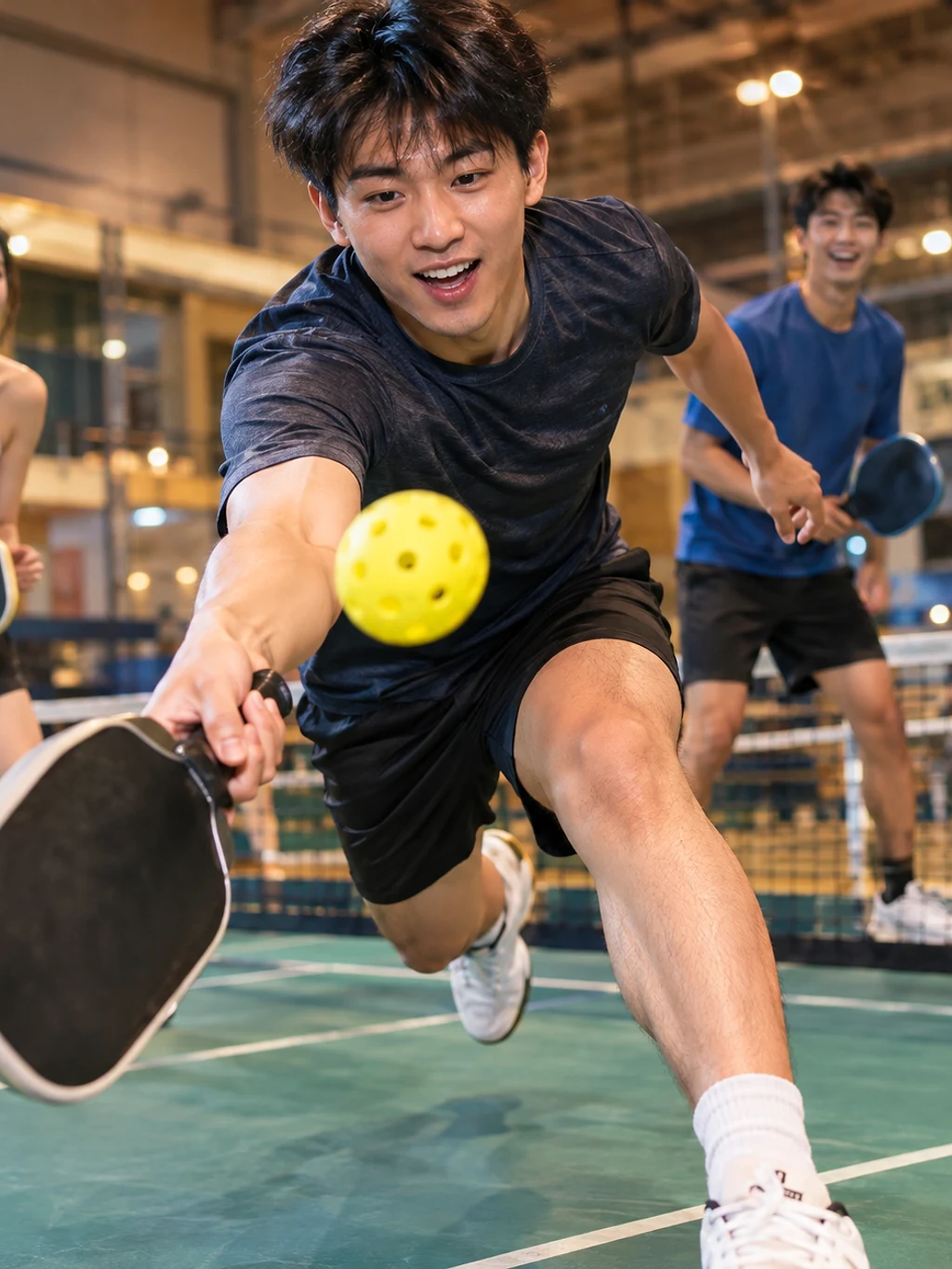
匹克球在中国火了:八百万人常打,一年一千场比赛
Pickleball Is Taking Off in China: 8 Million Regular Players and 1,000 Tournaments a Year
About this story
Pickleball — a paddle like an oversized ping-pong bat, a badminton-sized court, tennis-style bounces and a plastic ball full of holes — was invented in 1965 by two dads on an island in Washington State to entertain bored kids. Now about 8 million people in China play it regularly, and the China Pickleball Tour has grown from 80-odd stops in 2024 to about 1,000 this year. A Shenzhen student sums up its appeal: 'Just play and you get it.' Chinese listening practice at four levels. HSK 5-6 Chinese listening practice.
This is an HSK 5-6 Chinese listening episode that runs about 5 minutes. The full Mandarin script is shown with tap-for-pinyin and a line-by-line English translation, so you can listen and read at once — comprehensible input in the sense of Stephen Krashen's i+1 theory. It teaches 12 key vocabulary words such as 耐心、成本、条件 and walks through 3 grammar patterns, each explained in English with examples. The same news story is retold at 4 difficulty levels — use the level selector above to find the version that is challenging but still understandable for you.
Read at your level
原文Read the complete story in Chinese. Reveal pinyin and English only when you need them.
English transcript reference
A plastic ball with holes flies over a low net, bounces on the ground, and a paddle much bigger than a ping-pong paddle sends it back.
After a few exchanges, a real game starts to take shape.
This sport is called pickleball, and how fast it has spread in China has surprised a lot of people.
By estimates, about eight million people across the country play regularly, and around twenty million have tried it.
The China Pickleball Tour, founded only two years ago, has grown from eighty-some stops at first to about a thousand this year.
Why has a game born in an American family's backyard caught on in China?
Caixin interviewed a student it calls Joe, who started his first year at the Chinese University of Hong Kong in Shenzhen in September 2023.
Choosing a PE class, he wanted to avoid badminton, which he already knew well, and found tennis involved too much running; after watching videos online, he decided to try pickleball.
The first class began with bouncing the ball on the paddle; before long he could hit it over the net, and he summed it up in one line: just play and you get it.
That easy feeling has to do with what pickleball is like — it's a sort of blend of several sports.
Its paddle, with a short handle and a similar outline, is close to a ping-pong paddle, only with a bigger face, which makes the ball easier to hit.
Its court, 13.41 meters long and 6.1 meters wide, has exactly the same outer dimensions as a badminton doubles court, only with a lower net.
And its play is like tennis: the ball can bounce before you return it, or, when the rules allow, you can volley it straight out of the air.
So pickleball has the vivid nickname "three-not-alike," and some call it "three ball games in one."
Still, it has distinctive rules of its own.
On each side of the net is a non-volley zone just over two meters wide that players call "the kitchen"; standing in it, you can't volley.
That rule keeps players from smashing hard at the net all the time, so games need more patience and skill — brute strength alone rarely wins.
Pickleball's origin was actually pretty casual.
In the summer of 1965, on Bainbridge Island in Washington State, Joel Pritchard and Bill Bell wanted to get their bored kids moving.
They had a badminton court at home but not enough equipment, so they grabbed whatever paddles were at hand and a plastic ball with holes, and started hitting it across the badminton net.
Later they lowered the net and invited the neighbors, and the three families changed the rules as they played.
In 1967 the first permanent pickleball court was built; nine years later, the earliest known pickleball tournament was held in Washington State.
In recent years pickleball has become hugely popular in North America; according to a US sports-industry association, it's been America's fastest-growing sport three years running.
In China, pickleball spread roughly from the south.
In 2012, people returning from studying abroad brought it to Guangzhou.
In January 2018 the Shenzhen Pickleball Association was founded, the country's first professional pickleball organization.
In 2023, a department of China's General Administration of Sport set up the China Pickleball Working Committee, and competition rules and coach-training regulations followed one by one.
One important reason it spread so quickly is that courts are easy to convert.
A badminton court only needs a lower net, or a movable net on wheels, plus a few extra lines, to become a pickleball court.
Shenzhen has lots of badminton courts, and the low cost of converting them became one of the conditions for pickleball's early spread.
For young people, playing pickleball is like going to a party with a paddle in hand.
Doubles needs four players, the court isn't big, and when a game ends, people waiting at the side can rotate in.
One Shanghai club has more than 1,200 members, over seventy percent of them aged twenty to thirty-five.
For older people, it's a way to stay on the court.
Members of one Beijing club are mostly middle-aged and older, some nearly seventy, and many switched to pickleball because they could no longer run for tennis.
One enthusiast from Tianjin in her fifties later began traveling around the country with her paddle to compete, sightseeing along the way and making friends of every age and background.
With more competitions came more business.
About three hundred Chinese companies make pickleball products, and China is now one of the world's main producers of pickleball gear.
Brands like Li Ning, Anta and Adidas have launched pickleball products, and one industry group estimates China's pickleball equipment and services market passed 1.8 billion yuan in 2025.
A sport you "just play and get" is turning into big business.
What do you think matters most for a sport to really catch on: being fun, being cheap, or having people to play with?
Listen again
Try it without the transcript and notice what sounds clearer.
What vocabulary does this episode teach?
词汇HSK 4. 比赛更需要耐心和技术.
HSK 4. 这种改造成本低.
HSK 3. 早期推广的条件之一.
HSK 3. 一个重要原因是场地很好改.
HSK 2. 拍面更大,打起来更容易击中.
HSK 4. 增长到了今年的大约一千站.
一项诞生在美国家庭后院的游戏.
它像是几种运动的混合.
非截击区 — the "kitchen."
它能这么快推广开.
全球主要的匹克球装备生产国之一.
Equipment, training, venues and events together.
* beyond level超纲词
What grammar patterns appear in this episode?
语法只是……
Only / except that — adds a small difference.
它的球拍,短柄和轮廓都接近乒乓球拍,只是拍面更大,打起来更容易击中。
……,也成了……之一
Also became one of…
深圳羽毛球场多,这种改造成本低,也成了早期推广的条件之一。
Proper Nouns
专有名词Free account
Keep learning from this story
Create a free account to keep saved words and your preferred level together.
- Keep words with their story context
- Remember your preferred level
- Build your vocabulary over time