
A Chinese podcast · Same story, 4 levels
拼豆:漂亮的小珠子,为什么这么火?
Pindou Pixel Beads Hit 37B Xiaohongshu Views
About this story
A simple story about pindou pixel beads — the pretty little beads young people in China love to make together. HSK 1 Chinese listening practice.
This is an HSK 1 Chinese listening episode that runs about 7 minutes. The full Mandarin script is shown with tap-for-pinyin and a line-by-line English translation, so you can listen and read at once — comprehensible input in the sense of Stephen Krashen's i+1 theory. It teaches 18 key vocabulary words such as 朋友、做、看 and walks through 7 grammar patterns, each explained in English with examples. The same news story is retold at 4 difficulty levels — use the level selector above to find the version that is challenging but still understandable for you.
Read at your level
原文Read the complete story in Chinese. Reveal pinyin and English only when you need them.
English transcript reference
Today, Xiao Ming goes to see a friend.
The friend is Xiao Hong.
Xiao Hong is a girl.
She's at home.
Xiao Ming walks into the house.
Xiao Hong is sitting at a table.
What's on the table?
There are lots of beads on the table.
The beads are small.
And very pretty.
There's red, yellow, blue, green.
There's pink, white, black.
So many colors.
Xiao Ming says: wow!
What is this?
Xiao Hong says: these are beads.
Xiao Ming says: a lot.
Xiao Hong says: yes.
I'm making something.
Xiao Ming says: what?
Xiao Hong says: look.
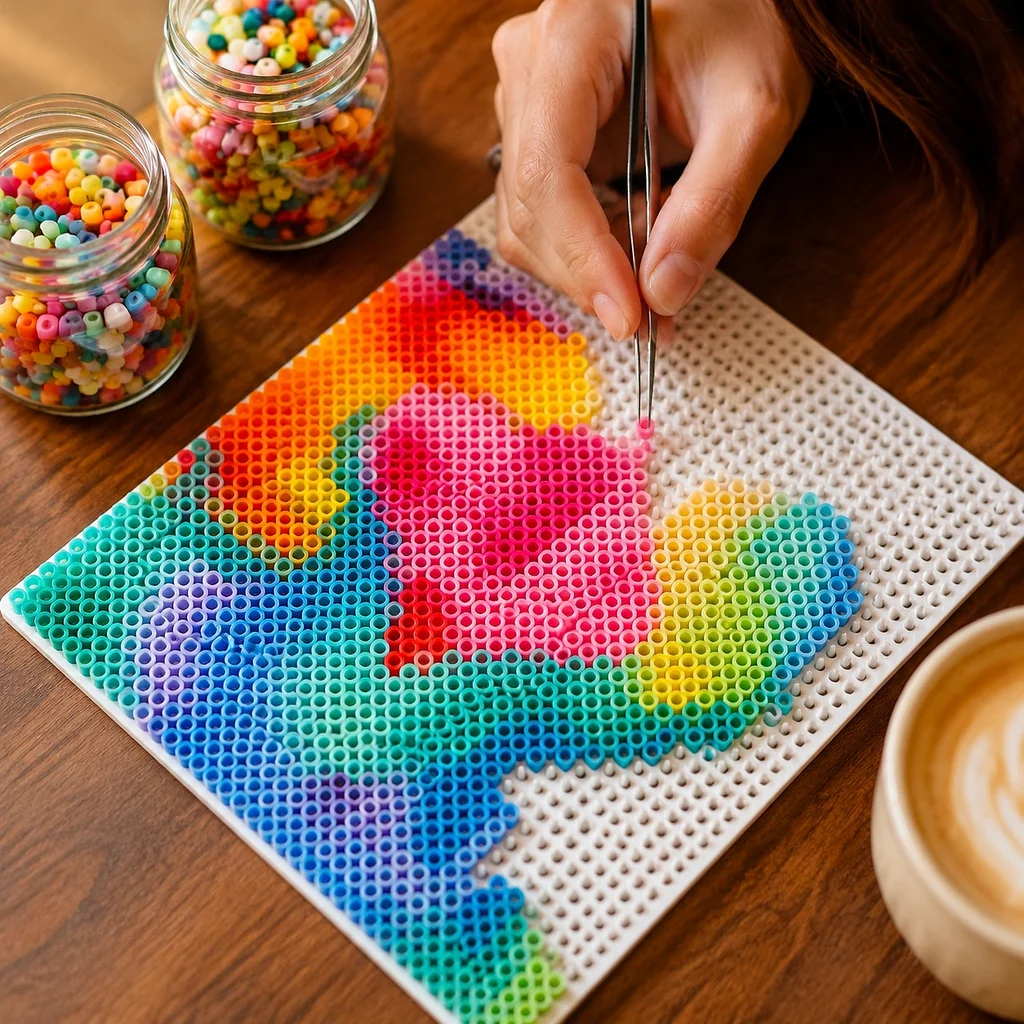
Xiao Hong picks up a board.
The board has lots of small holes.
Xiao Hong puts one bead into one hole.
She puts a red bead into one hole.
Then a yellow bead into another hole.
Then a blue bead.
Then a green one.
She places them one by one.
Slowly placing them.
There are more and more beads.
The board gets prettier and prettier.
Xiao Ming says: is this a picture?
Xiao Hong says: yes.
It's a picture made with beads.
Look.
After it's done,
it'll be a little cat.
It could also be a rabbit.
It could also be a flower.
Anything is fine.
Xiao Ming says: that's great.
So once it's done, what next?
Xiao Hong says: after it's done,
you use a tool.
Xiao Hong says: it's called an iron.
The iron is hot.
You put the iron on top of the beads.
The beads will become soft.
Then, the beads will stick together.
Becoming one solid piece.
It won't fall apart.
Xiao Ming says: oh.
Xiao Hong says: then,
you can take it with you.
You can put it on your backpack.
You can put it on your desk.
You can give it to a friend.
Xiao Ming says: that's really nice.
How long have you been making it?
Xiao Hong says: one hour now.
And about another hour to go.
Xiao Ming says: that long?
Xiao Hong says: yes.
But that's okay.
I love making it.
While I'm making it,
I'm not thinking about anything.
Just placing beads.
One, then another.
My heart is very quiet.
Xiao Ming says: oh.
I get it.
Is it kind of like watching stars before sleep?
Xiao Hong says: yes.
That's exactly the feeling.
After finishing, the heart is very comfortable.
Xiao Ming says: can you teach me?
Xiao Hong says: sure.
Come here.
Xiao Ming sits down.
Xiao Hong gives him a board.
Xiao Hong says: what do you want to make?
Xiao Ming says: I want to make a little dog.
Xiao Hong says: okay.
First put black.
Make the eyes.
Xiao Ming places them.
Xiao Hong says: now put white.
Make the face.
Xiao Ming places those too.
The two of them work slowly.
They place beads together.
They don't talk.
But both are happy.
Time goes by quickly.
Xiao Ming says: wow, has it been an hour already?
Xiao Hong says: yes.
Now we'll iron together.
The two of them finish together.
They've made a little dog.
And a little cat.
Both are cute.
Xiao Ming says: great.
I want to make another.
Xiao Hong laughs.
She says: you're hooked too.
Now let's talk about the real story.
These beads are called pindou.
Pindou — putting beads together.
In the past year,
pindou has become extremely popular in China.
Many young people are doing it.
Not only children.
But also college students.
And office workers.
They go to stores.
The stores have many beads.
They have tables, boards, and irons.
They sit there and slowly make things.
Some people make for an hour.
Some make all day.
Either is fine.
One session is about eighty or ninety yuan.
Not too expensive.
Why do so many people love it?
There are a few reasons.
First, the beads are pretty.
Many colors.
Just looking at them makes you happy.
Second, while you're making, your heart is quiet.
You don't have to think about work.
Or about anything else.
Just placing beads, one, then another.
Very slow, very comfortable.
Third, after finishing you have something.
A real thing.
You can take photos.
You can also give it to a friend.
Or put it at home.
So young people all love it.
In the past year,
they've posted many photos on Xiaohongshu.
Over thirty billion views in total.
That's a lot.
Some shops
sold over twenty thousand sets in one year.
Also a lot.
So today Xiao Ming learned something new.
He learned about pindou.
He's hooked too now.
He wants to come back next week.
He wants to make another.
Xiao Hong says: okay.
We'll do it together.
Both are happy.
That's the story for today.
Pindou is a small thing.
But it can make a person happy.
And quiet.
And let friends do something together.
And that's enough.
Listen again
Try it without the transcript and notice what sounds clearer.
What vocabulary does this episode teach?
词汇HSK 1. 我的朋友 = my friend. The story is two friends, 小明 and 小红.
HSK 1. 做拼豆 = make pindou. The episode's action verb.
HSK 1. 你看 = look! Used many times.
HSK 1. 我想做一只小狗 = I want to make a little dog. 想 + verb.
HSK 1. 很漂亮 = very pretty. The most basic intensifier.
HSK 1-2. 颜色很漂亮 = the colors are pretty. Common compliment.
HSK 2. The episode lists many 颜色: 红, 黄, 蓝, 绿, 粉, 白, 黑.
HSK 1. 一起做 = do it together. Repeated word in the friendship scenario.
HSK 1. 都很高兴 = both very happy. The emotional anchor of the story.
Beyond. 珠 (bead/pearl) + 子 (suffix). The thing the whole episode is about.
HSK 4. 一个板 = one board. The pegboard you put beads on.
HSK 5 but glossed inline. 一个小洞 = one small hole. Each pegboard hole holds one bead.
Beyond. 熨 (to iron) + 斗 (a tool). 熨斗是热的 = the iron is hot. Used to fuse beads.
HSK 5. 珠子会粘在一起 = the beads will stick together.
HSK 4. 用珠子做的图画 = a picture made with beads. The result of pindou.
HSK 3. 都很可爱 = all are cute. Common reaction to pindou pieces.
HSK 4. 心里很安静 = the heart is quiet. The core feeling of doing pindou.
HSK 3. 可不可以教我?= can you teach me? 小红 教 小明 in this episode.
* beyond level超纲词
What grammar patterns appear in this episode?
语法X 把 + Object + Verb (BA construction)
把 fronts the object so the verb can carry a result. 'Took A and did Y to it.'
小红把一个珠子放进一个洞。
你把熨斗放在珠子上面。
想 + Verb (want to V)
Modal of desire. 想 + verb = 'want to V.' Subject + 想 + verb.
我想做一只小狗。
我想再做一个。
他想下个星期再来。
X 也是 ... 也是 ...
'X is also A and also B.' Used to layer descriptions.
也可以拍照。
也可以送给朋友。
也可以放在家里。
X 就是 Y (definition)
The teaching pattern. Used to define a new word inline.
拼豆,就是把珠子拼起来。
板上有很多小洞。
熨斗是热的。
因为 + reason
Because + reason. Often used alone at HSK 1.
因为珠子很漂亮。
因为做完以后有东西。
Verb + 完 (resultative complement)
Verb + 完 = finish doing V. Indicates completion.
做完以后,要用一个东西。
做完以后,心里很舒服。
两个人一起做完了。
一个 ... 又一个 ...
'One after another.' Describes a repeating, calming sequence.
一个,又一个。
她一个一个放。
Proper nouns
专有名词Free account
Keep learning from this story
Create a free account to keep saved words and your preferred level together.
- Keep words with their story context
- Remember your preferred level
- Build your vocabulary over time