
A Chinese podcast · Same story, 4 levels
「如果明天世界完了,第二天全球的货币就是宝可梦卡」:一个手握五十万张卡的投资人是认真的,而他说错的地方比说对的地方更有意思
Pokémon Cards as Doomsday Money
About this story
A games-fund co-founder who owns well north of half a million Pokemon cards told The Hollywood Reporter that after an apocalypse the global currency would be Pokemon cards. Tested against the three standard conditions for money, his consensus argument is genuinely strong - and the two things wrong with it say more about money than the claim does. Chinese listening practice at four levels. HSK 2 Chinese listening practice.
This is an HSK 2 Chinese listening episode that runs about 4 minutes. The full Mandarin script is shown with tap-for-pinyin and a line-by-line English translation, so you can listen and read at once — comprehensible input in the sense of Stephen Krashen's i+1 theory. It teaches 12 key vocabulary words such as 条件、相信、愿意 and walks through 3 grammar patterns, each explained in English with examples. The same news story is retold at 4 difficulty levels — use the level selector above to find the version that is challenging but still understandable for you.
Read at your level
原文Read the complete story in Chinese. Reveal pinyin and English only when you need them.
English transcript reference
Last week an investor said something, and a lot of people laughed.
He said: if the world ended tomorrow, the day after that the money everyone used would be Pokémon cards.
It sounds like a joke, but he meant it.
First, about the man.
He runs an investment firm that invests in games.
He collects cards himself, and has for years.
How many does he have?
By his own account, more than five hundred thousand.
Five hundred thousand is not a hobby any more. That is a warehouse.
He gave one more figure.
He said these cards have gone up far more over the years than American stocks.
There is a problem with that figure, and I will come back to it.
First, the sentence itself.
Why would anyone think a paper card could work as money?
To answer that, you have to ask a bigger question first.
Why is money money?
That piece of paper in your pocket is just a piece of paper.
You cannot eat it, you cannot wear it, you cannot live in it.
It buys things because other people are willing to take it.
And they are willing to take it because the next person will take it too.
In the end, money is something we all believe in together.
For a thing to work as money, it usually needs a few conditions.
First, there cannot be too much of it.
Too much of it and it is worth nothing.
Second, it has to be easy to carry, divisible, and not spoil too fast.
Third, and most important of all, everyone has to accept it.
Now hold Pokémon cards up against those.
On quantity, they do all right.
However many of a rare card were printed, that is the number. They will not print more.
On carrying, they do all right too.
A card is far lighter than gold.
On not spoiling — just about.
Cards do not like water and do not like being bent, but they hold up better than a lot of things.
The one that really matters is the third: does everyone accept them?
That is what his sentence is about.
The people who play with these cards are not in one country.
Japan, America, Europe — there are a lot of people collecting them.
A rare card is worth roughly as much in Tokyo as it is in Los Angeles.
In other words, it already has a price the world agrees on.
There really are not many things like that.
Gold is one. After that, not much.
But there are problems with what he said too.
That "gone up more than stocks" figure is cherry-picked.
It picks the few most expensive cards, not all of them.
Most Pokémon cards are worth nothing.
Open a pack and most of what is inside is waste paper.
And cards are worth something because people collect them.
Collecting takes spare money.
In the kind of world he is describing, the people with spare money go first.
At that point, what people want is water, medicine and food.
So as a prediction, this is probably wrong.
But as a question, it is a very good one.
Think about it:
That piece of paper in your pocket — is it worth something in itself, or because other people think so too?
Listen again
Try it without the transcript and notice what sounds clearer.
What vocabulary does this episode teach?
词汇HSK 4. 一样东西要当钱用,一般要几个条件 — the frame for the whole test.
HSK 3. 钱是大家一起相信的一个东西 — the answer, stated early.
HSK 3. 别人愿意收它 — the chain that keeps money working.
HSK 3 root. 太多了就不值钱 — scarcity, in everyday words.
HSK 3. Implicit in the cherry-picking critique: which half of the cards you count.
HSK 6. 当成预测大概是错的 — the episode separates the prediction from the question.
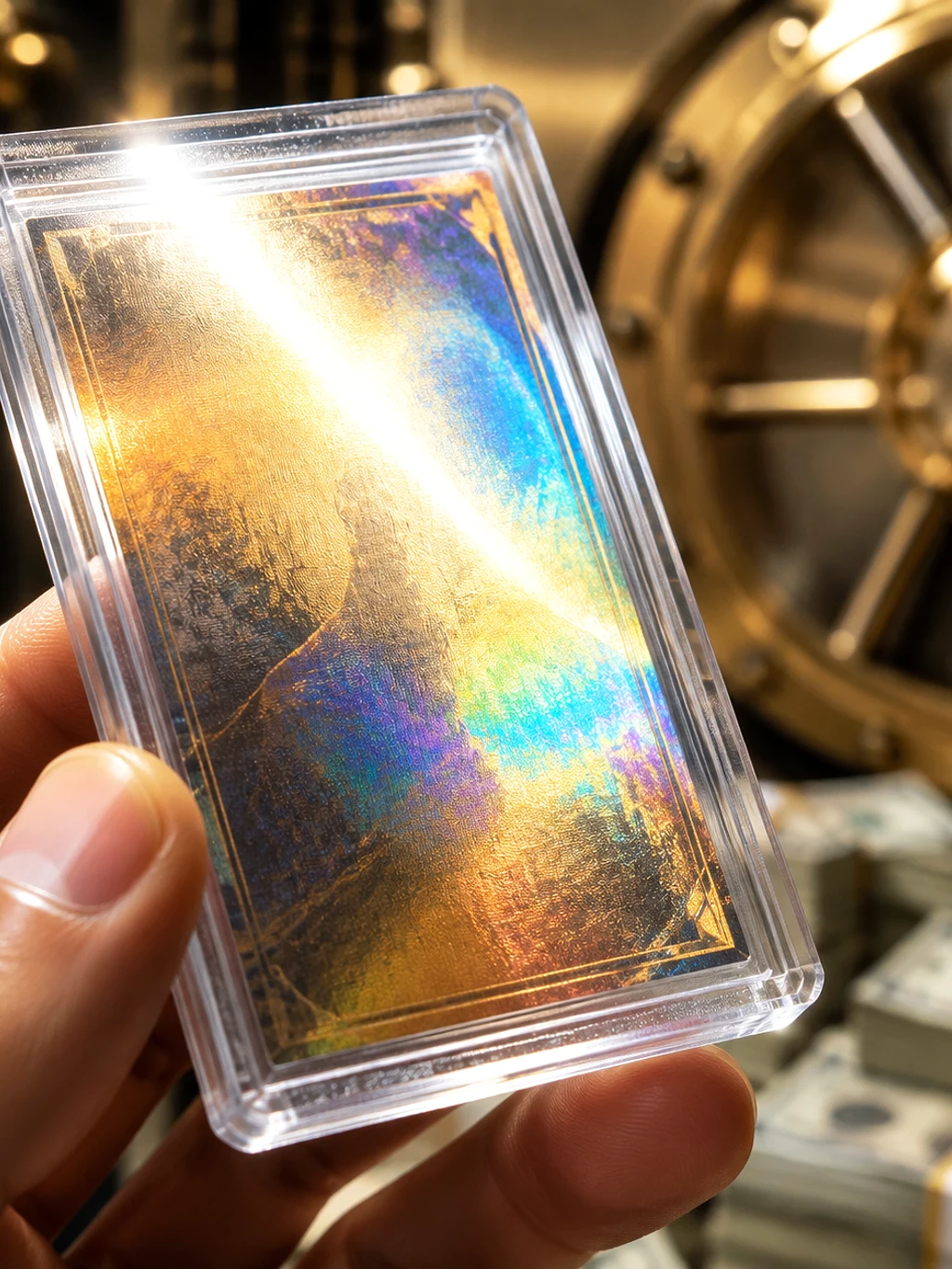
The cards in question, and the reason the claim got shared as a joke.
HSK 5. 卡值钱是因为有人收藏 — and collecting takes spare money.
稀有的卡印了多少张就是多少张 — supply is fixed at issue.
The comparison the whole argument is measured against.
The thing an apocalypse destroys first — which is what sinks the claim.
一包拆开,里面大部分是废纸 — most cards are worth nothing.
* beyond level超纲词
What grammar patterns appear in this episode?
语法说到底,……
When it comes down to it. Strips an argument back to its base — used here for the definition of money itself.
说到底,钱是大家一起相信的一个东西。
第一,……第二,……第三,……
Numbered conditions. Announcing the count as you go lets a listener follow a three-part test without seeing it written.
第一,不能太多。
第二,要好带,要能分,还不能坏得太快。
第三,也是最要紧的,大家都要认它。
当成……,……;当成……,……
Taken as X it is one thing; taken as Y it is another. Lets you reject a claim and keep the question it raised.
所以他这句话,当成预测大概是错的。
可是当成一个问题,问得很好。
Proper nouns
专有名词Sources
来源Free account
Keep learning from this story
Create a free account to keep saved words and your preferred level together.
- Keep words with their story context
- Remember your preferred level
- Build your vocabulary over time