
A Chinese podcast · Same story, 4 levels
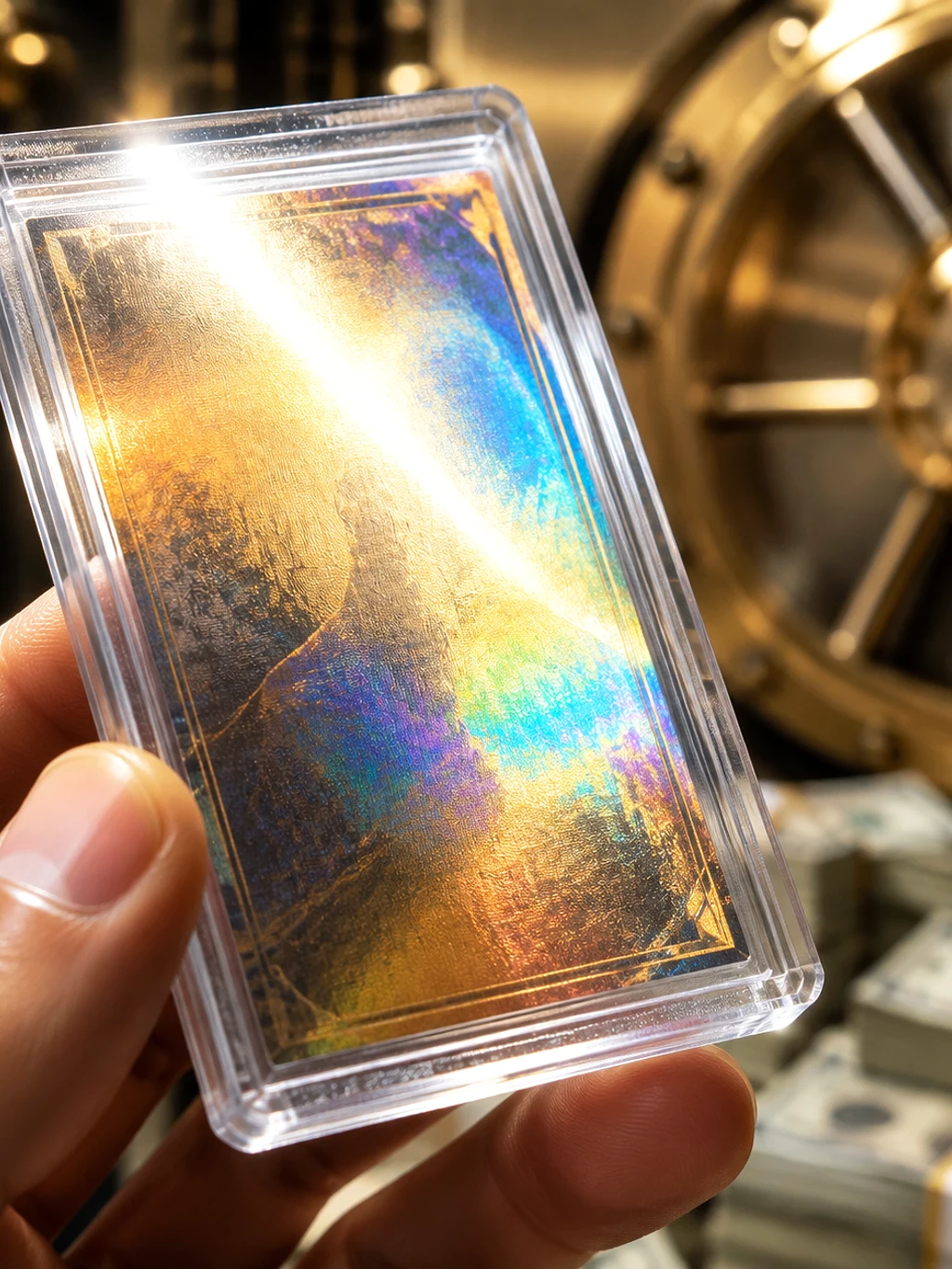
「如果明天世界完了,第二天全球的货币就是宝可梦卡」:一个手握五十万张卡的投资人是认真的,而他说错的地方比说对的地方更有意思
"If the World Ended Tomorrow, the Global Currency Would Be Pokemon Cards": an Investor Holding Half a Million of Them Means It, and Where He Is Wrong Is More Interesting Than Where He Is Right
About this story
A games-fund co-founder who owns well north of half a million Pokemon cards told The Hollywood Reporter that after an apocalypse the global currency would be Pokemon cards. Tested against the three standard conditions for money, his consensus argument is genuinely strong - and the two things wrong with it say more about money than the claim does. Chinese listening practice at four levels. HSK 5-6 Chinese listening practice.
This is an HSK 5-6 Chinese listening episode that runs about 6 minutes. The full Mandarin script is shown with tap-for-pinyin and a line-by-line English translation, so you can listen and read at once — comprehensible input in the sense of Stephen Krashen's i+1 theory. It teaches 12 key vocabulary words such as 价值、属性、框架 and walks through 3 grammar patterns, each explained in English with examples. The same news story is retold at 4 difficulty levels — use the level selector above to find the version that is challenging but still understandable for you.
Read at your level
原文Read the complete story in Chinese. Reveal pinyin and English only when you need them.
English transcript reference
This episode starts from a sentence that was treated as a joke, and ends on a question that is not small: what actually underwrites the value of money?
The original line first.
Last week, an investor said in an interview: I am absolutely convinced that if the world suffered a catastrophic event tomorrow, the day after, the global currency would be Pokémon cards.
It was widely shared on social media, and almost all of that sharing handled it as a gag.
I want to treat it as a proposition and test it, because it touches the most basic part of monetary theory.
First his background, because it bears on how much weight the sentence should carry.
He is a co-founder of a venture fund focused on the games sector, and a long-time card collector.
By his own statement he holds "well north of five hundred thousand" Pokémon cards.
That volume has passed beyond personal collecting and is closer to a market maker's inventory.
In the same interview he cited a figure: Pokémon card prices have outperformed the S&P 500 by three thousand percent.
There is a methodological problem with that number, which I will handle shortly.
First the argument itself, because it is more serious than it looks.
The standard framework for judging whether an asset can carry monetary functions has three properties.
First, scarcity: supply must be under a credible constraint, and the issuer must not be able to inflate it at will.
Second, portability and durability: easy to transfer, divisible, and not materially degraded over a reasonable period.
Third, consensus: a large enough population accepts it and expects others to accept it too.
The third is decisive; the first two are necessary rather than sufficient conditions for it.
Gold carried monetary functions for millennia precisely because all three held simultaneously.
Now test Pokémon cards against each.
Scarcity: holds.
The print run of a rare card is fixed at issue, no further printing follows, and the supply ceiling is a hard constraint.
Portability: holds strongly.
The weight difference between equivalent value in gold and in rare cards is several orders of magnitude.
Durability: just about holds.
Paper cards are sensitive to humidity, ultraviolet light and physical creasing, but in professional encapsulation they keep for decades.
Consensus: this is the core of his argument, and where he is relatively strong.
Holders and traders of Pokémon cards are distributed across Japan, North America, Europe, Southeast Asia and Latin America.
More importantly, mature third-party grading agencies exist, applying standardised condition grades to cards.
Grading lets long-distance trades settle without physical inspection, which cuts transaction friction enormously.
The result: a rare card at a given grade trades at the same order of magnitude in Tokyo as in Los Angeles.
In other words, it possesses a price consensus that crosses languages, jurisdictions and currency areas.
Among non-sovereign assets, the set that satisfies all three is quite limited.
Gold is one; some top-tier wines just about qualify; beyond that, not much.
Up to this point his argument holds.
What follows is two problems, the second of which is fatal.
The first is that three thousand percent.
The figure is drawn from the top of the sample — the handful of cards that have set auction records.
Include every card in circulation and the median value approaches zero.
Open a newly issued pack and most of its contents have no buyer on the secondary market.
Using top-sample returns to represent an entire asset class is textbook survivorship bias.
This problem is general to all collectible categories, not specific to Pokémon cards.
The second problem goes straight through the conclusion.
Collectible prices are underwritten by discretionary income.
Their value presupposes a population of sufficient size with a surplus beyond necessities, willing to allocate that surplus to non-functional assets.
And the premise "the world was destroyed" destroys exactly that population first.
In the scenario he describes, the medium of exchange reverts rapidly to things with direct use value: clean water, antibiotics, fuel, calories, ammunition.
A piece of card stock with a cartoon printed on it has a use value of zero in that scenario, and its consensus basis disappears at the same moment.
So as a prediction the sentence is wrong, and fairly comprehensively wrong.
But as a question, it is high quality.
Because it puts a default assumption we never inspect onto the table.
The value of fiat currency likewise does not come from the paper, nor from any consumable property.
It comes from a set of institutional arrangements, and from the collective expectation built on top of them.
Which is to say: banknotes and Pokémon cards belong to the same category in where their value comes from. The difference is the scale, stability and enforceability of the consensus.
What is special about gold is likewise not that it has "intrinsic value", but that its consensus has run the longest and reached the widest.
Two questions to leave you with.
The first is concrete: among the assets you currently hold, which one's value comes entirely from other people's consensus rather than from any use value?
The second is bigger: what conditions does a consensus need in order to survive when the institutions holding it up start to shake?
Listen again
Try it without the transcript and notice what sounds clearer.
What vocabulary does this episode teach?
词汇HSK 5. 货币的价值究竟由什么支撑 — the question the episode lands on.
HSK 6. 分析框架包含三项属性 — scarcity, portability, consensus.
HSK 6. The standard one for judging whether an asset can carry monetary functions.
HSK 6. 我想把它当作一个命题来检验 — treating a joke as a testable claim.
HSK 6. 它来自一套制度安排 — where fiat value actually comes from.
HSK 6. 建立在这套安排之上的集体预期 — the second half of the answer.
The decisive one of the three conditions, and where his argument is strongest.
供给必须受到可信的约束 — a fixed print run is a hard constraint.
Using record-setting cards to represent the whole asset class.
若将全部流通卡片纳入计算,中位数价值接近于零。
What underwrites every collectible price, and the first casualty of collapse.
Standardised grading removes it, which is how a global price forms at all.
* beyond level超纲词
What grammar patterns appear in this episode?
语法……是必要条件而非充分条件
Necessary but not sufficient. A precise logical distinction that keeps an argument from overclaiming.
第三项是决定性的,前两项是其成立的必要条件而非充分条件。
逐条检验……
Test it item by item. Announces that a checklist is about to be applied honestly, including where it passes.
现在逐条检验宝可梦卡。
……在价值来源上属于同一类,差别在于……
Belong to the same category in origin; they differ in X. Collapses a felt distinction and then says precisely what remains of it.
纸币与宝可梦卡在价值来源上属于同一类,差别在于共识的规模、稳定性与强制力。
Proper Nouns
专有名词Sources
来源Free account
Keep learning from this story
Create a free account to keep saved words and your preferred level together.
- Keep words with their story context
- Remember your preferred level
- Build your vocabulary over time