
A Chinese podcast · Same story, 4 levels
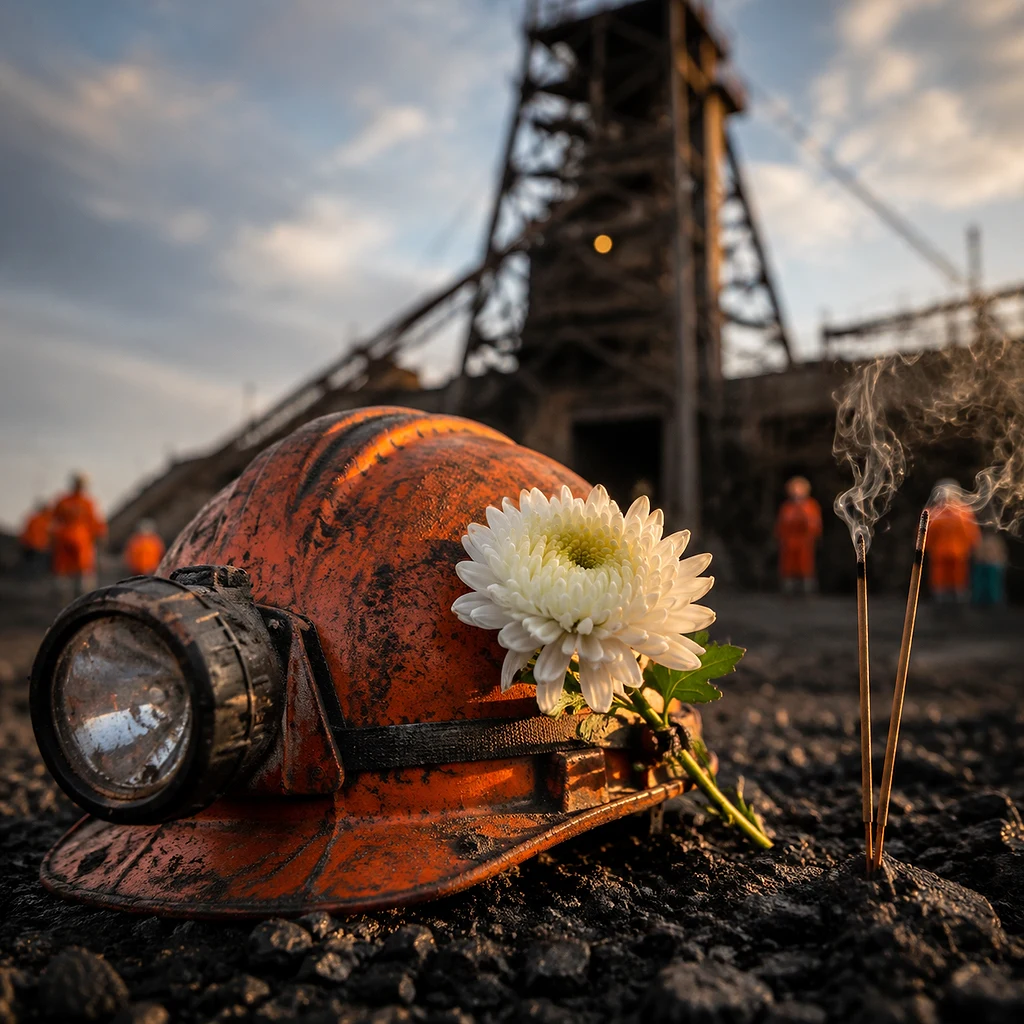
5·22 山西矿难——247 个矿工,82 个回不了家
5·22 Shanxi Mining Disaster — 247 Miners Underground, 82 Couldn't Come Home
About this story
The 5·22 Shanxi Liushenyu coal mine gas explosion in detail: 247 miners, 82 dead, the death-toll revisions, the 2024 high-gas warning, the hidden tunnels, and why 124 of the workers were 'black workers' without contracts. HSK 3 Chinese listening practice.
This is an HSK 3-4 Chinese listening episode that runs about 8 minutes. The full Mandarin script is shown with tap-for-pinyin and a line-by-line English translation, so you can listen and read at once — comprehensible input in the sense of Stephen Krashen's i+1 theory. It teaches 12 key vocabulary words such as 危险、安全、严重 and walks through 6 grammar patterns, each explained in English with examples. The same news story is retold at 4 difficulty levels — use the level selector above to find the version that is challenging but still understandable for you.
Read at your level
原文Read the complete story in Chinese. Reveal pinyin and English only when you need them.
English transcript reference
Today I want to tell you a very heavy news story.
On the night of May 22.
A coal mine in Shanxi had a major accident.
82 people died.
Two more people, even now, haven't been found.
Over a hundred are injured.
This is the most serious mining disaster in China in 15 years.
Let's talk about it today.
First, let's say where this happened.
Shanxi Province, Changzhi City, Qinyuan County.
There's a coal mine.
Called "Liushenyu Coal Mine."
It's run by a company.
The company is called "Shanxi Tongzhou Group."
That night, May 22.
At 7:29 p.m.
A gas explosion happened in the mine.
What is "wasi"?
It's a kind of gas that occurs naturally underground in the mine.
The gas itself has no smell.
You can't see it.
But the moment it meets fire, it explodes.
So what coal mines fear most is "wasi."
That night, how many people were down in the mine?
247 miners.
They were working.
Some were digging coal.
Some were moving coal.
Some were operating machines.
Suddenly, the gas exploded.
With a "boom."
The whole mountain shook.
Fire and smoke were everywhere.
Down in the mine was like hell.
The temperature was terrifyingly high.
The exit was blocked.
Some were close to the blast.
They had no time to run.
Some were further away.
But the smoke and toxic gases spread quickly.
Escaping was hard for them too.
After the accident.
The country immediately sent rescue teams.
Six teams, 345 people.
They brought equipment.
Went in to find people.
Underground was dark and hot.
There was still smoke.
They cleared the tunnels section by section.
They found people one by one.
They searched for several days.
Those who could be saved, were saved.
Those who couldn't, were found.
The families waited at the mine entrance the whole time.
While they waited, every phone call terrified them.
The final numbers were:
82 dead.
2 missing.
123 injured.
Of those, 4 are in critical condition.
What do 82 people mean?
It means 82 families.
Waiting for dad to come home — he won't.
Waiting for husband to come home — he won't.
Waiting for son to come home — he won't.
And this number — there's something wrong with it too.
When the accident first happened.
Officials said: 8 dead.
The whole country let out a breath.
Saying: at least it's not more.
A few days later.
The number suddenly became 90.
Everyone was shocked.
A few days later again.
Officials "verified" it.
And changed the number to 82.
Why does the number keep changing?
Did they really miscount?
Or is someone trying to "push down" the number?
Some say: it might be under-reporting.
Some say: it might be deliberate concealment.
Concealment means knowing but not saying.
It means saying a few less.
Making the thing look less serious.
This made a lot of people angry.
Families slammed tables outside the mine.
They said: my family is missing a person, and you're sitting here changing numbers.
But what's even more infuriating comes next.
As soon as reporters investigated, they uncovered many problems.
First problem: this mine shouldn't have been operating at all.
Way back in 2024.
The country had put this mine.
On the "National List of Coal Mines with Severe Disaster Risks."
What does that mean?
It means the country had said: this mine, gas levels are too high.
It's high-risk.
But the mine wasn't shut down.
It kept producing.
Second problem: this mine was penalized twice last year.
Both times for safety problems.
But the mine owners just paid a small fine.
And kept operating.
As if nothing had happened.
Third problem: there were "hidden tunnels" underground.
What are hidden tunnels?
Tunnels not on the official blueprints, secretly dug.
Why would the mine owners dig hidden tunnels?
Because they wanted to evade safety inspections.
When inspectors arrived.
They looked at the mapped areas.
Where the owners worked was the unmapped areas.
That's deception.
Even more terrifying: there were also miners in the hidden tunnels.
They were digging coal in places that had been deliberately concealed.
When the accident happened, outsiders had no idea they were there.
That's why the initial death toll was so low.
Fourth problem: of those 247 miners.
Only 124 were legally employed.
In other words.
More than half were "black workers."
"Black workers" means workers without proper contracts.
No insurance.
No training.
Wages paid under the table.
When something happens, their families can hardly get compensation.
Their families often can't even prove their loved one worked here.
The four problems added together.
Are the real causes of this accident.
Not just a single "accident."
It's a chain of illegality, deception, and neglect.
So the State Council specifically sent an investigation team.
They want to investigate "rigorously and firmly."
"Rigorously and firmly" is what the State Council said.
It means: this time we're investigating seriously.
We can't let anyone off.
We can't let go just because the other side has money or connections.
Now, the mine owner has already been arrested.
Over a dozen related people have also been arrested.
The investigation is still ongoing.
Reportedly they want to find out exactly who.
Allowed this mine to keep operating after being warned.
Listening to this news.
I have several feelings.
First, sadness.
82 families.
Won't be able to celebrate Dragon Boat Festival this year.
Won't be able to celebrate Mid-Autumn Festival this year either.
Their families are missing a person.
And that person.
Was lost in the most painful way.
Families might not even get to see a complete body.
Second, anger.
Not anger at the workers.
Anger at those who chase money and don't care if the workers live or die.
The country warned two years ago.
Last year you were fined.
You still didn't change.
You just paid a little money.
And kept going.
The ones who died in the end were the workers.
Other people's sons.
Other people's fathers.
Not you.
Third, helplessness.
This kind of thing isn't the first time.
And it won't be the last.
Shanxi.
Inner Mongolia.
Henan.
Hebei.
China's coal mines.
At regular intervals.
A major accident happens.
We remember how angry we were at the time.
A few months later, we slowly forget.
Then the next one comes.
And we get angry again.
And we forget again.
Finally I want to ask you a question.
What about you?
Around you, do you know anyone who does this kind of tiring, dangerous work?
For example.
Construction workers.
Delivery workers.
Long-haul drivers.
Miners.
Cleaners.
How do you see them?
Do you understand their lives?
How do you think society could treat them better?
Take your time, no rush.
Listen again
Try it without the transcript and notice what sounds clearer.
What vocabulary does this episode teach?
词汇HSK 3. Central recurring word in the episode — describes the work, the gas, the conditions.
HSK 3. 安全问题 = safety problems. 安全检查 = safety inspection.
HSK 3. 最严重的一次矿难 = the most serious mining disaster.
HSK 3. 国务院专门派了一个调查组 = the State Council specifically sent an investigation team. Both verb and noun.
HSK 3. 安全检查 = safety inspection. Central to the 'hidden tunnels' problem — the inspections were being deceived.
HSK 3 noun. The episode uses it in the context of corruption: 有钱有关系 = having money and connections.
Beyond HSK 1-3. The most feared word in Chinese coal mining. The script glosses it: 自然产生的一种气,看不见,没有味道,遇到火就会爆炸.
Beyond HSK 1-3. 瓦斯爆炸 = gas explosion. The direct cause of the May 22 disaster.
Beyond HSK 1-3. 国家级矿山救援队 = national-level mine rescue team. 救援 carries a formal, large-scale connotation.
Beyond HSK 1-3. 违 (to violate) + 法 (law). The script uses it to describe what enabled the disaster: 一连串的违法、骗、和不管.
Beyond HSK 1-3. 这个矿,去年被处罚过两次 = the mine was administratively penalized twice last year.
HSK 4, beyond the HSK 1-3 target. 谁的责任 = whose responsibility. Central to the investigation question.
* beyond level超纲词
What grammar patterns appear in this episode?
语法不只是... + 是...
Used to redirect: 'it's not just X, it's Y'. Strong rhetorical correction.
这件事,不只是一个人的问题。
不只是一次'意外'。
是一连串的违法、骗、和不管。
Subject + 被 + Agent + Verb
Passive construction with 被. The agent who does the action follows 被.
出口被堵住了。
矿的老板已经被抓了。
这个矿,去年被处罚过两次。
Subject + 为了 + Goal, + Action
为了 = 'for the sake of / in order to'. Introduces a purpose clause.
不是对工人生气。
是对那些为了赚钱,不管工人死活的人。
对... + Verb / 来说
对 marks who the action is directed at; 对... 来说 marks whose perspective is being discussed.
是对那些为了赚钱,不管工人死活的人。
对一个和尚来说。
Subject + 几乎 / 每隔 + Time + Verb
Marks rough regularity. 每隔一段时间 = at regular intervals. 几乎 = almost.
几乎每隔一段时间。
就会出一次大事。
Verb + 过 + Number + 次
Verb + 过 + 数量 + 次 expresses 'has done [action] [N] times' as a frequency expression.
这个矿,去年被处罚过两次。
两次都是因为安全问题。
Proper Nouns
专有名词Free account
Keep learning from this story
Create a free account to keep saved words and your preferred level together.
- Keep words with their story context
- Remember your preferred level
- Build your vocabulary over time