
A Chinese podcast · Same story, 4 levels
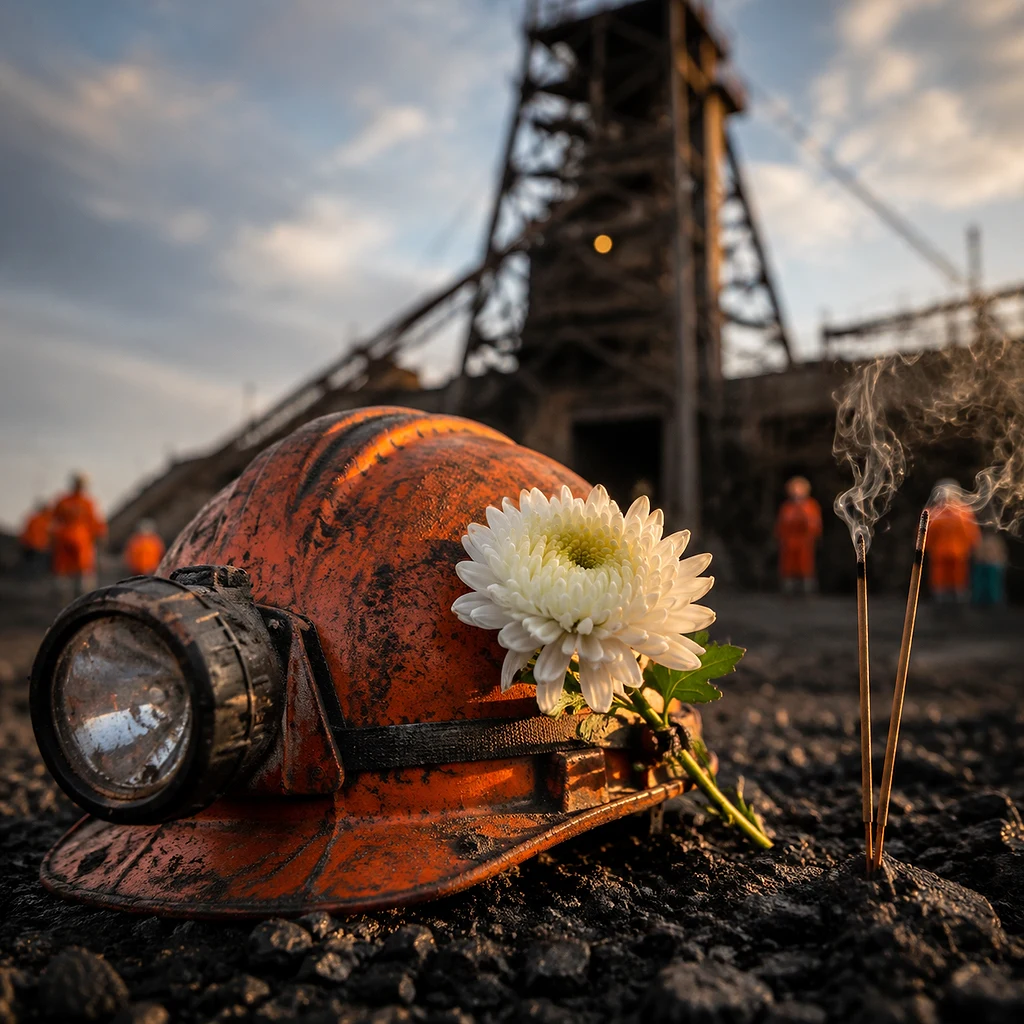
山西煤矿事故:一次大爆炸
Shanxi Mine Blast Involves 247 Workers
About this story
A simple family story about a girl whose uncle works in a Shanxi coal mine, set against China's worst mining disaster in 15 years: 82 dead at the Liushenyu mine on May 22, 2026. HSK 1 Chinese listening practice.
This is an HSK 1 Chinese listening episode that runs about 6 minutes. The full Mandarin script is shown with tap-for-pinyin and a line-by-line English translation, so you can listen and read at once — comprehensible input in the sense of Stephen Krashen's i+1 theory. It teaches 12 key vocabulary words such as 工作、家、看 and walks through 6 grammar patterns, each explained in English with examples. The same news story is retold at 4 difficulty levels — use the level selector above to find the version that is challenging but still understandable for you.
Read at your level
原文Read the complete story in Chinese. Reveal pinyin and English only when you need them.
English transcript reference
Let me tell you a news story.
Xiao Hong is nine years old.
She lives in China.
Her home is in Shanxi.
Shanxi is in northern China.
Xiao Hong has an uncle.
Her uncle is forty.
He is a good person.
Xiao Hong really likes her uncle.
Her uncle is a worker.
Where does he work?
He works in a mine.
What is a mine?
A mine is under a mountain.
People go down under the mountain to dig.
Dig what?
Dig coal.
Coal is black.
Coal can burn.
People use coal to make electricity.
People use coal to cook.
So many people dig coal.
Her uncle goes to dig coal every day.
He leaves in the morning.
He comes home at night.
He is very tired.
His clothes are black.
His face is also black.
Xiao Hong sees him and says: uncle, you're back.
Her uncle smiles.
He says: I'm back.
Xiao Hong's mom says: let's eat.
They eat together.
Xiao Hong watches her uncle.
She thinks: uncle is so tired.
She asks mom: is it okay under the mountain?
Mom says: it's not good under the mountain.
Under the mountain it's dark and hot.
Sometimes there's gas under the mountain.
The gas isn't good.
The gas can cause accidents.
Xiao Hong is scared.
She asks: will uncle be in trouble?
Mom says: I hope uncle will be okay.
Xiao Hong listens and doesn't speak.
One day, it was May 22.
That day was at night.
Xiao Hong was at home.
She was doing her homework.
Mom was cooking.
Suddenly, mom's phone rang.
Mom answered the phone.
The person on the phone said: something happened.
A mine in Shanxi had an accident.
There was gas under the mountain.
The gas exploded.
There were a lot of people in the mine.
More than two hundred people.
Right now, we don't know how many are okay.
Mom listened and her face went white.
Xiao Hong was scared too.
She asked: is it uncle's mine?
Mom said: no.
It's a different mine.
But it's also in Shanxi.
There are a lot of people too.
Xiao Hong listened and let out a breath.
But she was still very sad.
She thought: those miners — they're also someone's uncle.
They're also someone's father.
That night, Xiao Hong watched the news.
On the news it said: a mine in Shanxi had an accident.
There were 247 people inside.
Later they found out: 82 people are gone.
2 people, they can't find.
Over 100 people are injured.
Xiao Hong listened and cried.
She thought: 82 people.
That's a lot of people.
They also have families.
They also have children.
They also like to eat.
They also like to go home.
But they can never go home again.
Later, the news said: this mine was bad to begin with.
Two years ago, the country said: this mine is not safe.
But the mine was still open.
People still went down.
People still dug.
Now, the police are investigating.
The boss of the mine was arrested.
Xiao Hong's mom said: I hope it gets better from now on.
I hope everyone stays safe.
Xiao Hong looked at her uncle.
That night her uncle didn't go down to the mine.
He was at home.
He hugged Xiao Hong.
He said: uncle is okay.
Uncle will always be here.
Xiao Hong hugged her uncle.
She cried for a while.
She said: uncle, you be careful too.
Uncle said: okay.
What about you?
Are there people like this in your family?
Is the work they do very tiring?
Is it dangerous?
Have you ever worried about them?
This news story is called "5·22 Shanxi mining disaster."
"Mining disaster" means a big accident at a mine.
"5·22" means May 22.
This day was May 22, 2026.
It's China's biggest mining disaster in 15 years.
82 people died.
2 people went missing.
Over 100 people were injured.
They all had families.
They all had people waiting for them to come home.
But they can't go home.
Let's remember this day.
And let's remember them.
Listen again
Try it without the transcript and notice what sounds clearer.
What vocabulary does this episode teach?
词汇HSK 1. Both a verb and a noun. 他每天去挖煤 — his work is digging coal.
HSK 1 noun. The script uses it many times: 回家 (go home), 在家 (at home), 他们也有家 (they have families too).
HSK 1 verb. 小红看着舅舅 = Xiao Hong looked at her uncle. 看新闻 = to watch the news.
HSK 1 verb. Used many times in the script for Xiao Hong's inner thoughts: 她想 = she thought.
HSK 1 noun/adverb. 现在不知道有多少人没事 = right now we don't know how many are okay.
HSK 1 verb. 小红听了,哭了 = Xiao Hong listened, then cried.
Beyond HSK 1. The central topic noun. The script teaches it: 矿在山下面 = a mine is under the mountain. 煤矿 = coal mine. 矿工 = miner.
Beyond HSK 1. The other central topic noun. 煤是黑的 = coal is black. 挖煤 = to dig coal. The script glosses what coal is used for: 做电 (make electricity), 做饭 (cook).
HSK 3, beyond the HSK 1 target. Used to describe the miner's work: 是不是很危险 = is it dangerous? Can be both an adjective and a noun.
HSK 2, beyond the HSK 1 target. Used at the end: 你担心过他们吗 = have you worried about them?
HSK 2, beyond the HSK 1 target. The script uses it both literally — 煤是黑的 (coal is black), 他的脸也是黑的 (his face was black) — and to describe the dark underground.
HSK 2, beyond the HSK 1 target. 他很累 = he is very tired. Recurs as a theme — the uncle comes home exhausted every day.
* beyond level超纲词
What grammar patterns appear in this episode?
语法Basic identity sentence in Chinese — 是 links the subject to a noun.
她在中国。
他是工人。
煤是黑的。
Subject + 不 / 没 + Verb
Negate verbs with 不 for general negation, or 没 to mark that something didn't happen.
山下面不好。
他们再也回不了家了。
舅舅那天晚上没去矿里。
Use 很 (very) before adjectives. Even when 'very' isn't strictly meant, 很 is often needed.
他很累。
小红很怕。
他们也是别人的舅舅。
Subject + 也 + Verb
也 (also) goes between subject and verb, never at the start of the sentence.
舅舅也四十岁。
小红也怕了。
他们也喜欢回家。
了 after a verb marks a completed action. Often translates as English past tense.
气爆炸了。
小红听了,哭了。
矿里的老板,被抓了。
Proper Nouns
专有名词Free account
Keep learning from this story
Create a free account to keep saved words and your preferred level together.
- Keep words with their story context
- Remember your preferred level
- Build your vocabulary over time