
A Chinese podcast · Same story, 4 levels
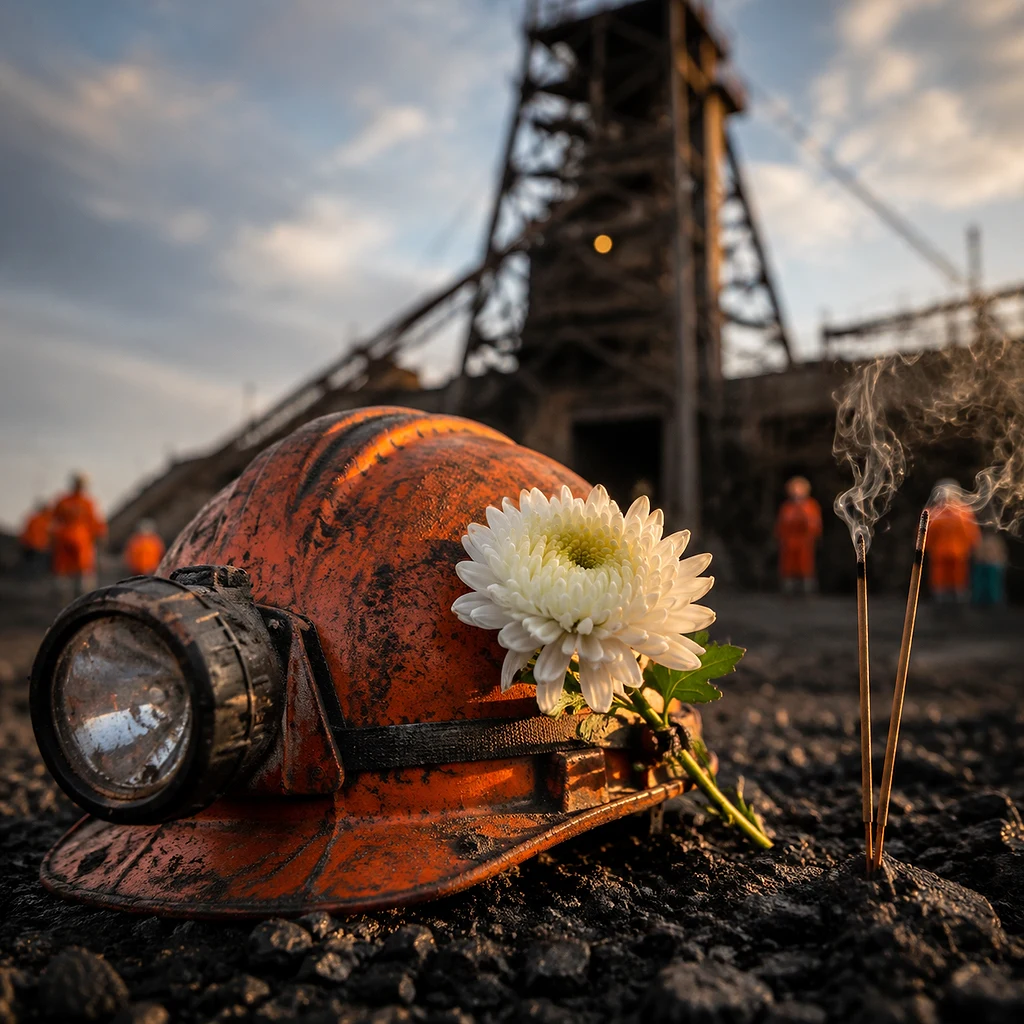
山西 5·22 矿难——一座煤矿,247 个人,和一个被反复改写的死亡数字
Shanxi Mine Blast Involves 247 Workers
About this story
A deeper read on the 5·22 Liushenyu coal mine gas explosion: the 8/90/82 death-toll revisions, the 2024 high-gas warning ignored, the hidden tunnels built to deceive inspectors, the 124-of-247 'black worker' ratio, and why arresting a dozen people won't fix the system. HSK 5-6 Chinese listening practice.
This is an HSK 5-6 Chinese listening episode that runs about 9 minutes. The full Mandarin script is shown with tap-for-pinyin and a line-by-line English translation, so you can listen and read at once — comprehensible input in the sense of Stephen Krashen's i+1 theory. It teaches 12 key vocabulary words such as 严重、调查、检查 and walks through 7 grammar patterns, each explained in English with examples. The same news story is retold at 4 difficulty levels — use the level selector above to find the version that is challenging but still understandable for you.
Read at your level
原文Read the complete story in Chinese. Reveal pinyin and English only when you need them.
English transcript reference
Why, in 2026 China.
Are 82 miners still.
Unable to come home on the same single night?
And why does that number.
Keep getting rewritten?
What we're going to talk about today.
Is the 5·22 Shanxi Liushenyu coal mine.
Gas explosion accident.
This is China's worst mining disaster.
In 15 years.
Let's lay out the facts first.
May 22, 2026.
At 7:29 p.m.
Location: Qinyuan County, Changzhi City, Shanxi Province.
The accident happened at a coal mine.
The name of the mine.
Is "Liushenyu."
This coal mine.
Belongs to Shanxi Tongzhou Group.
That night, the underground workforce.
Was 247 people.
The direct cause of the accident.
Was a gas explosion.
"Wasi" — methane.
The methane gas that occurs naturally in coal seams.
Has no color.
Has no smell.
But once the concentration is high, it explodes at any spark.
This is the word every coal mine in China.
Knows best — and fears most.
At 7:29 p.m. that night.
The underground sensors triggered an alarm first.
Showing carbon monoxide had "exceeded limits."
But it was already too late.
Immediately after, the violent explosion.
Tore through a section of tunnel.
Thick smoke and high temperatures.
Quickly sealed off the exit.
247 people.
Were instantly split into different locations.
Some were close to the blast point.
Some a bit further away.
Some were in the direction of the airflow vent.
Whether they could survive.
Was basically luck.
After the accident.
The State Council's Emergency Management Department.
Urgently dispatched 6 national-level mine rescue teams.
A total of 345 people.
Equipment in hand, going into the mountain.
They spent several days.
Clearing tunnels section by section.
Finding people one by one.
The final official numbers.
82 dead.
2 missing.
123 injured.
Of those, 4 in critical condition.
But this number.
Has been rewritten multiple times.
When the incident first happened.
The earliest notice was.
8 dead.
The country was shocked but also relieved.
8 is already a lot.
But people thought.
At least it isn't out of control.
The very next day.
The number became 90-something.
Everyone realized.
This is a catastrophic accident.
Then another day or two passed.
After officials "verified" things.
The number was "revised down" to 82.
This process caused enormous controversy.
Many family members.
And many in the media.
Started asking the same question.
8, 90, 82.
What exactly happened in between?
Did they really just miscount?
Or is someone trying to "push down" the number?
Is it a technical statistics issue?
Or is it administration trying to save itself?
We don't know the answer.
But this "repeatedly rewritten number" itself.
Has already become one of the most chilling parts.
Of this entire disaster.
Then dig further down.
You'll find.
This accident.
Wasn't a simple unexpected event.
It was a chain of "things that had shown up long before."
Finally converging on one night.
The first problem.
This mine.
Was already on the country's "danger list."
April 15, 2024.
The National Mine Safety Supervision Bureau.
Put Liushenyu Coal Mine.
On the "National List of Coal Mines with Severe Disaster Risks."
The reason was clear.
High gas.
In other words.
Two years ago, the country had clearly said.
This mine is a high-risk mine.
But it wasn't shut down.
It kept producing.
The second problem.
In 2025.
Liushenyu Coal Industry was administratively penalized twice.
Both times for safety problems.
But the company just paid the fines.
Then resumed operations.
As if.
The fines had become a kind of "operating cost."
Problem comes up, pay some money.
Reopen.
Problem comes up again, pay again.
Reopen.
The people are fine.
The money is fine.
Everything's fine, forever.
Until the night of May 22.
The third problem.
"Hidden tunnels" were found underground.
What are hidden tunnels?
Tunnels not reported to any authority.
Secretly dug out.
Not on the mine's blueprints.
Some were even deliberately modified.
For the express purpose.
Of dealing with safety inspections.
Making sure the inspectors couldn't see.
The places where real production happened.
This isn't negligence.
This is planned deception.
The fourth problem.
Of those 247 underground workers.
Only 124.
Were genuinely legally employed.
In other words.
More than half.
Were "black workers" without proper contracts.
They had no insurance.
No training records.
When something happens.
Their families can hardly even prove.
That they ever worked here.
They used the lowest cost.
To do the most dangerous work.
And paid the highest price in the end.
For someone else's illegality and gamble.
They picked up the tab.
The four problems added together.
What you see is no longer.
A single "accident."
But a system.
A gray production model running for many years.
After the accident.
The State Council investigation team went into Qinyuan.
Saying they'd investigate "rigorously and firmly."
The mine owners and company executives.
Have been criminally detained.
Subsequent responsible parties are being arrested one after another.
But the really hard part is the deeper question.
Why, after the country warned two years ago.
Could the mine keep operating?
At that layer of supervision.
Did they really not see it?
Or did they not want to see it?
Those penalties.
Why did they have no binding force on the mine owners?
Were the fines too light?
Was there some other force protecting them behind the scenes?
These questions.
Are much harder to answer than arresting a few mine owners.
When I look at this myself.
I actually have three feelings.
The first feeling is sadness.
82 families.
For all the holidays in the second half of this year.
None will pass peacefully.
Some.
Have parents still waiting for them to get off work.
Some.
Have children still waiting for them to come home for dinner.
Some.
Maybe got married not long ago.
Some.
Are maybe still paying off a mortgage.
The news won't broadcast these details.
But they're real.
The second feeling is familiarity.
Familiarity is a terrible feeling.
Shanxi.
Inner Mongolia.
Henan.
Hebei.
China's coal-producing regions.
At regular intervals.
Spread similar news.
We remember the anger at the moment.
Then a few months pass.
And we slowly forget.
Then the next one comes.
The media comes in waves.
Then disperses.
"Familiarity."
Is itself a systemic tragedy.
The third feeling.
Is the hardest to say.
It's about the distribution of responsibility.
82 people died down inside one mine.
Who ended up getting arrested.
Was the mine owners.
The executives.
A few supervisory officials.
Of course they're guilty.
They should be sentenced.
But we all also know.
Those who let this kind of mine keep operating.
Aren't just those few.
It's a whole apparatus.
Of tacit approval, looking away, not reporting, protecting.
And this apparatus.
Isn't fixable.
By arresting a dozen people.
Back to the original question.
Why, in 2026.
Are we still seeing news like this?
The answer isn't in that mine.
And isn't only in Shanxi.
It's in that logic of "pay a small fine and keep operating."
It's in the reality where half being "black workers" is silently accepted.
It's in every single time.
We finish reading the news.
And then forget about it a few months later — that habit.
Finally.
I want to leave two questions with you.
The first is more concrete.
Around you, do you know anyone doing "high-risk, low-protection" work?
For example.
Construction workers.
Delivery workers.
Long-haul truck drivers.
Miners.
Cleaners.
Do you understand their contracts?
In their work.
Which risks are "by default" accepted?
How do you feel about that "default"?
The second question.
Think a bit bigger.
Why do some industries.
Where everyone clearly knows it's dangerous.
And where people clearly keep getting injured and dying.
Find it so hard to actually change?
Is it because they make too much money?
Is it because no one speaks for the workers?
Is it because society as a whole.
Doesn't really care about "low-end labor" lives in the first place?
What do you think.
Which one.
Comes closest.
To the reality you see?
These two questions have no standard answer.
But they're worth thinking about slowly.
And I hope after thinking slowly.
We don't just "think."
Listen again
Try it without the transcript and notice what sounds clearer.
What vocabulary does this episode teach?
词汇HSK 3. 最严重的一次矿难 = the most serious mining disaster.
HSK 3. 国务院调查组 = the State Council investigation team. Both verb and noun.
HSK 3. 应付安全检查 = to deal with / evade safety inspection.
HSK 4. 这个系统 = this system. Used to describe the underlying enabling structure: not just one person.
HSK 4. 责任的分布 = the distribution of responsibility. Central to the third layer of feeling.
HSK 4. Within the HSK 1-4 target for normal. 迅速封住了出口 = quickly sealed off the exit.
Beyond HSK 1-4. The most feared word in Chinese coal mining. From Japanese ガス, ultimately from English 'gas'.
Beyond HSK 1-4. The direct cause of the disaster.
Beyond HSK 1-4. 矿 (mine) + 难 (calamity). Specifically refers to large-scale loss of life at a mine.
Beyond HSK 1-4. 违 (to violate) + 法 (law). Used to describe the deliberate deception of inspectors.
Beyond HSK 1-4. 监 (supervise) + 管 (manage). 监管的那一层 = the regulatory layer. A central word in the second-layer analysis.
Beyond HSK 1-4. 瞒 (to hide / conceal) + 报 (report). The opposite of 漏报 (accidental omission). The death-toll changes — 8 → 90 → 82 — raised suspicions of 瞒报.
* beyond level超纲词
What grammar patterns appear in this episode?
语法Subject + 不是... + 而是 / 是...
Correction structure: 'not X, but Y'. Used to redirect or clarify what something actually is.
这不是疏忽。
这是有计划的欺骗。
答案,不在那座矿里。
也不只在山西。
Verb + 着
着 after a verb marks an ongoing state or that the action is in progress.
矿没关。还在生产。
家里的位置,永远空着。
Subject + 被 + Agent + Verb
Passive construction. Used heavily here because of the actions taken against people involved.
出口被堵住了。
矿主和企业高管。已经被刑事拘留。
数字又'下调'到了 82。
对... + 没有 / 有 + Noun
对 marks who or what something is directed at. Common in legal/abstract discussion.
为什么对矿主没有约束力?
对'低端劳动'的命,本来就不那么在意?
是不是 + Clause
Used to pose a question of possibility or to invite reflection. The English equivalent is often 'is it that...'.
是真的核错了?
还是有人想'压一下'数字?
是不是罚款太轻?
为... + Verb
为 = 'for the sake of'. Marks the beneficiary or purpose of an action.
为别人的违法和侥幸。
买了单。
为的就是。应付安全检查的时候。
Topic + 本身 + Adjective / Verb
本身 = 'itself / on its own'. Used to point at the inherent nature of something.
但是这个'反复改写的数字'本身。
'熟悉'。本身就是一种系统性的悲剧。
Proper nouns
专有名词Free account
Keep learning from this story
Create a free account to keep saved words and your preferred level together.
- Keep words with their story context
- Remember your preferred level
- Build your vocabulary over time