
A Chinese podcast · Same story, 4 levels
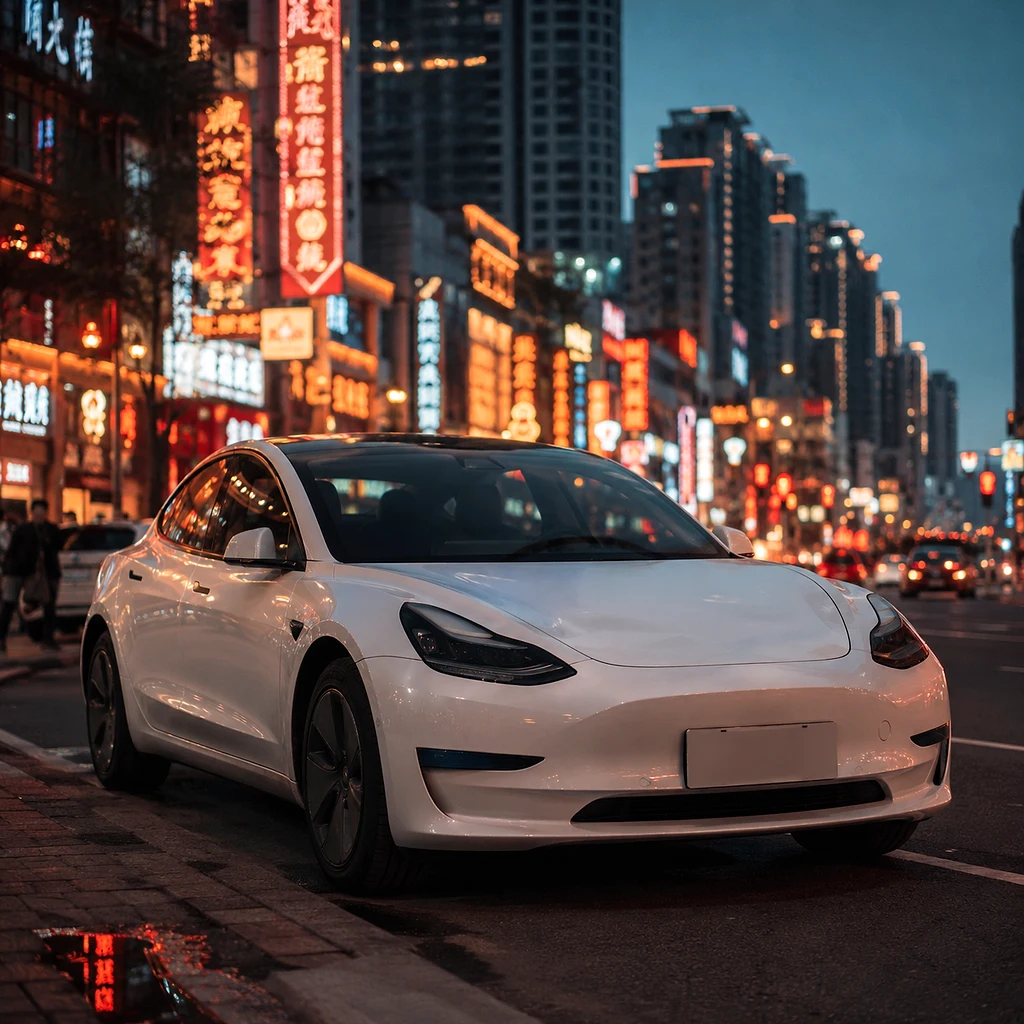
会自己开的车,来中国了
Tesla FSD Arrives in China
About this story
Tesla FSD Arrives in China. HSK 2 Chinese listening practice.
This is an HSK 2 Chinese listening episode that runs about 3 minutes. The full Mandarin script is shown with tap-for-pinyin and a line-by-line English translation, so you can listen and read at once — comprehensible input in the sense of Stephen Krashen's i+1 theory. It teaches 12 key vocabulary words such as 今天、想、看 and walks through 4 grammar patterns, each explained in English with examples. The same news story is retold at 4 difficulty levels — use the level selector above to find the version that is challenging but still understandable for you.
Read at your level
原文Read the complete story in Chinese. Reveal pinyin and English only when you need them.
English transcript reference
Today I'll tell you a news story.
This news is about cars.
Have you heard of Tesla?
Tesla
is a
car-making company.
It is in America.
The cars it makes are very famous.
Why famous?
Because this kind of car
is different from other cars.
Other cars
need you to drive them.
You sit in the car,
hands on the steering wheel.
If you don't drive,
the car doesn't move.
But Tesla's car
is a little different.
It has a new thing.
This thing
is called "FSD."
What is "FSD"?
We can put it this way:
the car
can drive itself.
You just sit in the car,
and that's enough.
But
there is one very important thing
you must remember.
When the car is driving itself,
you can't sleep,
you can't play with your phone.
You still have to watch the road.
Why?
Because the car
isn't really
able to do everything yet.
Sometimes
the car will get it wrong.
You have to watch,
and if there's a problem,
you must drive immediately.
That's what "FSD" means.
Now here's the good news.
On May 21,
Tesla announced:
people in China
can also buy this FSD now.
But
this thing is not cheap.
It costs 64,000 yuan.
Sixty-four thousand yuan.
That's a lot of money.
So,
how do people in China see it?
There are two voices.
One says:
this thing is great;
Tesla is amazing.
The other says:
China itself
also has cars like this.
And what's more,
some are even cheaper than this.
Some even
don't cost anything.
So,
should you buy Tesla's FSD?
Each person
has each person's answer.
I read this news,
and I thought of one thing.
New things
sound very cool.
But
whether they are actually good
we have to see slowly.
The most important point is this:
even if the car says,
"I can drive myself,"
you still can't relax.
You still have to watch the road.
This is for your own safety.
Finally I'll ask you:
Would you be willing
to sit in a car
that drives itself?
Or
do you think
a person driving the car
makes you feel safer?
Think about it.
Okay.
That's all for today.
Talk tomorrow.
Listen again
Try it without the transcript and notice what sounds clearer.
What vocabulary does this episode teach?
词汇Today. The narrator opens 今天我给你说一个新闻 — 'today I'll tell you a news story.'
To think. 我想了一件事 — 'I thought of one thing'; the closing 你想一想 — 'think about it.'
To watch. The episode's safety point: 你还要看路 — 'you still have to watch the road.'
To listen / have heard. 你听过特斯拉吗 — 'have you heard of Tesla?'
To know. The episode invites the listener: 你知道吗 — 'did you know?'
Happy. 有人很高兴 — 'some people are happy'; the response to the launch is divided.
Car. Beyond HSK1. The whole story is about a car company and the cars it makes.
Oneself / by itself. Beyond HSK1. The core idea: 车可以自己开 — 'the car can drive by itself' (with you watching).
Automatic. Beyond HSK1. The 'A' in FSD — but the episode warns that 'automatic' here is not yet really automatic.
The USA. Beyond HSK1. Tesla is an American car company; the FSD feature came from there.
Impressive. Beyond HSK1. 特斯拉太厉害了 — one side of the debate calls Tesla impressive for landing FSD in China.
Safe. Beyond HSK1. The episode's hard line: 这是为了你自己的安全 — 'this is for your own safety.'
* beyond level超纲词
What grammar patterns appear in this episode?
语法X 和 Y 不一样
和 + Y + 不一样 sets up a comparison. The episode uses it to mark Tesla's cars as different from other cars.
这种车,和别的车不一样。
但是特斯拉的车,不太一样。
X,可以自己 V
可以自己 + verb describes something doing an action on its own. The episode's central premise: the car can drive itself.
车,可以自己开。
你坐在车里,就可以了。
就算 A,也 B
就算 sets up a hypothetical concession; 也 carries the result that holds anyway. The episode's safety warning.
就算车说,"我可以自己开",你也不能放心。
就算别人说没事,你也要看着。
还是 X 更让你 Y?
还是 inside a question offers an alternative choice — a soft prompt for the listener.
你愿意,坐一辆,自己开的车吗?
还是说,你觉得,人开车,更让你安心?
Proper nouns
专有名词Free account
Keep learning from this story
Create a free account to keep saved words and your preferred level together.
- Keep words with their story context
- Remember your preferred level
- Build your vocabulary over time